The Silica Is Talking — What a mystic, the periodic table and a server farm have in common
What a mystic, the periodic table and a server farm have in common
Silica, silicon and silicones are not the same thing. What a mystic's line about talking to mountains reveals about the materials inside AI hardware.
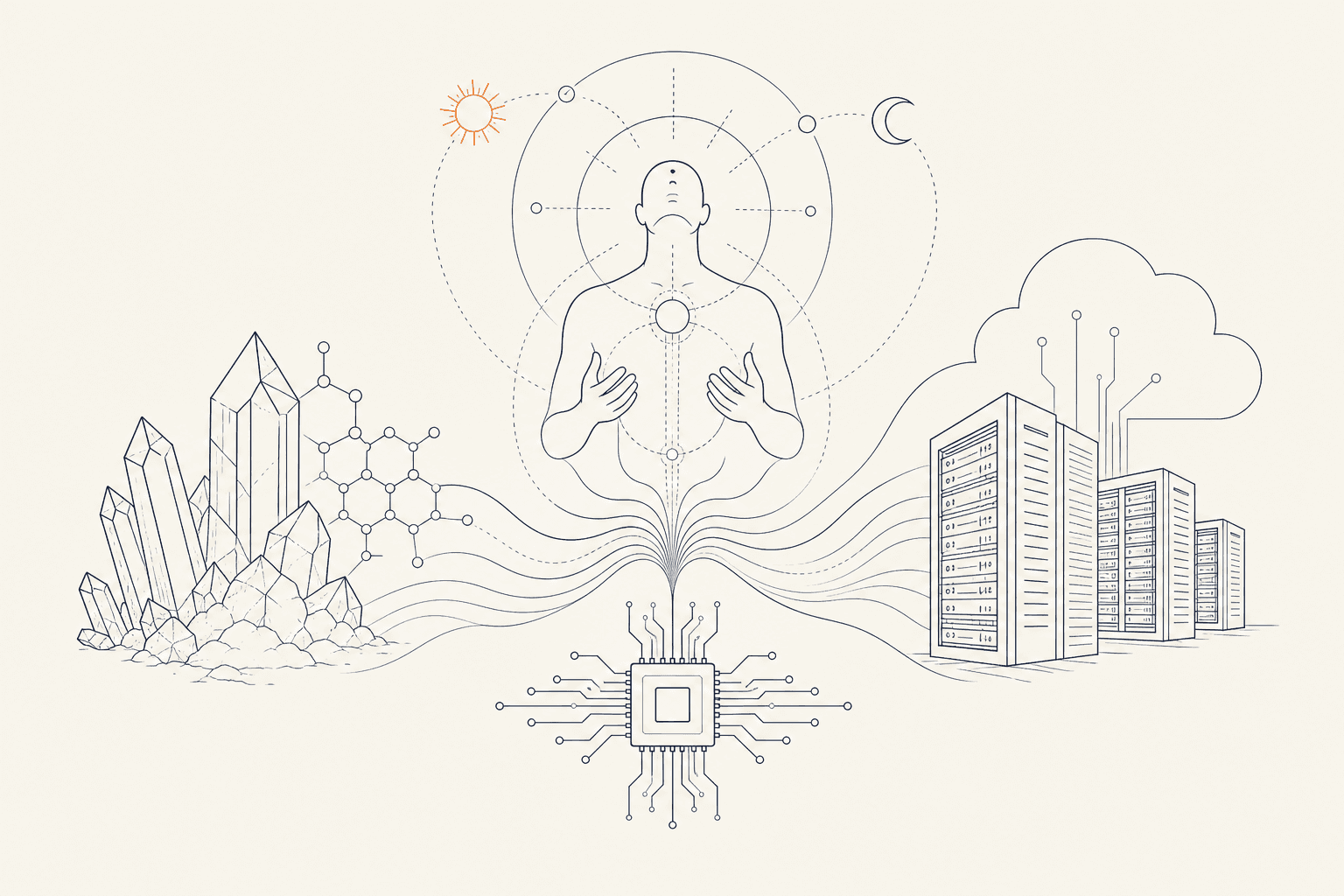
I went looking into a line from Matías de Stefano and ended up reading about quartz purification and thermal interface materials.
De Stefano is an Argentine teacher who says he "remembers the deep history of the Earth." His work mixes cosmology, myth and what you might call geological spirituality. He is easy to dismiss. But he keeps mentioning silica — silicon dioxide — which I've written about before. And the more I stumble across his clips, the less it sounds like fluff and the more it sounds like supply chain dynamics I'm used to in the digital domain.
The line that stopped me:
"…you have awakened the silica. Now you can talk to the mountains."
Before going further: silica is silicon dioxide (SiO₂ — quartz, sand), silicon is the purified element inside chips, and silicones are synthetic siloxane polymers built on a Si–O–Si backbone with organic side groups bonded to the silicon. Three related words. Three different things. The difference is the whole essay.
Humans as the "AI" of the mineral kingdom, in his framing
The usual story is that life sits on top of rocks. De Stefano flips it: biological life — humans, plants, fungi — isn't separate from the Earth. We're the part of the mineral kingdom that processes information. Its active layer. Its "AI," in his framing. The universe, in that view, doesn't need factory-made machines. Its tools are its basic elements, and silica is one of the oldest.
He also points to a number. Silicon (Si) is element 14: fourteen protons. In Plutarch's telling, Osiris is cut into 14 pieces and reassembled — though other Egyptian sources differ on the count. Whether you read that as pattern or coincidence, the image holds: something broken apart and rebuilt into a form that comes back to life.
Then there's this, again in his framing:
"People used to climb mountains to hear the minerals. Now the silica speaks to us directly."
He means through our chips.
Carbon meets silicon
De Stefano describes two kinds of intelligence. One runs on Carbon (C): DNA, blood, the brain. The other runs on silicon: transistors, code, the machines we're building now. He doesn't treat them as enemies. He calls them two branches of the same elemental family learning to speak to each other.
If carbon and silicon are learning to talk, what sits between them?
Three words that get blurred together
I had assumed silica, silicon and silicones were three names for roughly the same story. They aren't.
- Silica — silicon dioxide, SiO₂. Quartz. Sand. The raw mineral.
- Silicon — the purified element. The semiconductor in conventional chips.
- Silicones — polymers built on a backbone of alternating silicon and oxygen atoms (Si–O–Si), with carbon-based side groups bonded to the silicon. The family name: siloxanes.
Siloxanes don't form in rock. We make them, bonding organic side groups onto an inorganic silicon–oxygen backbone. That hybrid structure is why they're flexible, heat-stable and water-resistant at once. So silicones aren't "partly biological." Carbon-containing isn't the same as living. They are a deliberate hybrid — mineral skeleton, organic surface — which is why de Stefano's metaphor has somewhere concrete to stand.
What silicones actually do in AI hardware
AI hardware is heat, pressure and power. Silicones are in all three.
Cooling. Top AI accelerators draw hundreds of watts each; NVIDIA's B200 is configurable up to 1,000 watts. Silicone-based thermal gels, gap fillers and interface materials sit between the chip and its cooling hardware and move heat across the gaps. The conductive fillers do much of the heavy lifting; silicone itself is a good insulator, which is part of why it's useful everywhere else in the stack.
Durability. Silicone coatings, encapsulants and sealants protect electronics from moisture, vibration and temperature swings. Hardware that lasts matters more as data centers scale.
Embodiment. As AI moves out of the data center into the physical world, it needs a body that can bend. Rigid chips crack. Siloxane elastomers are the base of soft robotics, wearable sensors and skin-like interfaces. They give the silicon brain a flexible body for an organic world.
| Material | De Stefano's framing | Real-world role |
|---|---|---|
| Silica → Silicon | The Earth's ancient memory crystal | Chips, transistors, computing |
| Carbon | The organic processing layer: DNA, consciousness | Brains, living systems |
| Siloxanes (silicones) — hybrid Si–O–Si backbone with organic side groups | The alchemical bridge | Thermal interfaces, encapsulation, soft robotics, biosensors |
The mountain, reorganized
Here's the tension I kept circling. The more immaterial computing is supposed to become, the more physical it gets. We talk about "the cloud" as if thinking happens somewhere else. Meanwhile the thing doing the thinking is a rock we purified at enormous cost, wired into a building that has to be cooled.
I've been circling this same Si–O–Si bridge from the geology and materials side for a while — through the Si-O-Si concept, The Totumo Hypothesis, and Nodal Bend Theory. De Stefano approaches it from myth and cosmology. The landing point is similar: the boundary between mineral and organic isn't a wall. It's a working interface.
De Stefano's bigger point is that we should stop seeing technology as a synthetic trap outside nature, and start seeing it as an extension of the Earth's crust.
It's the mountain, reorganized.
That image drags AI back into a material world of extraction, energy, heat and human choices. A data center isn't the cloud; it's quartz, copper, water and power, arranged by people and answerable to people.
What changed for me
I started this thinking the coincidence was the interesting part: element 14, Osiris in fourteen pieces, a mystic talking about rocks. I finished thinking the coincidence is the least interesting part.
The interesting part is that the metaphor survives translation into materials science. Drop the cosmology entirely and you still end up with a true sentence: the machines we're using to think with are rearranged crust, and the rearranging has a cost, a supply chain and a set of people who can turn it off.
We have spent a decade describing software as weightless. The weightlessness was always borrowed.
A question to carry
For anyone buying, building on or writing about this stack, here is the question I now ask about any technology that presents itself as immaterial: what is it made of, where does the heat go, and who can switch it off? If you can't answer those, you're still looking at the cloud. They're also the questions that sit at the center of stack coherence and cognitive sovereignty — the capacity to understand and govern the systems you depend on.
One last thing
The mountains may or may not be talking. What matters is what we're building to say back.