What Signal One Taught Me About the Space Between Things
A sci-fi film, a fractal antenna, and the chemical bond in my name
A Sierpiński tetrahedron, a quantum comms device called LITTLEMOUTH, and the Si-O-Si bond inside quartz: why structure lives in the joins, not the parts.
Light spoilers for Signal One (2026).
One Sunday, I was halfway through a movie called Signal One when I paused it to ask Notion AI why air matters so much in this film.
It's a quiet sci-fi thriller written and directed by Jonathan Sobol. A computer scientist is recruited by a tech billionaire to investigate evidence that something from outside our reality has already reached Earth. The team builds a device called LITTLEMOUTH to talk back. And the strangest thing about the contact is where it happens. There's no ship and no body. The intelligence is ambient, around us all the time, and the reply has to be staged in the air of a room.
I kept pausing. By the end of the film I had a page of notes, a screenshot of a weird tetrahedron device, and a question about my own work I hadn't answered yet.
The device was a shape

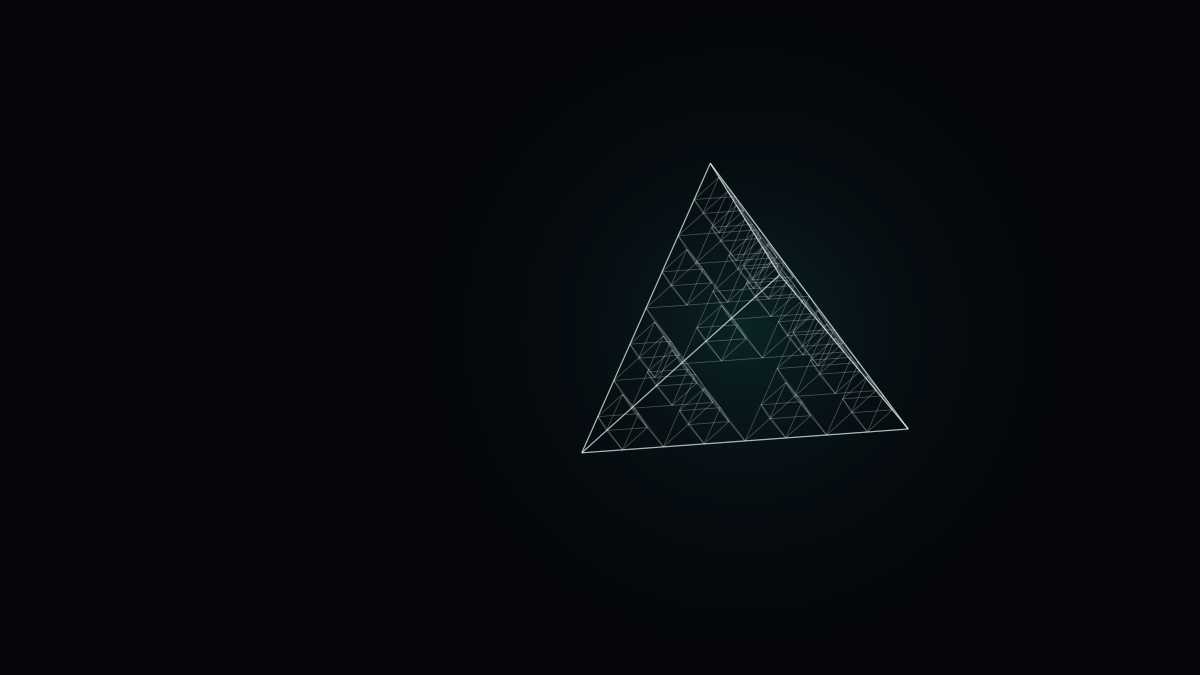
Here's what caught me. LITTLEMOUTH is built as a Sierpiński tetrahedron. You make one by taking a pyramid with four triangular faces, keeping the four half-size pyramids at its corners, and removing the space in the middle. Then you do the same to each of those, and again, forever.
Two things happen as you repeat it. The volume halves with every step, heading toward zero. The surface area stays exactly the same. In the limit you get an object that is all boundary and no interior. And the holes you removed touch each other, so the emptiness forms one connected network running through the whole thing.
As a design choice for a communication device, that's sharp. A thing with no inside has nothing to breach and can sit almost anywhere. It's a mouth with no body.
Then it hit me why it felt familiar.
The tetrahedron I already carry
The basic building block of silica (quartz, sand, glass, the chip in your phone) is also a tetrahedron: one silicon atom at the centre, four oxygen atoms at the corners. Those blocks link by sharing corners. Each oxygen sits between two silicons and belongs to both, which is why quartz has no separate molecule you can point to. The structure is made of the sharing. By mass, quartz is more than half oxygen.
Chemists write that shared corner as Si-O-Si. Silicon, oxygen, silicon. Siosi (my Tuvaluan name).
I've been working with that resonance for a while, ever since my psilocybin experience in 2025. Seeing it turn up as the "alien antenna" in a film I'd picked for a quiet Sunday was uncanny.
What silica and crystals share is a structural rule: the corners are shared, the gaps carry the function, and the pattern repeats at every scale. Some silicate frameworks, the zeolites for example, exist for their voids. Their channels and cages are what let them filter molecules and speed up reactions. The empty space is where the work happens.
What changed in how I saw it
I went in expecting another Contact story (anyone remember that Jodie Foster film from the 90s?): humans build a better antenna, aim it at the sky, get an answer. Most of our stories about meeting another intelligence work that way, and so do most of our stories about building one. Find the signal, point the instrument, extract the message.
Signal One kept me on my toes, because the intelligence was already in the room. Nothing external from us or our planet. The useful channel was the medium everyone shared, and the device that worked was a shape made mostly of gaps. Whatever was being reached was relational from the start (just like Si-O-Si, the siloxane bridge).
I'd been thinking about AI, community, and personal systems mostly in terms of their parts: which tools, which people, which features. The film made me look at the joins.
Bonds, not properties
The phrase I use for this is bonds, not properties. Siloxane, the Si-O-Si backbone in silicones, earns its usefulness from how silicon and oxygen connect. The bond angle is wide and flexible, around 143°, which is why the same backbone can become a sealant, a medical implant, or a waterproof coating. Change how the pieces join and you change what the material can do.
The same goes for a team, a community, or a tool stack. Two groups can have identical members, budgets, and software and behave completely differently, because their joins are different. Who shares a bridge with whom. What gets passed across it. Where the open space is.
The shadow side
In the film, the intelligence warns that we cease to exist when we reveal ourselves.
I read it a few ways. One is the dark forest idea from science fiction: in a dangerous universe, being found is the risk. Another is scale. Becoming legible to something far larger than you can amount to being overwritten by it. Either way, the same open channel that lets you hear also lets you be heard. A medium that connects everything also exposes everything.
Oxygen carries that double meaning too. It's the bridge in the lattice, and it's also what makes things rust and burn. The bond that holds you together can be the one that wears you down.
This is the part I care about most for conscious technologists. We're building systems that sit in the shared medium of our attention, all day. Some of those bonds make us stronger. Some mainly make us readable to systems that would rather predict us than serve us.
A practice: look at the joins
Pick one system you live inside: your team, your community, or the handful of tools you use every day. Then ask:
- What is shared? Where do two people or tools hold the same corner, like a doc, a channel, or a ritual? Those are your bridges.
- Where is the open space doing work? Which gaps (unscheduled time, silence, white space) make the rest function? Protect those before you fill them.
- What are you making legible, and to whom? Which bonds help you hear more clearly, and which mostly let you be read?
- Does the pattern hold at every scale? Does the way you work alone match how your team works and how your community works? Coherence shows up as the same rule, repeated.
You rarely need to rebuild the parts. Changing one join often does more than swapping a component.
Watch the joins
The film is about contact with something we can't see. What I took home was smaller than a thesis. I paused a movie to ask why air mattered, and came back to my own work looking at the joins.
If that framing is useful to you, the essay that sits closest to this one is What Cloud Gazing Taught Me About the Last Unhackable Layer. It takes the same question one layer down, into the part of you that has to stay unreadable.