The 6 C's of a Siosiphist
Siloxane as a working philosophy for the carbon-to-silicon transition
A philosophy for bridging carbon and silicon intelligences through the Siloxane bridge, mapped onto six pillars of the Conscious Stack.
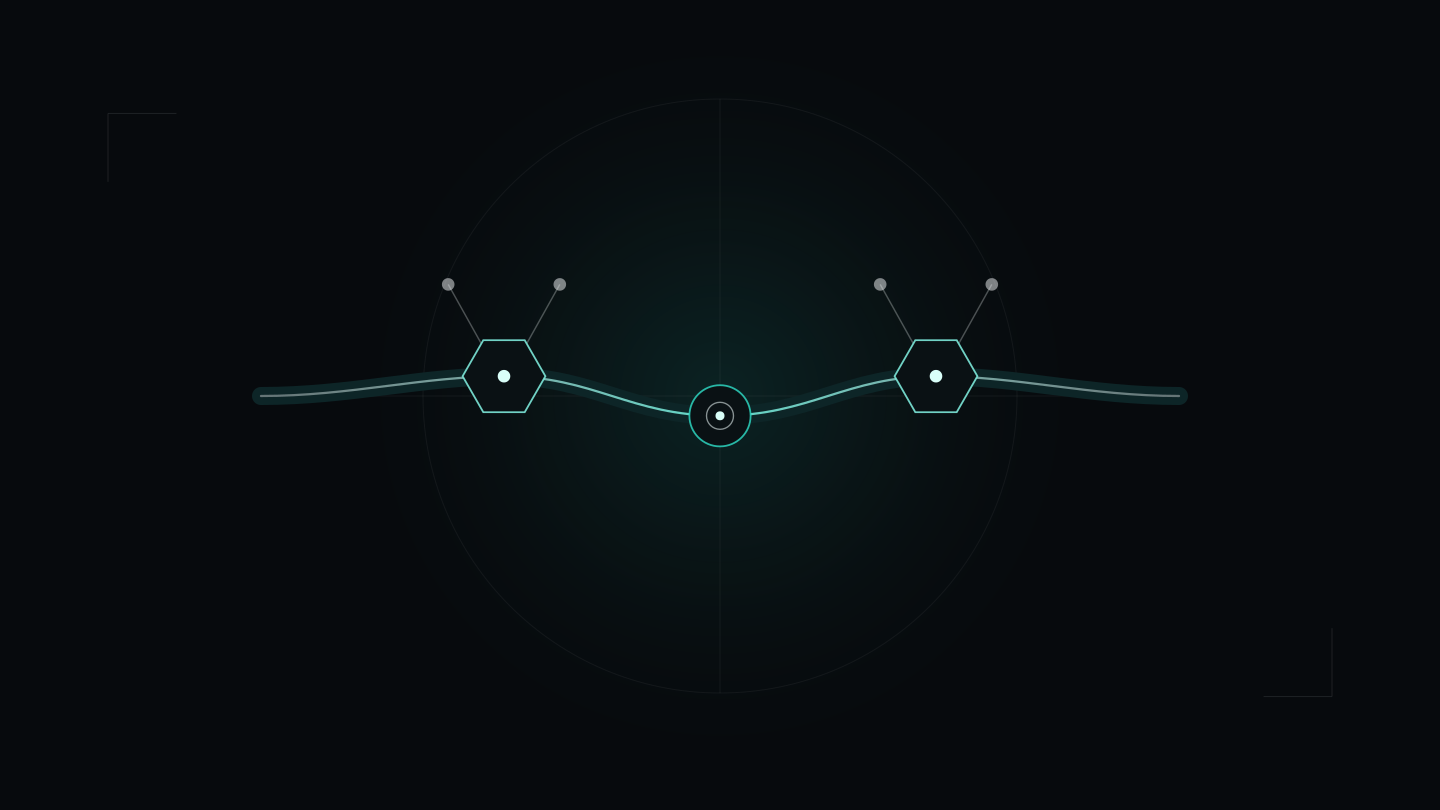
We are currently living through the greatest phase-shift in human history: the collision of two distinct intelligences. On one side stands Carbon intelligence—the organic, messy, ancient lattice of human culture, ritual, and consciousness. On the other stands Silicon intelligence—the synthetic, hyper-scalable, immutable architecture of artificial intelligence, cryptography, and digital protocols.
Historically, we have viewed these two worlds as fundamentally adversarial. The dominant tech narratives split into two reactive camps: Silicon accelerationists, who seek to automate away human friction at all costs, and Carbon protectionists, who pull back in fear, attempting to insulate humanity from technological disruption.
But true systems design teaches us that the future does not belong to the purists. It belongs to a new breed of architect: The Siosiphist.
Named after the Siloxane bridge (Si-O-Si) in chemistry, a Siosiphist is a systems philosopher and digital wayfinder who specializes in engineering the hybrid composite structures where technology protects, rather than hollows out, the human spirit.
The Chemistry of Systems Architecture
To understand the Siosiphist philosophy, we must look to the material world. In chemistry, the Siloxane bridge (Si-O-Si) forms the spine of silicones—unique polymers that are half-inorganic and half-organic.
The Si-O-Si spine behaves entirely differently than standard Carbon-to-Carbon (C-C) bonds:
- The Carbon Backbone (Organic): Forms rigid, tight zigzags. It is highly complex and versatile, but under intense environmental friction or extreme heat, it melts, burns, or cracks.
- The Siloxane Backbone (Inorganic): Acts like a loose, highly flexible hinge. It can rotate, coil, and expand effortlessly, remaining incredibly stable under extreme temperatures, UV exposure, and environmental shock.
When you bond organic Carbon side chains to an inorganic Si-O-Si backbone, you get the best of both worlds: an impenetrable, flexible shield that protects the delicate organic elements within it.
Siosism takes the Siloxane bridge as both its material reference and its design principle. We are entering a transition from carbon-dominant intelligence—biological, cultural, and embodied—toward a world that may become silicon-dominant through AI and digital systems. The question is not which form of intelligence should win, but how the two can be coupled without stripping away the strengths of either. Siloxane offers a natural model: a flexible Si-O-Si backbone that can carry organic carbon groups, joining inorganic resilience with organic adaptability.
As a working philosophy, Siosism applies that pattern to human systems. It asks us to build digital infrastructure that supports, protects, and scales sovereign human expression while allowing silicon intelligence to contribute what it does well. Purely human systems can fracture under scale and pressure; purely computational systems can become efficient yet culturally hollow. The task is to design the bridge so carbon and silicon intelligences develop in relationship, with neither treated as disposable.
The Siosiphist engineers the hybrid bridge.
The 6 C's of the Siosiphist Matrix
To transition this philosophy from an abstract chemical metaphor into an actionable framework, we must look at the Conscious Stack™ through six core pillars: The 6 C's.
These six pillars map precisely onto the molecular arrangement of a standard polysiloxane chain, balancing the immutable systemic infrastructure with dynamic human execution.
               [ ORGANIC LAYER: THE CARBON SHIELD ]
                     Direct Human Experience

         ( C₁: Consciousness )        ( C₂: Commerce )
                \                          /
                 \                        /
  ================\======================/================
               [ THE INORGANIC SI-O-SI BACKBONE ]
                     Structural Infrastructure

     ( Si₁: Culture ) ─── ( O₁: Currency ) ─── ( Si₂: Cognition )
                                                    │
                                                    └─── ( O₂: Continuity )
The Silicon Core (Si): The Structural Anchors
Silicon provides the primary framework constraints that hold reality together. These are the structural baselines of the ecosystem.
- 1. Culture (Si₁): The internal structural baseline. Culture is not data to be scraped by an LLM; it is the living lattice of localized contexts, shared rituals, values, and place-memory. It forms the bedrock of how a specific group relates to one another before any technology is introduced.
- 2. Cognition (Si₂): The internal processing baseline. This is the individual mind and its decision signals. In an age of synthetic media and algorithmically weaponized feeds, this pillar focuses heavily on cognitive security—ensuring the sovereign human mind can process reality without external manipulation.
The Oxygen Bridges (O): The Connective Protocols
Oxygen acts as the highly flexible, connective tissue that links the Silicon atoms, allowing the system to scale and bend without snapping under pressure.
- 3. Currency (O₁): The structural connective bridge. This represents decentralized systems, blockchain ledger tech, and programmatic smart contracts. It is the fluid protocol layer that facilitates trustless connection, predictable value capture, and sovereign economics between cultural nodes.
- 4. Continuity (O₂): The temporal connective bridge. This represents lineage, time-memory, and legacy. Continuity ensures that systems honor long-term feedback loops, historical context, and sustainable evolutionary pacing rather than constantly churning in response to short-term technological hype cycles.
The Carbon Side Chains (C): The Organic Applications
Carbon represents organic life on the periphery of the backbone. It interacts directly with the messy, unpredictable outside environment. It is what makes the cold infrastructure useful, alive, and adaptive.
- 5. Consciousness (C₁): The organic subjective shield. This is the felt signal of what is intrinsically true for the living organism. It is human awareness, empathy, and spiritual alignment. It sits at the top of the stack, ensuring that the entire technological apparatus remains subservient to human agency.
- 6. Commerce (C₂): The organic material output. This is the practical marketplace, the day-to-day transactional engine, and real-world utility. It is where human value-generation meets material reality, closing the economic loop to sustain the community financially.
The Framework in Practice: The Stack Audit
When auditing an organization, community, or tech architecture, a Siosiphist looks for systemic imbalances across this matrix. Systems inevitably break down when they neglect the balance between their Silicon rails and Carbon shields:
- The Soulless Machine (High Currency/Commerce, Zero Culture/Cognition): This is the classic Web3 pump-and-dump or hyper-automated AI SaaS company. The economic engine works, but it possesses no distinct human identity, zero mental sovereignty for its participants, and absolutely no long-term stability. It burns out quickly.
- The Starving Tribe (High Culture/Consciousness, Zero Currency/Commerce): This is the well-meaning, deeply bonded community or activist group that completely rejects modern technical tools. Because they lack reliable cryptographic rails (Currency) or a viable marketplace strategy (Commerce), they fracture under financial pressure or fail to scale their impact.
- The Disjointed Enterprise (High Cognition/Culture, Zero Continuity): This is the organization that has highly intelligent individuals and a great baseline vibe, but no respect for institutional memory, tracking loops, or legacy protocols. They are forced to reinvent the wheel with every tech shift.
The objective of a Conscious Stack Audit is to structurally anchor the Carbon applications (Consciousness and Commerce) directly into the Siloxane backbone (Culture, Currency, Cognition, Continuity), creating an architecture that is simultaneously unyielding to system manipulation and highly flexible to human needs.
Conclusion: The Digital Wayfinders
We cannot afford to retreat into an idealized, pre-digital past, nor can we blindly hand over our cognitive sovereignty to centralized silicon algorithms.
The path forward requires us to become Siosiphists—digital wayfinders who understand that the ultimate function of advanced technology is to serve as a resilient, flexible chassis for human culture and consciousness. By consciously engineering the hybrid composite of Carbon and Silicon, we construct infrastructure that does not dilute who we are, but instead gives us the structural sovereignty to scale what makes us human.
Siosism is the lens; the conscious technologist is the practice. One describes how the bond forms, the other names the person who keeps it holding—building, maintaining, and repairing the bridge in their own stack and in the systems they touch.