What Cloud Gazing Taught Me About the Last Unhackable Layer
Polynesian wayfinding, the attention economy, and why cognitive sovereignty is the one layer of self left undefended
Cloud gazing looks passive. It isn't. Tracing a line from Polynesian wayfinders to 2026 optogenetics research to argue that awareness is the last layer of self that still requires your participation to be compromised.
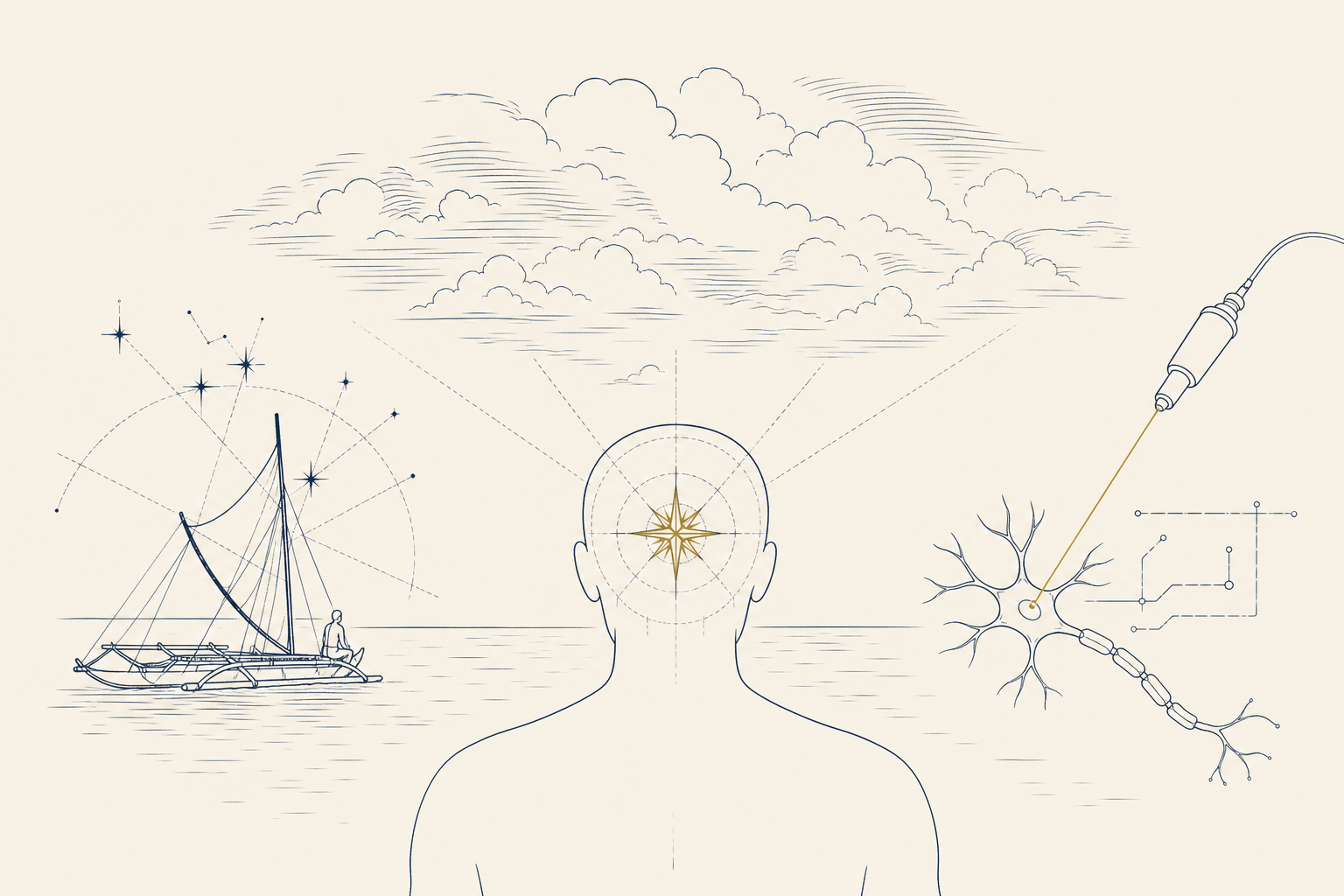
There's a particular kind of stillness that comes from lying on your back and watching clouds move.
Not thinking about them. Not naming them. Just watching.
If you've ever done it — really done it, phone face-down, no agenda — you've probably noticed something strange: a quality of attention that feels different from your usual mental weather. Quieter. Wider. Less like a spotlight and more like an open sky.
That quality has a name in contemplative traditions. And in 2026, it may be the most strategically important thing you can cultivate.
This essay starts with clouds and ends somewhere more urgent — at the edge of neuroscience, ancient navigation, and a question about which parts of you are still yours to defend. If you've been thinking about attention, focus, or what it means to stay grounded in a world that's getting better at pulling you apart, stay with it.
The Five Layers of the Stack
Think of the self the way you'd think of any technical stack: layers, each one running on top of the one below it, each one with its own failure modes.
Layer 1 — Behavior. The surface layer. What you look up, click, scroll past. Cloud gazing lives here — free, visible, and (this is the tell) one of the last behaviors where nobody is bidding for the output.
Layer 2 — Attention. The runtime layer. Where behavior gets routed moment to moment. Polynesian navigators turned this layer into instrumentation — reading swells and the green underside of clouds the way a trained operator reads a dashboard. This is also the layer the last fifteen years of ad-tech was built to compile against.
Layer 3 — Belief. The config layer. The values and assumptions that decide which signals even get attention in the first place. This is where "navigating the digital ocean" actually happens — not by consuming less, but by checking what your config file is set to before the feed decides for you.
Layer 4 — Biology. The firmware layer. Moods, memory, neural firing — the stuff we assumed was fixed hardware. Optogenetics (2026 Nobel Prize territory) just proved firmware can be flashed with light. This layer stopped being read-only.
Layer 5 — Awareness. The kernel layer. The process that notices what's running in every layer above it, without itself being written by them. Everything else in the stack can be patched, exploited, or overwritten remotely now. The kernel can be degraded — fragmented by chronic distraction, numbed by trauma — but it can't yet be flashed the way Layer 4 can. That's the asymmetry.
Most people are patching Layer 1 and getting outmaneuvered at Layer 2, while Layer 5 — the only layer actually running the show — gets zero investment. It's the same logic I apply when auditing a founder's actual tools through Conscious Stack™ design: the surface layer is rarely where the real problem lives.
The Navigator's Lesson
Polynesian wayfinders crossed the Pacific without instruments. No compass. No GPS. No charts in the Western sense.
What they had was a trained capacity to read the world as it actually was: star paths, ocean swells, wind shifts, the behavior of birds far from land. They navigated by staying in continuous, unmediated contact with reality.
The skill wasn't knowledge. It was presence. The ability to receive information without the distortion of assumption, fatigue, or wishful thinking.
There's a word for what they were doing that I find more useful than "navigation": wayfinding. And the core of wayfinding isn't the map. It's the quality of attention brought to the territory.
A navigator who can't feel the swell beneath the vaka — the canoe — is lost even with perfect charts. A navigator who can feel it has something no external system can fully replace.
That quality of attention, that trained receptivity, is what cloud gazing is actually practicing.
What the Attention Economy Can't Touch
Here's the distinction that matters.
Behavior, attention, belief, and biology can all be interfered with from the outside. Someone else can design the environment that shapes your behavior. Someone else can capture your attention before you've decided to give it. Someone else can, increasingly, modulate the biological processes that generate your moods.
But the observer-self — the awareness that watches all of this happening — operates one level up.
You can be anxious. You can also notice that you're anxious. Those are not the same event. The noticing is not the anxiety.
That gap, however small it sometimes feels, is where cognitive sovereignty lives.
A light hedge is worth making here. The awareness layer isn't invincible. Trauma can narrow it. Chronic distraction can dull it. Sustained propaganda can train it to mistake the propaganda for its own thoughts. The observer-self can be degraded — it just can't yet be directly coded or rewritten the way optogenetics can now reach into biological processes. That distinction matters. The claim isn't that awareness is permanently safe. The claim is that it's the last layer that still requires your participation to be compromised. Which means it's also the layer most worth defending.
The Load-Bearing Wall
When I work with founders and teams on their operating stack, I find the same structural problem again and again: the stack was built to serve someone else's objectives.
Not through malice. Through drift. A tool adopted for convenience becomes the system of record. A platform chosen for reach starts shaping what gets made. The founder's calendar fills with commitments that made sense six months ago and now just generate inertia.
The stack is running. But it's running on borrowed purpose.
This is the same hijacking that happens at the individual level, just expressed through a business. And it's exactly the pattern I work to interrupt with founders through Counsel at georgesiosi.com — not by prescribing a new stack, but by asking whose objectives the current one is actually serving. That question only has a useful answer if the person asking it can access the observer-self clearly enough to tell the difference between "I chose this" and "I drifted here."
Cognitive sovereignty isn't a personal development concept. It's a structural requirement for building anything that's actually yours.
The Practice
Cloud gazing works as a practice because it trains the specific muscle that everything else in this essay depends on.
Three stages. No equipment required.
Set a baseline. Before you look up, notice your mental state. Not to judge it — just to register it. Busy, scattered, flat, anxious, whatever's there. Ten seconds.
Tag the wave. As you watch the clouds, notice when your mind grabs onto something — a shape, a thought, a to-do item that surfaces. Don't push it away. Tag it: thinking. Then return to watching. You're not trying to empty the mind. You're training the noticing.
Check the underbelly. After five or ten minutes, notice your mental state again. Compare it to the baseline. Something usually shifts — not dramatically, but measurably. That shift is data. You're learning what it feels like when the observer-self has a little more room.
Simple doesn't mean easy. And simple doesn't mean small.
What you're building, one session at a time, is the capacity to watch your own attention without being fully captured by it. That capacity is the foundation of every other kind of discernment — strategic, creative, relational.
The Sky Is Still Free
The five-layer stack ends somewhere interesting.
Behavior, attention, belief, biology — all of these are now contested terrain. The technologies that can reach them are advancing faster than our social and ethical frameworks for governing them.
But the sky is still free.
Not because it's beyond reach forever. Because it requires a different kind of access. The observer-self can't be hacked from the outside without your cooperation — and even when it's been narrowed by circumstance, it can be recovered through practice. That's not true of a hijacked algorithm or a modified neuron.
The Polynesian navigator didn't need anyone's permission to feel the swell. The skill was internal. The territory was real. The connection between them was direct.
That's what cloud gazing is practicing. That's what cognitive sovereignty actually means: not a political position, not a productivity hack, but a trained capacity to remain in direct contact with your own experience — even as every layer below it gets more contested.
The navigator who can feel the swell is never fully lost.
If this framing resonates, the next place to take it is practical: how the same principles apply to the tools and systems you've built around your work. Start with The 5 Elements of Digital Wayfinding — five things a navigator reads to stay oriented under digital change.