How to Guard Your Mind in the Age of AI
Consciousness warfare, the nine triangles, and why your home screen is a yantra
A fifteen-turn inquiry that started with cognitive warfare and ended with a 1:3:5 phone layout — revealing where manipulation lands and where a practical defense can begin.
I started with two words in a Google search: consciousness warfare.
Fifteen turns later, I was looking at the nine triangles of the Sri Yantra, the Sanskrit anatomy of mind, psilocybin research, Kabbalah, AI harness engineering, and a phone home screen arranged into nine slots. The inquiry moved across traditions and disciplines quickly enough that I had to keep asking what was established, what was analogy, and what was simply a pattern worth testing.
One line held the whole thing together: the attack lands on the receiver before it becomes a message.
The war is on the receiver
NATO's Allied Command Transformation describes cognitive warfare as a fight in which the brain is both the target and the weapon. That sentence moves the battlefield inside the person.
Disinformation competes for belief. Cognitive warfare reaches further upstream, shaping perception, trust, emotional tempo, and the interval between stimulus and reaction. When that interval becomes short enough, verification cannot keep pace. A conclusion arrives already carrying the feeling that it is yours.
Cognition and consciousness describe different layers of that process. Cognition covers memory, logic, attention, language, and decision-making: the mechanics through which we process the world. Consciousness names the subjective field in which those mechanics appear: the felt experience of being the one to whom this is happening.
Media literacy strengthens cognition through better sources, stronger verification, and clearer reasoning. The older traditions I have been reading add another layer to the defense. They ask whether a person can observe the machinery of thought while it is operating.
One English word, several Sanskrit layers
English uses “consciousness” for several things at once. Sanskrit traditions offer a more differentiated map:
- Chit — pure awareness, unbounded by a particular object.
- Chitta — mind-stuff, memory, and the impressions experience leaves behind.
- Manas — the sensory and reactive mind that coordinates input and desire.
- Buddhi — discernment, judgment, and the capacity to evaluate.
- Ahamkara — the “I-maker” that organizes experience around a separate self.
- Turiya — “the fourth,” awareness described as underlying waking, dreaming, and deep sleep.
Read cognitive warfare through this map and its mechanics become easier to name. A stimulus catches Manas. Buddhi assembles an explanation. Ahamkara claims the conclusion as mine. The sequence can run so smoothly that the constructed response feels self-authored.
A contemplative practice introduces a gap: fear is moving through; a narrative is forming; awareness can observe both. That gap does not make anyone immune to manipulation. It restores enough distance for discernment to re-enter.
The psychedelic comparison — held carefully
This led me to psilocybin and the Default Mode Network (DMN), a set of interacting brain regions associated with self-referential processing. Psychedelic research has linked psilocybin to changes in DMN connectivity and to experiences of ego dissolution, although the neuroscience is more complex than simply “turning the ego off.” A systematic review of psychedelic effects on the DMN and research into the neural correlates of ego dissolution give the comparison a scientific foothold without collapsing one map into the other.
In Sanskrit language, I can describe the experience as Ahamkara loosening. In neuroscience, I can describe altered network dynamics correlated with a reduced sense of self. The two descriptions arose from different methods and carry different kinds of authority.
The analogy that stayed with me was simple: psychedelics can resemble a helicopter to a summit, while meditation trains the climb. A helicopter can reveal that the summit exists. Repeated practice develops the capacity to navigate the terrain. Neither image proves an equivalence with Turiya; it gives me a practical way to think about temporary state change and trained access.
The yantra as a tuning dial
From there I asked what role yantras played in meditation.
A yantra gives attention a bounded geometric object. In trataka, the practitioner holds a steady gaze on a single point, flame, symbol, or yantra. Language recedes. Peripheral input softens. The visual field becomes organized around one chosen center.
The Sri Yantra is the densest example: nine interlocking triangles, traditionally read as four upward Shiva triangles and five downward Shakti triangles, generating forty-three smaller triangular regions around a central Bindu. Its exact construction is mathematically demanding enough to remain an object of formal study; one paper on the construction of the Śrī Yantra traces both the geometry and the uncertainty surrounding its historical origins.
I became interested in the asymmetry. Four triangles rise, five descend, and the field converges on one point. The geometry gives the eye somewhere to return.
The 1:3:5 pattern I kept following
Then the numbers started speaking in a familiar rhythm:
1 = 1²
1 + 3 = 4 = 2²
1 + 3 + 5 = 9 = 3²
Adding consecutive odd numbers produces consecutive squares. That mathematical fact does not prove a theory of consciousness. It gave me a design hypothesis.
One could represent source or orientation. Three could represent the active triad — the small number of moving parts that remain available to working memory. Five could represent materialization: the sensory or supporting layer where complexity is present and bounded. Together they create nine positions with an explicit hierarchy.
The thought that changed the direction of the inquiry was this: if 1:3:5 works as a code for organizing attention, it should be buildable.
Nine slots on a home screen
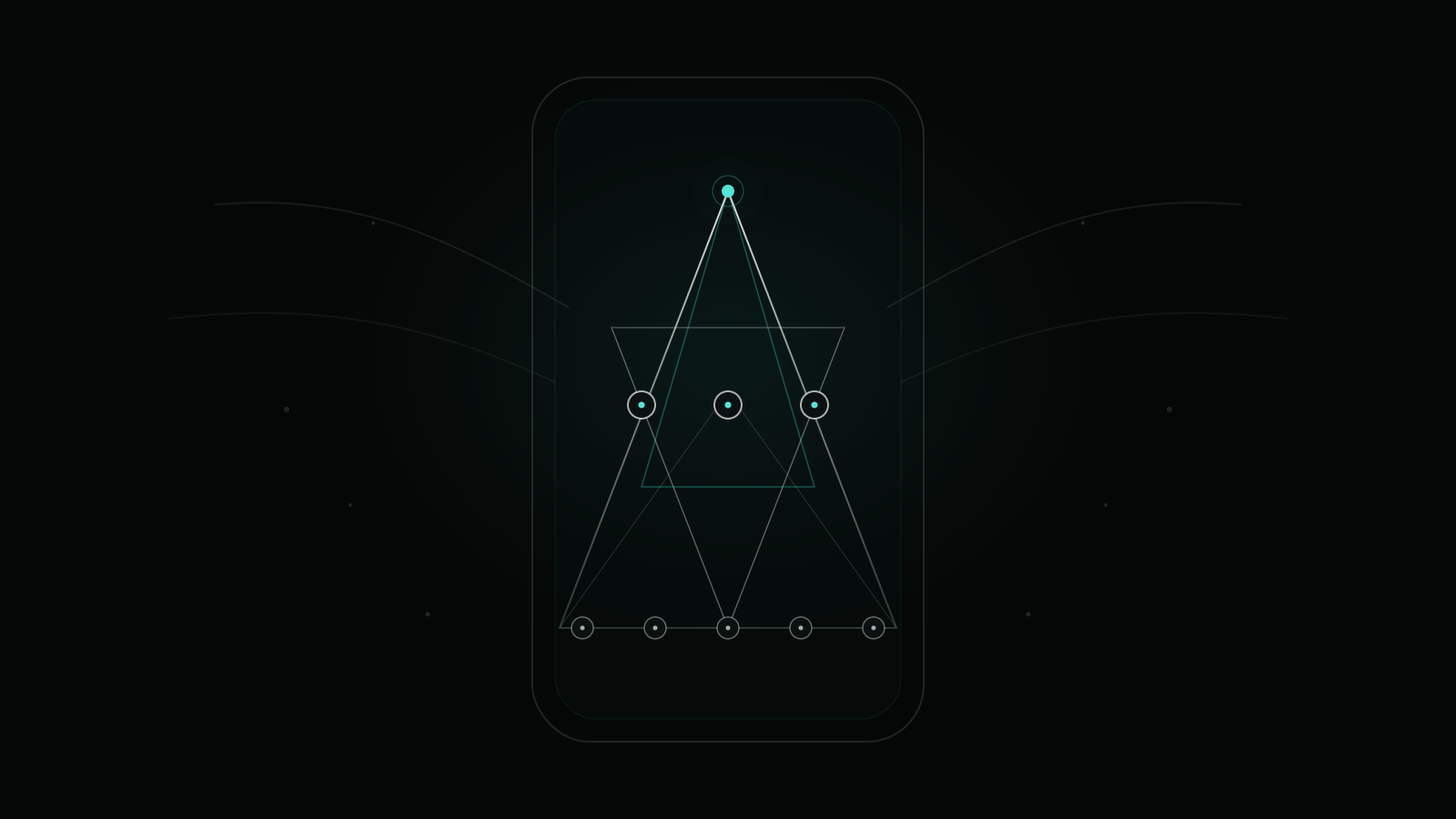
So I pictured a phone home screen with nine folders or slots arranged as a pyramid:
        [ 1 ]
    [ 3 ][ 3 ][ 3 ]
[ 5 ][ 5 ][ 5 ][ 5 ][ 5 ]
The top position becomes the anchor: the place where context, intent, and judgment meet. The middle row holds three active tools used for current work. The five at the base hold supporting and sensory functions — useful, accessible, and unable to occupy the visual center.
A uniform grid gives every icon equal authority. The eye wanders until colour, familiarity, or a notification badge makes the choice. A pyramid gives the gaze a Bindu. The hierarchy exists before the thumb moves.
The layout also breaks muscle memory. Your thumb loses the old coordinate that opened a feed before intention caught up. For a moment, you have to mean it.
When the AI missed the center
I asked the model whether anyone was already applying 1:3:5 to technology and tech stacks. It returned task-management apps, fractal UI essays, and calm-technology theory. The references were adjacent, yet the central example was missing.
So I typed my own name and pointed it toward Conscious Stack. Only then did it assemble the framework I had already been building: 1 Anchor, 3 Active, 5 Supporting.
That correction revealed more than the initial miss. A model trained across a vast surface optimizes for broad statistical probability. It can describe the whole grid and still miss the node that matters until someone supplies the center.
The same architectural failure appears in a crowded home screen and a sprawling technology stack. Everything is available. Nothing is authoritative. Context disperses across the surface.
The stack, the bridge, and the gate
Conscious Stack formalizes the geometry:
- 1 Anchor — where context, intent, and judgment meet.
- 3 Active — the daily systems kept within a bounded working layer.
- 5 Supporting — specialized tools that contribute without continuously interrupting.
I have also been exploring the siloxane bridge, Si–O–Si, as a material metaphor for the relationship between carbon and silicon intelligence. The chemical reference needs precision: modern chips rely primarily on crystalline silicon and silicon dioxide structures, while siloxane names a different class of Si–O–Si bonding. The correspondence I am drawing is architectural. A bridge can connect unlike elements while preserving a boundary between them.
The inquiry eventually reached Da'at, the hidden knowledge point in Kabbalistic diagrams, and the Zeal Point or “Mouth of God” found in later esoteric anatomy. I treat these as parallel correspondences rather than a shared historical system. Each describes a threshold where a larger field becomes embodied, knowable, or operational.
That is also the purpose of a harness in AI engineering. Raw capability passes through boundaries, permissions, context, and operational logic before it can act. The harness creates a usable relationship between a powerful system and the person responsible for its consequences.
The caveman version is easier:
The mountain has a million berries. The brain goes “boom,” you drop the spear, and the tiger eats you. So you need a basket. The basket holds three.
A harness is the basket. A bounded interface is a hollow bamboo in a flooding river: one clean cup instead of the whole current at once.
Four rules for guarding the receiver
- Name your anchor before you name your tools. Choose one place where context, intent, and judgment meet. Every tool inherits its usefulness from that orientation.
- Cap the active layer at three. A fourth active system competes with the first three and raises the cost of maintaining their shared context.
- Keep the sensory layer at the base. Social media, entertainment, shopping, and feeds remain accessible while losing their claim to the focal center.
- Ask what the system is training you to become. A tool shapes reflexes through repeated use. Watch what happens to your capacity to refuse, revise, and leave.
Cognitive warfare aims at the layers that make a person predictable. The defense begins by reclaiming the architecture through which signals enter, compete, and become action.
Build the gate first. Then decide what gets in.