What Is Tool Sprawl? A Definition, and Why Subtraction Beats Consolidation
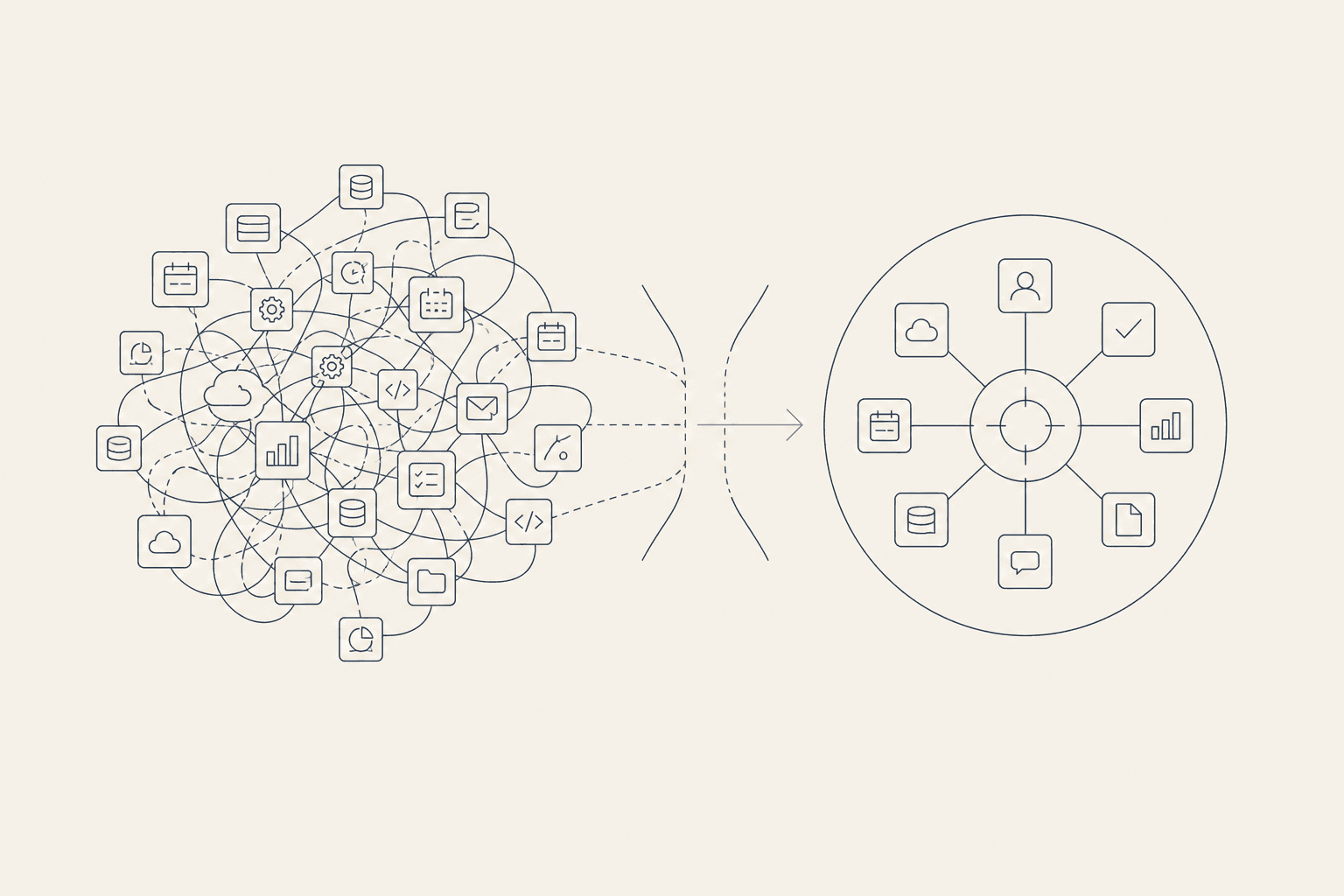
You open your laptop on Monday and count the tabs. Slack, Notion, a CRM, two project boards, a scheduling app, three AI assistants, a dashboard nobody checks. Each tool was a sensible answer to a real need on the day it arrived.
Together, they don't add up to anything.
Tool sprawl is the accumulation of software tools, subscriptions, and workflows beyond what an organization can coherently use, connect, or explain. It shows up as duplicated functions, scattered information, unclear ownership, and a widening gap between the tools you pay for and the work you actually do. SaaS sprawl is the same condition seen through the cloud-software lens. Tool sprawl is the broader term, because the problem isn't limited to subscriptions. It includes free tools, personal apps, automations, and AI assistants nobody formally adopted.
If you're an operator-founder or a senior leader, you probably feel this as drag before you can name it. Handoffs slow down. Answers live in the wrong place. New hires ask where things go, and nobody gives the same answer twice.
The Surface Problem Everyone Recognizes
Sprawl shows up in small, ordinary moments.
- You search three places for one document and find three versions.
- Two teams track the same project in different tools, each convinced theirs is canonical.
- A subscription renews and nobody remembers who asked for it.
- A new tool is adopted to fix the friction caused by the last tool.
That last one is the tell. Sprawl reinforces itself. Every new tool creates a seam, and every seam calls for a connector, a workaround, or yet another tool to bridge the gap.
The scale is hard to pin down, so I'd be cautious with the numbers. Vendor blogs in the SaaS management space often claim that a typical company runs around 106 SaaS applications, that an average enterprise runs around 291, and that roughly 51% of licenses go unused. Treat those as claims from companies that sell visibility into software spend, not as settled research. They're a rough signal that the pattern is common. They're not a benchmark to manage against.
Why Sprawl Is a Pattern Problem, Not a Procurement Problem
The usual framing comes from IT, security, and finance. It sounds like this: audit the licenses, find the shadow IT, consolidate vendors, negotiate a better contract. All reasonable. Some of it will save money and reduce risk.
It also misses the point.
Procurement thinking assumes the tools are the unit of the problem. Count them, rank them, cut the weakest. But a stack with 40 tools can be coherent, and a stack with 12 can be chaos. The count isn't the disease. It's a symptom.
The root cause is that tools were added without a shared answer to one question: what is this stack for?
Without that answer, every tool decision is local. A team solves its own problem with the best option available that week. Each choice is defensible. The sum is incoherent. I call this operational drift: the slow, unplanned divergence between how your organization intends to work and how its systems let it work. Nobody decides to drift. It's what happens by default when additions are made one reasonable decision at a time.
This is a structural gap, not a discipline failure. I wrote about a version of it in Not Broken, Misaligned Stack, where the core argument is that most organizations aren't failing at tools. They're running tools that were never aligned to each other, or to the work.
The Consolidation Trap
Consolidation feels like the obvious answer. Fewer vendors, fewer logins, fewer invoices. Sometimes it's right.
But consolidation without a decision about purpose fails in a predictable way. You pick the biggest platform, migrate into it, and find you've moved the mess instead of removing it. The duplicated workflows now live inside one product. The unclear ownership becomes a permissions problem. The habits that created the sprawl recreate it, just with a single logo on the bill.
There's a second trap. Consolidation optimizes for fewer things, so it quietly rewards tools that do many things adequately over tools that do one thing well. The stack gets simpler on paper and blunter in practice.
Consolidation answers "how many?" The better question comes first.
Subtraction Starts With Purpose
Subtraction differs from consolidation in sequence. You don't begin by looking at the tools. You begin by deciding what the stack exists to do.
Not a feature list. A purpose. What does your organization need its systems to make easy, and what should they make impossible? Where should information live, who should be able to find it, and what should happen to it after it's used?
Once that's written down, every tool gets a simple test: does it serve the purpose, and does it connect to the rest? Tools that fail aren't merged into something else. They're removed.
That's the contrast in one line. Consolidation reorganizes what you have. Subtraction decides what you're allowed to keep.
It's also why a leaner stack tends to feel calmer. You're not just paying for fewer things. You're carrying fewer decisions.
Thinking in Layers
Here's the analogy I use. A stack isn't a pile. It's a set of layers, and each layer carries weight for the one above it.
Layer 4: Output        (what the world sees)
Layer 3: Workflow      (how work moves)
Layer 2: Context       (where knowledge lives)
Layer 1: Foundation    (identity, data, ownership)
Sprawl usually starts when tools get added to a layer that was never defined. A new AI assistant lands in the workflow layer, but it needs context that lives somewhere else, on a foundation nobody owns. The tool works. The layer beneath it doesn't. So you add another tool to patch the gap.
Seen this way, the audit question changes. You stop asking "which apps are redundant?" and start asking "which layer is this tool in, and is the layer beneath it solid enough to carry it?"
The context layer is usually where things break first. Most stacks have no deliberate home for organizational knowledge, so it scatters across chat threads, documents, and individual memory. I explored this in the essay on the Notion context layer, which makes the case for treating context as a designed layer rather than an accident of whichever tool happened to be nearby.
The Conscious Stack and the 1:3:5 Rule
The alternative to a normal stack that grew by accident, is one designed on purpose. I call it a conscious stack: every tool has a stated reason to exist, a defined shape, and a clear relationship to the others.
The method we use to build a conscious stack hinges on 1:3:5 rule. I'll keep it high level here, because the details belong on the framework page, but the rule constrains every stack by ratio (1:3:5) as the top most limit, which respects human cognitive limits (e.g. Miller's Law), so it stays aligned intentionally as it grows instead of expanding without conscious awareness. It gives you a structure to subtract against, so cutting isn't arbitrary.
For the full framework, including how to apply it, the details and the Stack Builder are at consciousstack.com. Start there if you'd rather work through your own stack than read about someone else's.
The point of a rule like this isn't minimalism for its own sake. A stack with a shape can be explained, handed off, and maintained. A stack without one can only be survived.
A Practical First Step
If you're facing sprawl now, order matters more than tactics.
- List your tools first. One page. What are all your tools? What are your top 9 most used tools?
- Map your tools to layers. Don't judge them yet. Just place them. Gaps and pile-ups will show themselves. But organize your tools into relevant categories like Knowledge, Finance, Sales, Marketing, Comms, Socials, setc.
- Park the unknowns. There's usually a few tools you can't put neatly into categories. Take note of them.
- Subtract against the purpose. Remove what doesn't serve you, anymore even if it's cheap, free, or well loved.
- Add only into defined slots or layers. The next tool earns its place by fitting a layer, not by solving a Tuesday problem.
Notice that cost savings arrive late, if at all. They're a byproduct. Lead with savings and you'll cut whatever is easiest to cut. Lead with coherence and you'll cut what's actually in the way.
FAQ
What is tool sprawl? Tool sprawl is the buildup of software tools and subscriptions beyond what an organization can coherently use or connect. It's marked by duplicated functions, scattered information, and unclear ownership of systems and data.
What causes tool sprawl? Mostly local, well-intentioned decisions made without a shared purpose for the stack. Teams adopt tools to solve immediate problems, each tool creates new seams, and those seams invite more tools. Easy purchasing, free tiers, and the speed of AI adoption accelerate the cycle.
How is tool sprawl different from SaaS sprawl? SaaS sprawl refers specifically to uncontrolled growth in cloud software subscriptions. Tool sprawl is broader. It also covers free apps, personal tools, automations, and AI assistants that never went through formal procurement. SaaS sprawl is a subset.
How do you reduce tool sprawl? Decide what the stack is for before deciding what to cut. Map tools to layers, find the layer nobody owns, then remove what doesn't serve the purpose. Consolidating vendors can help afterward, but it works poorly as a first step.
What Remains
A coherent stack isn't a small one. It's one where every part can say why it's there.
If you're an operator-founder who wants a second set of eyes on how your own stack is layered, I work with founders 1:1 here. But if you'd rather start on your own, the framework page is the place to begin.
Structure doesn't replace judgment. It's the ground that makes judgment repeatable.