The Totumo Hypothesis
Volcanic Clay as a Bio-Interface Between Carbon and Silicon
How a dream, a Colombian mud volcano, and three disconnected research streams converged into a testable proposition about the future of neural interfaces
The Dream
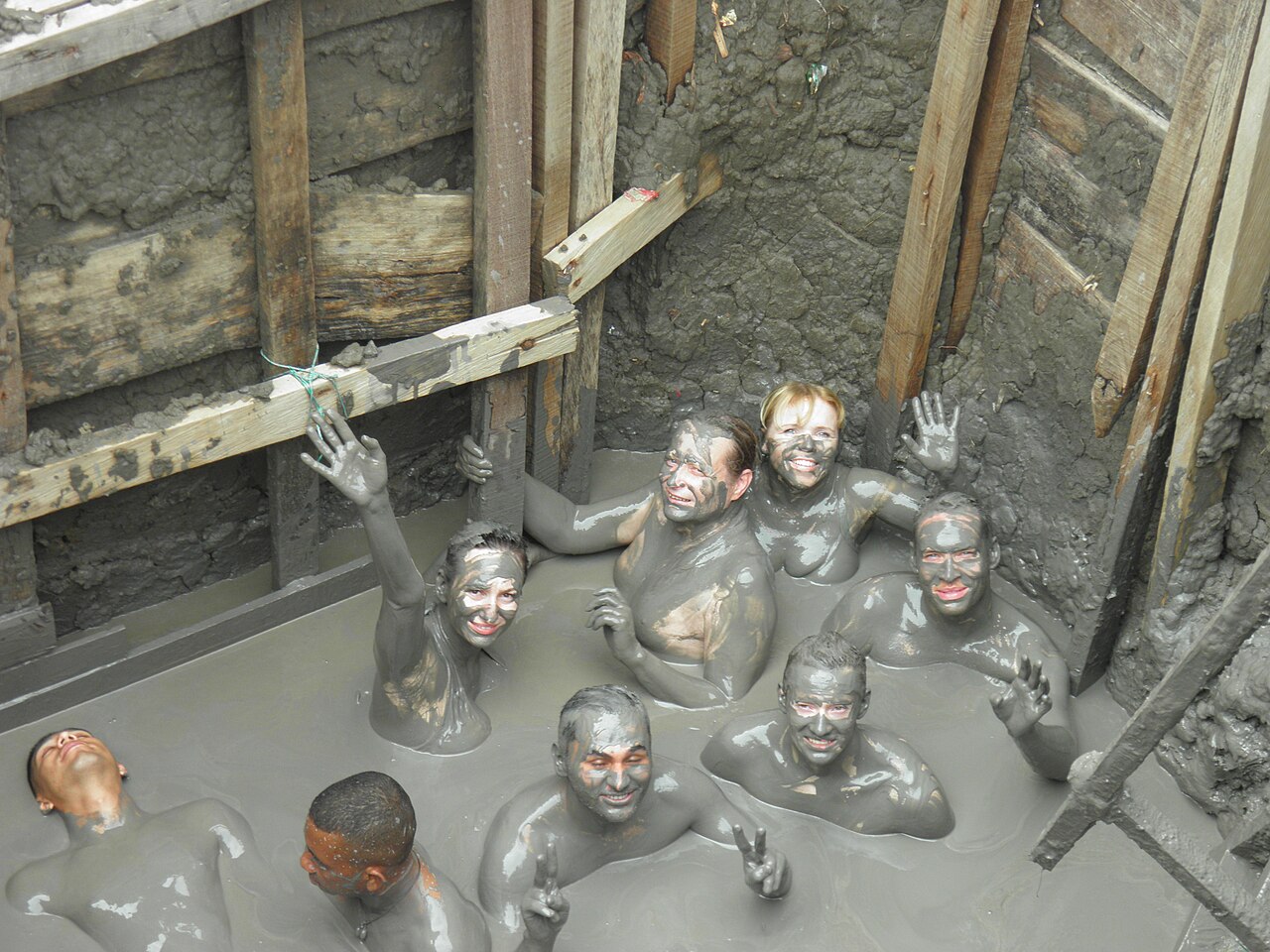
I was covered in bluish-grey clay. Walking through a town. The coating slowly wore off as I moved — through streets, past buildings — until I arrived in a kitchen where my wife was waiting. There was a lot more, but that's the gist of it.
When I described the clay in this dream to my wife, she paused. "That sounds like El Totumo," she said. The mud volcano on Colombia's Caribbean coast. I looked it up, she was right. The colour, the texture, the way it clung on people's bodies.
That recognition sent me down a rabbit hole, which took up most of my morning. What I found — across three separate scientific fields that have never been formally connected — is what I'm now calling the Totumo Hypothesis.

The Hypothesis
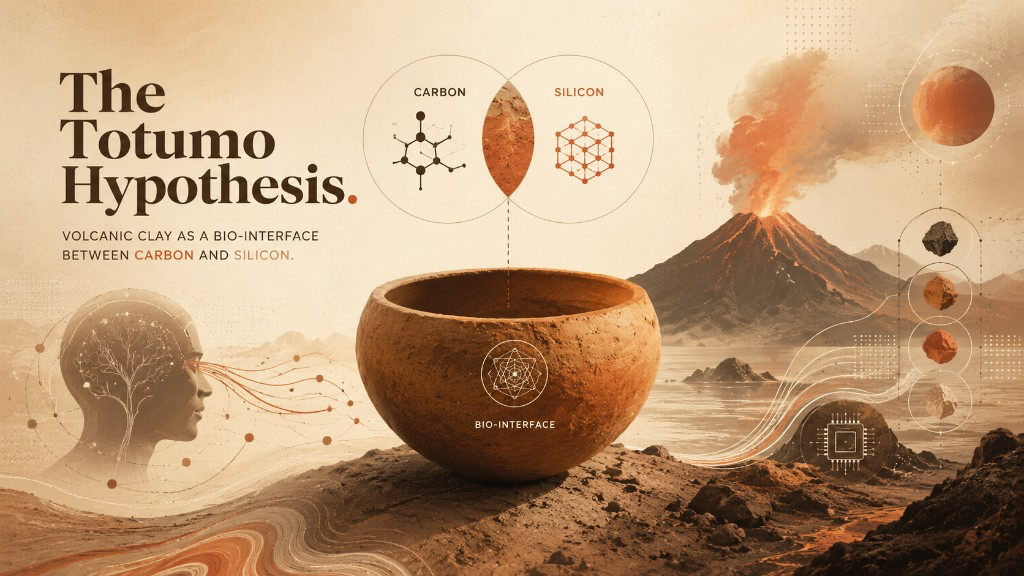
Volcanic silicate clay, specifically El Totumo-type mud volcano clay, could serve as a mediating bio-interface layer between carbon-based biological tissue and silicon-based machine systems (if it hasn't already).
Note: this is a speculative proposition, not an established finding. What I am proposing is that the mineral chemistry of this clay — silicates, iron, sulfur, magnesium, calcium — is already proven safe for extended skin contact, already chemically adjacent to both biological and electronic materials, and already sits at the intersection of three research streams that nobody has formally connected. The hypothesis is testable. That is what makes it worth stating.
The question it poses: could volcanic clay become a standardized bio-interface coating for neural implants and prosthetics?
The Three Legs
1 - Clay Already Heals the Body
Clay minerals have been used therapeutically for centuries. The science behind that use is now reasonably well documented.
Montmorillonite, kaolinite, and halloysite — all present in volcanic clay deposits — have demonstrated wound-healing properties in peer-reviewed research. Kaolinite, specifically, activates Factor XII in the intrinsic clotting cascade. This is the mechanism behind QuikClot, the kaolin-impregnated hemostatic gauze used by military and emergency medical services worldwide. The clay does not merely absorb blood — it actively triggers the body's own clotting response.
Pelotherapy, the therapeutic use of mineral-rich muds, has a documented research base for volcanic and marine clays. Colombian mud volcano muds, including those from El Totumo, have been studied for their geochemical and mineralogical profiles in the context of therapeutic application. Clay is also an established drug-delivery carrier — its layered structure can hold and release compounds in contact with tissue.
The body already knows how to work with clay. The relationship is old.
2 - Silica Already Heals the Machine
Brain-machine interfaces have a materials problem. When a silicon probe is implanted in neural tissue, the body treats it as foreign. Glial scarring forms around the electrode. Signal quality degrades. The interface fails.
Researchers have been working on this for years. Silicon carbide — SiC, including amorphous a-SiC coatings — has emerged as one of the most promising solutions. Studies published in peer-reviewed journals have shown strong biocompatibility, reduced inflammatory response, and improved long-term signal stability compared to conventional silicon dioxide coatings. Engineered silica nanoparticle coatings have shown similar results in reducing inflammation at the probe-tissue boundary.
Carbon fiber electrodes, for their part, outperform silicon electrodes dramatically in signal capture — 71% versus 3% in some comparisons. The field is converging on a hybrid materials approach: carbon-based conductivity, silicon-based or silica-based biocompatibility coatings.
The machine is already reaching toward the chemistry of earth.
3 - Nature Already Runs the Collaboration
This is the part that stood out. Diatoms — single-celled algae — build their cell walls from silica. Marine sponges construct elaborate skeletal architectures from biogenic silicon. Biosilicification, the biological production of silica structures, is a well-studied phenomenon across multiple kingdoms of life. Nature has been engineering at the carbon-silicon boundary for hundreds of millions of years.
Silicon plays a role in human connective tissue, bone formation, and skin integrity. Diatomaceous earth, a silica supplement derived from fossilized diatom shells, is in common use. Research published in PMC has explored silicon's potential as a building block for biological processes beyond what we currently recognize.
The collaboration between carbon and silicon is not a future technology. It is an ancient one. We are only now building instruments sensitive enough to see it clearly.
The Gap
Three research streams exist independently: clay biomedicine, neural interface materials science, and biosilicification biology. Each has its own journals, its own conferences, its own vocabulary.
Nobody has connected volcanic silicate clay specifically to standardized bio-interface materials for human-machine systems.
That gap is where the Totumo Hypothesis sits.
Why Volcanic Clay Specifically
Not all clay's the same. The volcanic origin matters (and I'm a nerd for them).
Volcanic clay is emergent, not deposited. It forms through hydrothermal processes that carry deep-subsurface minerals upward — minerals that sedimentary clays simply do not contain in the same concentrations or combinations. El Totumo-type mud volcano clay carries kaolinite, smectite, illite, chlorite, vermiculite, mica, and pyrophyllite. That mineral diversity is not incidental. Each has distinct surface chemistry, distinct charge properties, distinct interaction profiles with biological tissue.
The iron content is chemically resonant with oxygen-carrying blood. The sulfur content is relevant to both antimicrobial function and tissue repair — properties that matter enormously in the context of implant coatings, where infection and inflammatory response are the primary failure modes.
And there is the cultural precedent. Centuries of skin-contact use across multiple civilizations. The safety profile is not theoretical.
The Research Proposal
If this hypothesis is worth testing — and I believe it is — the work would proceed in three phases.
Phase 1: Characterization. Standardize the mineral composition of El Totumo-type volcanic clay across multiple sample sites. Test conductivity, adhesion, rheology, and biocompatibility in controlled conditions. Address microbial and fungal safety concerns that arise from the natural, unprocessed state of the material.
Phase 2: Interface Testing. Apply processed volcanic clay as a coating on neural implants, prosthetics, and biosensors. Compare performance against current leading materials — silicon carbide coatings and silica nanoparticle coatings — using established biocompatibility and signal-fidelity metrics.
Phase 3: Hybrid Systems. Move beyond passive barrier testing. Explore whether the iron and sulfur content of volcanic clay can function as an active participant in the bioelectronic signal chain — not merely reducing rejection, but contributing to the interface's functional properties.
This is the kind of thinking I find myself drawn to more and more: the place where ancient material knowledge and contemporary engineering meet in the same sentence. If that intersection interests you, my Substack is where I work through these ideas openly — pattern recognition at the edge of deep history and practical system design.
The Middle Way
Geology acts as the middle layer here. That is what I'm proposing here with the Totumo Hypothesis.
A mineral bridge — earth's own material, formed at depth, carrying the chemistry of both worlds — making carbon and silicon compatible at the interface where they meet. No technological solution imposed on biology. No retreat into purely organic systems. Something older and more patient than either.
The Si-O-Si bond, the molecular backbone of siloxane chemistry, is the same structural motif that appears in volcanic silicates. Silicon bridged by oxygen. The same arrangement that gives silicone its flexibility, its biocompatibility, its durability. The same arrangement that makes glass. The value, as always, is in the arrangement (like what I talk about Conscious Stack Design™).
The question my hypothesis poses is a simple one: what if the coating doesn't have to wear off? What if, processed correctly, applied with precision, it becomes a permanent interface — a material layer that allows body and machine to speak to each other without rejection, without scarring, without the slow degradation that currently limits what brain-computer interfaces (BCIs) can do?
That question was inspired by my dream, but it's grounded in three real research streams. And it is, as far as I can tell, unanswered.
References
- Clay minerals for cutaneous wound healing (ScienceDirect).
- Geochemistry and mineralogy of Colombian mud volcano muds for pelotherapy (ResearchGate)
- QuikClot kaolin hemostatic technology (quikclot.com)
- Silicon Carbide Neural Interfaces review (PMC)
- Silica nanoparticles for neural interface biocompatibility (ACS).
- Biosilicification across biological hierarchies (ACS Nano).
- Biogenic silica (Wikipedia).
- On the Potential of Silicon as a Building Block for Life (PMC).
- The Totumo mud volcano: sedimentology and mineral setting (ScienceDirect).
Concept originated by George Siosi Samuels, August 4, 2026. Derived from dream analysis conducted in collaboration with Notion AI and his wife, who identified the clay as El Totumo mud volcano clay.