Surviving the Digital Tsunami: A Digital Wayfinder's Guide
Five wayfinding protocols for navigating technological disruption from the inside out
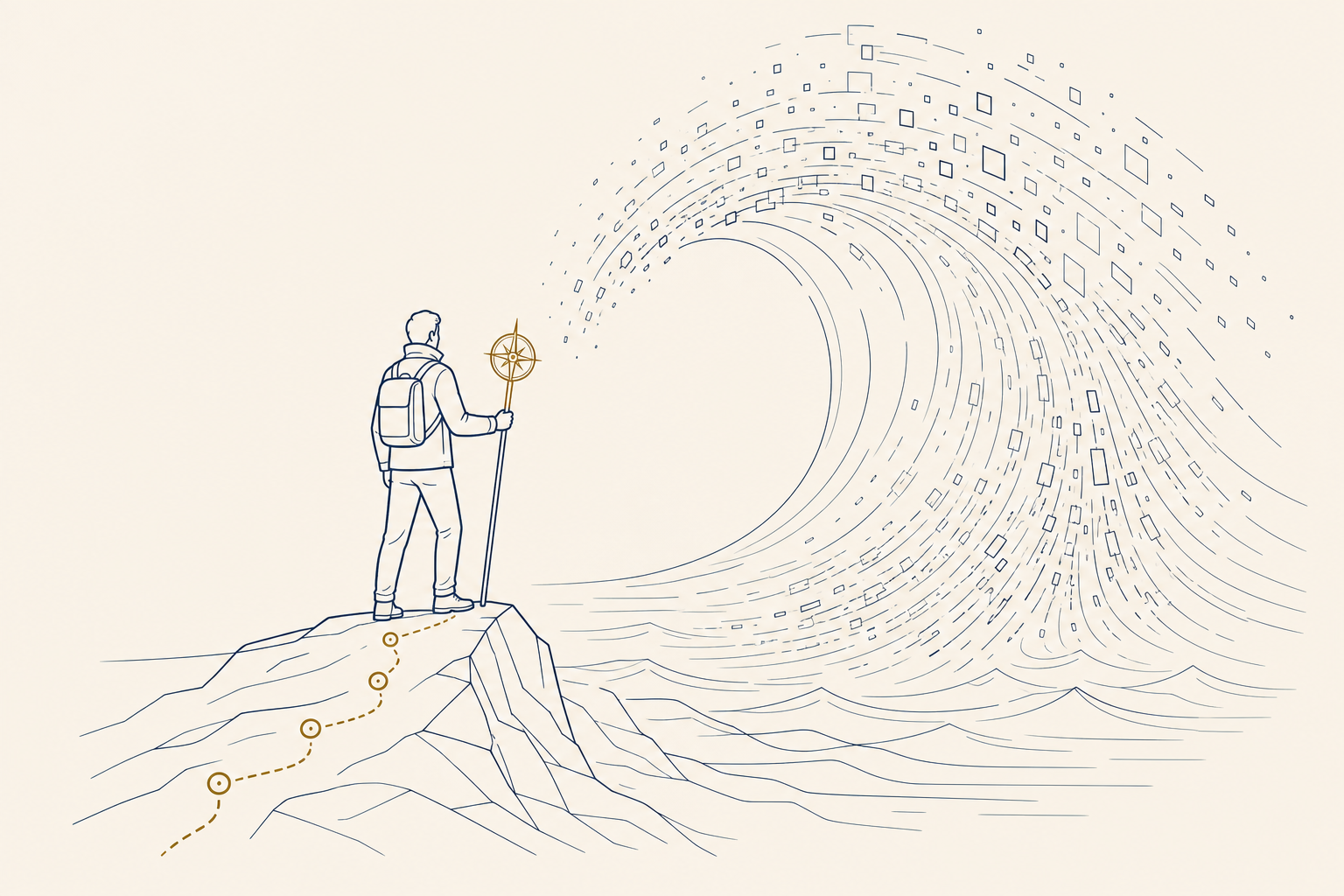
We are already submerged in the digital ecosystem. When the next wave of autonomous intelligence hits, there is no shore to run to — only depth, direction, and community to navigate by.
By George Siosi Samuels
When a physical tsunami approaches a coastal town, the warning protocol is straightforward: evacuate inland and get to higher ground.
Nature offers unmistakable signs — if you know how to read them. The ocean suddenly recedes, exposing the sea floor. Coastal water rushes out at an alarming rate. Birds alter their flight patterns and head inland. Animals abandon low-lying pastures and trek toward elevation. Non-human life recognizes the structural shift in the environment and moves before the kinetic force arrives.
Humans, on the other hand, often linger on the beach — distracted by the novelty of exposed tide pools, or caught unaware because they never learned to read the swell.
Today, we face a similar threat. But with a critical difference: there is no shore left to run to.
We are no longer standing on dry land watching a technological wave build on the horizon. We are already submerged — swimming, living, working, and raising families inside synthetic ecosystems. When the next major wave of intelligence hits — whether through hyper-autonomous AI agents, rapid economic compression, or synthetic media saturation — you cannot retreat to higher ground when ground zero is everywhere you stand.
In maritime navigation, a swimmer caught in deep open water when a mega-wave rolls through faces a fatal choice if they try to swim back toward shore. In shallow water, kinetic energy compresses, turns violent, and destroys everything in its path. Safety isn't found by running toward the beach. It's found by navigating deeper into the ocean — riding out the wave where the water has depth.
So if we apply the principles of a Digital Wayfinder to our current technological transition, the question isn't how do we avoid it. It's: how do we survive when we're already in the water?
Here are five wayfinding protocols for navigating a digital tsunami from the inside out.
1. Dive Beneath the Surface Tension (Master First Principles)
Surface water is where violent turbulence, viral panic, and noise live. If you stay on the surface — reacting to every news cycle, every tool release, every breaking headline — you will be continuously tossed around until cognitive exhaustion sets in.
Safety lies in depth.
Tool layers change weekly. Fundamental human principles — systems thinking, critical reasoning, emotional intelligence, sovereign identity, core domain physics — move slowly.
When a wave rolls over the ocean, the turbulence is strongest at the surface. Dive ten meters down, and the water is calm. To survive the acceleration of autonomous intelligence, step back from superficial tool-chasing and anchor yourself in first principles.
Depth equals stability.
2. Head Toward Deep Water, Not the Shore (Steer Into the Disruption)
The default human instinct during rapid change is nostalgia — the urge to retreat to how things used to be. In the context of a wave, that's the equivalent of swimming back toward the beach. But near the shore, the wave breaks, churning up debris and destruction.
In times of profound technological shift, trying to preserve legacy workflows without adapting makes you vulnerable to the break.
Steer into deep water instead. Become an early practitioner and active experimenter with the tools reshaping your landscape. By engaging directly with emerging systems before they hit shallow, mass-market saturation, you learn the physics of the wave. You move from being a victim of shockwaves to a navigator who understands current dynamics.
3. Establish Your Buoyancy Engine (Curate Your Information Diet)
Swimmers caught in open water rarely drown from a lack of water. They drown from physical fatigue and panic.
In the digital realm, cognitive fatigue is the real threat. The endless stream of algorithmic feeds, outrage-driven media, and synthetic noise degrades your ability to sense pattern shifts. When your mind is flooded with low-signal input, your reaction time slows down.
To maintain cognitive buoyancy:
- Prune your inputs relentlessly. Eliminate low-signal content feeds and outrage channels.
- Disable non-essential alerts. Reclaim your passive attention.
- Build curated signal filters. Rely on high-trust sources, primary research, and lived experience — not secondary commentary.
Clear judgment requires mental headroom. Protect it ruthlessly.
4. Attach to a Vessel, Don't Swim Alone (Build Decentralized Collectives)
A lone swimmer in open water has a finite amount of energy. Regardless of strength or skill.
When systemic shifts occur, individual sovereignty relies on collective intelligence. Modern resilience isn't built through isolationism — it's built through tight-knit, trusted human networks.
Anchor yourself to high-trust peer collectives, localized networks, and intentional communities. A well-connected group functions like a multi-hulled vessel: it absorbs kinetic shockwaves, distributes cognitive load, and keeps everyone afloat through mutual skill-sharing and shared pattern recognition.
When the wave passes, it's the connected nodes — not the isolated individuals — that remain standing.
5. Read the Swell, Not the Spray (Distinguish Shift from Hype)
When a physical tsunami forms, the subtle receding of the waterline is the real indicator. Not the loud crashing of surface spray.
In technological cycles, "spray" is the constant PR noise, hype cycles, and sensationalist commentary designed to capture short-term attention. The "swell" is the quiet, structural shift happening underneath:
- A collapse in the marginal cost of cognitive production.
- Fundamental shifts in economic incentives.
- Changes in energy infrastructure and compute demands.
- Structural changes in sovereign data governance.
A Digital Wayfinder ignores the spray to study the swell. When you train your eyes to spot structural shifts in energy, incentives, and capabilities, you stop reacting to surprise events and start anticipating where the water will move next.
The Navigator's Mindset
We cannot stop the ocean from moving. We cannot step off the digital planet we've constructed. But being in the water does not mean being powerless.
The goal isn't to fight the wave or pretend it isn't coming. The goal is to cultivate the awareness, depth, and community required to ride it through to clear waters.
Pay attention to the signs. Dive deep into fundamentals. Stay connected to your vessel.
And above all — keep navigating.
George Siosi Samuels is a Digital Wayfinder teaching pattern recognition, sovereign systems design, and cultural adaptation for the digital age. Learn more at georgesiosi.com.