Pax Silica vs. Pax Sinica
The AI order is being written in weights, not prompts
America is securing the upstream AI stack while China distributes the downstream one. Both promise sovereignty, and each creates a different architecture of dependence.
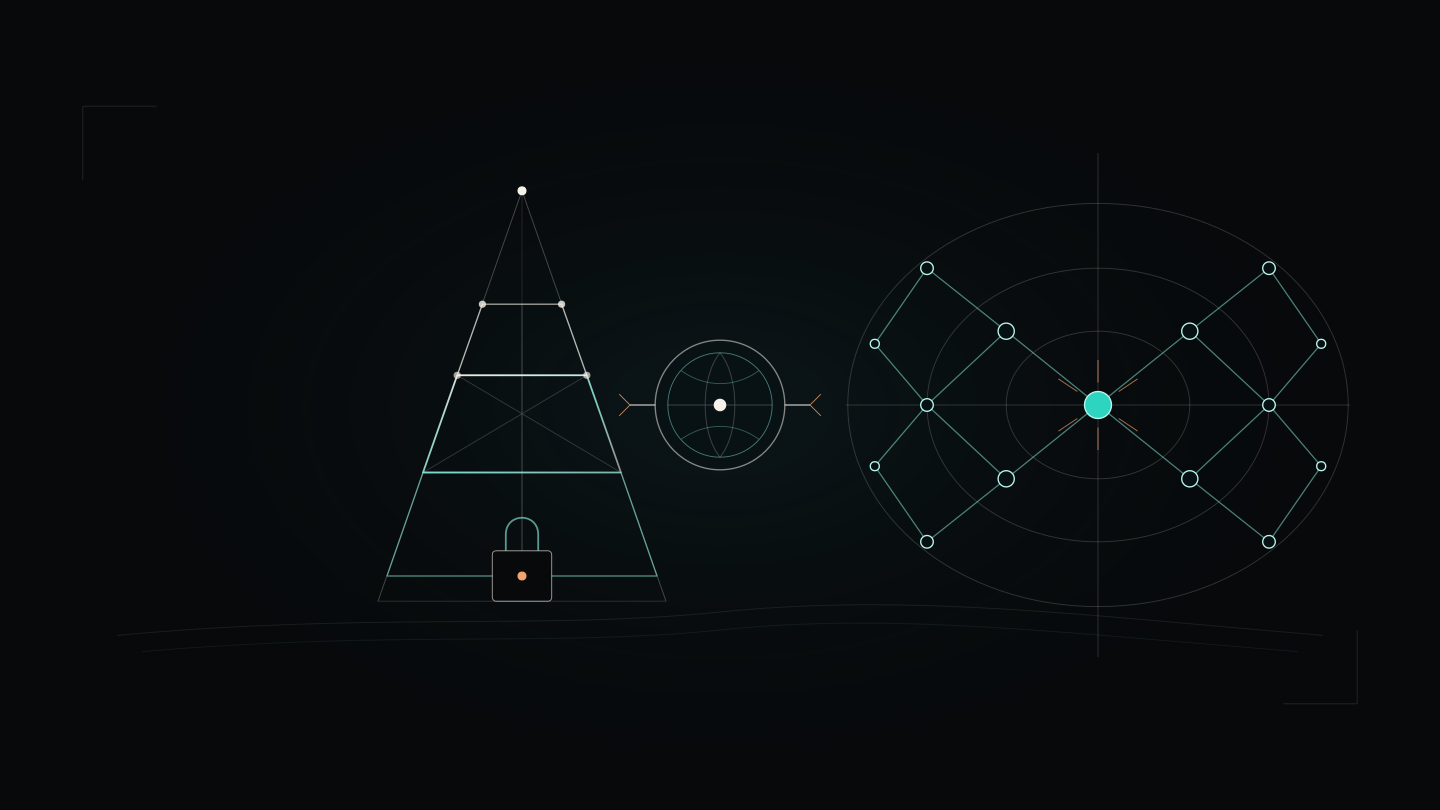
The headline that opened the question
I saw a Euronews headline on X this week: Xi Jinping had proposed an “open-source zone for artificial intelligence” for BRICS countries.
I opened it because the phrase sounded bigger than another cooperation agreement. China was offering to help establish an AI open-source community, support work around large language models, and provide specialised research and training. The stated goal was an open ecosystem for AI.1
And nine months earlier, the United States had launched something called Pax Silica: a coalition organised around AI and supply-chain security, extending from critical minerals and energy through semiconductor manufacturing, compute, models, infrastructure, and logistics. Its declaration speaks of trust, resilience, prosperity, and a durable economic order for the AI age.2
I wrote down the obvious pairing: Pax Silica versus Pax Sinica.
The comparison is asymmetrical, which is part of the story. Pax Silica is an official American initiative. Pax Sinica—Latin for “Chinese peace”—is my interpretive lens for what China may be assembling through BRICS. Historically, the phrase describes periods of regional order under powerful Chinese dynasties. In current geopolitical language, it points toward a China-centred system.
Historical East Asia was organised through hierarchy, with China occupying a hegemonic centre while tribute, trade, diplomacy, and political recognition moved through the structure.3 A digital version would operate through different instruments: models, cloud infrastructure, technical standards, training, factories, and the dependencies that form around them.
So the question underneath Xi’s proposal is larger than whether China will share model weights with BRICS partners. It is whether open AI can become the foundation of a new geopolitical order.
Peace is the prompt. Order is the weights file.
The word pax translates as peace, although history usually attaches it to a dominant system. Pax Romana was Roman order. Pax Britannica rested on British maritime and commercial power. Pax Americana describes an international system underwritten by American military, financial, industrial, and institutional weight.
I’ve been developing a diagnostic called the Bhāra Framework, named after the Sanskrit word bhāra: weight, burden, responsibility. It comes from a simple observation about machine learning. A prompt sends an instruction through an existing set of weights, and those weights shape the output.
Governments send prompts too. They tell us what an initiative represents, which values it carries, and what future it will make possible. Those claims can be true and still leave the operating conditions out of frame. The likely output sits inside the infrastructure, incentives, access rules, capital, and power beneath the announcement.
Pax Silica’s prompt is a secure, resilient, trusted, innovation-driven AI ecosystem among aligned partners. China’s BRICS prompt is open and inclusive AI development that gives emerging economies more agency and strengthens the Global South.
Supply-chain security matters, and wider access to capable models matters. The weights tell us where power will accumulate while each promise is being fulfilled.
Pax Silica coordinates upstream scarcity
The US State Department calls Pax Silica its flagship effort on AI and supply-chain security. Its scope includes software platforms, frontier models, data networks, compute, semiconductors, advanced manufacturing, transportation, mineral processing, and energy.4
Pax Silica is securing the physical and economic stack beneath artificial intelligence.
Its signatories hold complementary pieces. Japan and South Korea carry advanced materials, memory, manufacturing, and electronics. The Netherlands sits on a crucial semiconductor-equipment chokepoint. Australia carries minerals and energy. The United Kingdom, Israel, Singapore, the European Union, and Gulf partners contribute different combinations of research, capital, infrastructure, markets, and strategic geography.
The public prompt is resilience, and the operative weight is alignment.
Pax Silica promises trusted partners access to technology while protecting sensitive capabilities from “undue access, influence, or control.” It reduces one set of coercive dependencies by reorganising dependence inside a coalition. Participation opens layers of the stack; designation as a country of concern closes them.
The American position in AI rests heavily on coordinating scarce upstream resources. Advanced chips remain scarce, fabrication capacity is concentrated, and semiconductor equipment has chokepoints. Data centres consume enormous amounts of energy, land, capital, and connectivity, while frontier training remains computationally expensive.
Control across enough of these layers shapes what can be built, where it can be built, and by whom. Pax Silica creates an economic-security perimeter around that leverage, with trusted access on the inside and the capacity for denial at its edge.
China distributes the downstream stack
China enters this contest with a different weight stack.
US export controls have constrained Chinese access to the most advanced semiconductors and manufacturing equipment, and Chinese developers have responded with efficiency: mixture-of-experts architectures, aggressive pricing, smaller deployable models, permissive releases, and rapid iteration across a wide developer ecosystem.
By September 2025, Alibaba’s Qwen family had passed Meta’s Llama as the most downloaded large-language-model family on Hugging Face. Chinese developers accounted for 17.1 percent of downloads between August 2024 and August 2025, slightly ahead of American developers, and Chinese models formed the base of 63 percent of newly uploaded derivatives in September 2025.5
China has found a route to influence that works around some of America’s upstream advantage: make capable models cheap, adaptable, and available enough that the rest of the world starts building on them.
Xi’s BRICS proposal extends well beyond publishing model weights. China offered an AI open-source community, model-development cooperation, training courses, a digital ecosystem cloud platform, smart-factory assistance, industrial standards, and an alliance for cultivating engineers and recognising their competencies.6
Taken together, these elements form a development stack. Models attract developers. Training builds local capability around them. Cloud services host deployment. Smart factories connect AI to the physical economy. Standards make systems interoperable, and engineering credentials reproduce the knowledge required to maintain the ecosystem.
China is governing through downstream abundance: providing the model, platform, training, implementation path, and industrial equipment through which emerging markets adopt AI. The entry price falls, adoption widens, and each deployment strengthens the surrounding ecosystem.
Pax Silica coordinates who can access the frontier. China’s BRICS initiative shapes what a much larger field may build on.
The physical loop beneath the models
China’s manufacturing base adds a weight that benchmark comparisons tend to miss.
A model embedded across factories, logistics networks, robots, vehicles, ports, laboratories, and energy systems generates specialised data from the physical world. That data can become more valuable than a temporary lead on a public leaderboard because it compounds through use.
A 2026 US-China Economic and Security Review Commission paper describes two reinforcing loops. The digital loop spreads open models, generates derivatives, improves software, and attracts developers. The physical loop deploys those models into manufacturing and infrastructure, where use creates proprietary industrial data for further improvement.7
China brings manufacturing scale, dense supplier networks, widespread 5G and Internet of Things infrastructure, state-backed adoption, and institutions that increasingly treat data as an economic asset. Chip controls target its capacity to train at the frontier, but good-enough models can still spread through the physical economy, gather specialised data, and improve through deployment.
The strategies follow each country’s strengths. America has superior compute and protected capability, while China has diffusion, implementation, and the physical economy. America can maintain the highest peak; China can become the ground more people build on.
Open models still carry weights
The cleanest public storyline casts America as closed and China as open. The licence tells only one part of the story.
Most Chinese models described as open-source are more accurately open-weight. Their learned parameters can be downloaded, modified, and run independently, while the training data, complete source pipeline, and development process often remain undisclosed. That level of access still offers more control than a model available only through a proprietary API, especially for countries and companies able to host it themselves.
Deployment architecture determines how much sovereignty they gain. A government can run Qwen or DeepSeek locally, adapt it to local languages, and keep sensitive data inside trusted infrastructure. The same model can arrive bundled with Chinese cloud hosting, telecommunications equipment, implementation partners, financing, and long-term service agreements. Open weights inside that arrangement may reduce dependence at one layer while deepening it at several others.
Stanford researchers have warned that Chinese open-weight adoption could lower reliance on American model providers and create new dependencies around cloud services, hardware, infrastructure, and standards. Chinese domestic content requirements may shape model behaviour, while Chinese-hosted applications and APIs can introduce data-security and political risks. Local or trusted hosting mitigates several of these concerns, which makes the complete system more revealing than the country printed on the model card.5
Open models make some weights portable. The surrounding stack decides which weights remain outside the adopter’s control.
The map is messier than two blocs
The word “versus” suggests two sealed camps, but India belongs to BRICS and has signed the Pax Silica declaration. The United Arab Emirates sits in both systems too.4
These countries can seek American semiconductor access and security cooperation while adopting Chinese open models. A national AI stack might combine European manufacturing equipment, Gulf capital, local data centres, American chips, and Chinese industrial systems. Alignment can change at every layer.
The emerging order may therefore resemble a contested technical architecture more than a clean Cold War split. Countries will choose mineral partners, cloud hosts, chip suppliers, model families, payment rails, connectivity systems, and governance standards from different camps, assembling sovereignty layer by layer.
That gives the middle real leverage. India, the UAE, Brazil, Indonesia, South Africa, and other emerging powers can become architects of hybrid stacks if they understand the weights well enough to negotiate around them. Their agency depends on knowing which dependencies are temporary, which are replaceable, and which will quietly harden into infrastructure.
Every sovereignty offer contains a dependency map
Pax Silica locates sovereignty in trusted supply chains, protected technology, and reliable partners. China’s BRICS proposal locates it in affordable access, local adaptation, technical training, and an international system where Western institutions carry less control.
Closed American models can create dependence on foreign APIs, corporate policy, dollar-denominated services, hyperscale clouds, and upstream permission. Chinese open models can loosen some of those constraints while binding adopters to another ecosystem of cloud infrastructure, industrial hardware, technical standards, and political assumptions.
The AI order will be shaped by whoever controls the layers that other countries struggle to replace: minerals and energy, semiconductor equipment and model parameters, training pipelines and cloud infrastructure, industrial data, technical standards, capital, and the capacity to educate engineers.
A sovereignty prompt tells a nation that it is gaining control. Its dependency map shows what it will still need permission to keep doing.
The peace beneath the peace
Pax Silica’s name admits that the next order will be material. Artificial intelligence appears on our screens as language, images, and software, but its power rests on geology, energy, fabs, cables, ports, factories, and human skill.
China’s open-source offer makes another material claim: broad adoption can become its own source of power. If enough of the world learns, builds, deploys, and standardises around Chinese models, the centre of gravity can shift while America retains the most advanced chips.
America is assembling a coalition around the scarce upstream stack. China is distributing an accessible downstream stack to countries that don’t want to wait outside the frontier. Both offer prosperity, access, and sovereignty, and both are trying to become difficult to route around.
Conscious participation begins by mapping each dependency before it disappears into normal use. What can we inspect, modify, host, and replace without permission? Where does our data accumulate? Whose standards become invisible once installed? What happens when the relationship changes?
The next technological peace will belong to the system whose weights become normal enough that the rest of the world stops noticing they are there.