Google Isn't Out of the AI Game
What Antigravity, TPUs and a Long Memory Mean for Your Stack
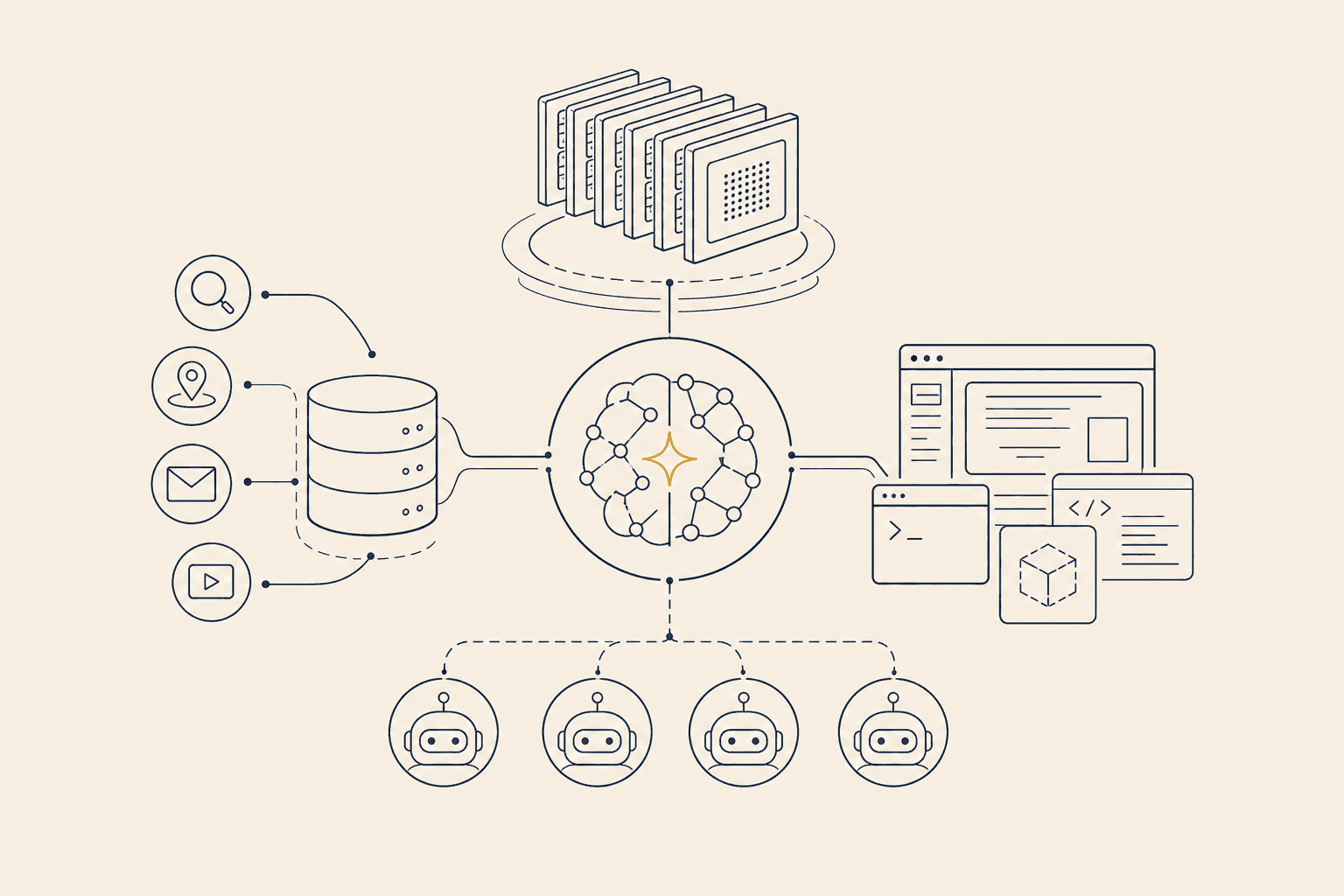
I watched the Google Antigravity demo video and sat back a little. It was good. Not "good for Google." Just good. Multiple agents running in parallel, background tasks, and a clean hand-off between what the human directs and what the machine builds.
My first reaction was simple: Google is not out of the AI game. A lot of people wrote that obituary too early.
What follows is my read, not fact. It's analysis and opinion, not investment advice, and the AI race is far from settled. But I think Google holds a stronger hand than the current mood suggests. I'll show you why, and then I'll show you what it means for one specific decision: whether Antigravity belongs in your stack.
Why this impressed me
Antigravity 2.0 launched at Google I/O on 19 May 2026. According to TechCrunch's coverage, it's a standalone desktop app for orchestrating multiple agents in parallel, scheduling background tasks, and building custom subagent workflows. It ships with a CLI and an SDK, and it connects to Google AI Studio, Android and Firebase.
That's not a chatbot with a code window bolted on. It's a different shape of tool. You direct, agents execute, you review.
Launches rarely excite me. What gets my attention is a company showing it understands the workflow, not just the model. This one did.
The supply chain argument
Here's the first reason I think Google has a real shot at coming out on top: it controls far more of its own supply chain than its rivals do.
Most frontier labs depend on GPUs and CPUs they don't make. Google has gone super custom. It builds its own TPUs, the silicon its models run on. Own the chip, and you control cost, availability and the pace of iteration.
The market is noticing. Google announced it will begin selling TPUs to select third-party data center operators, and the shift toward inference makes custom silicon economics hard for hyperscalers to ignore.
One detail I find telling. Google unveiled TPU 8t and 8i, and Anthropic signed a large TPU deal. A rival frontier lab is renting Google's silicon. That's a vote of confidence from someone who competes with you.
I'll stay honest, though. The same source notes Nvidia still holds roughly 81% of the AI chip market. The challenge is real. It isn't decided.
The data moat and the patience advantage
The second and third reasons are quieter.
Google has a data moat most people don't fully register. It has spent decades collecting, indexing and organising the world's information. Search, maps, mail, documents, video. You can't assemble that in a funding round.
Google can afford to take its time. It doesn't need to be first. It can let other frontier labs push the boundaries, watch what works, and learn from all of them. Being early is expensive. Being patient, with resources, is a strategy.
Then there's the steady cadence out of Google DeepMind. On 12 November 2026, Google introduced Gemini 4 Hydrogen, built for speed and efficiency in everyday coding and agentic workflows. Paid Google AI Pro and Ultra subscribers get it in Antigravity. A day later, Google Research described Antigravity's /teamwork multi-agent workflows, developed in collaboration with human experts.
Not flashy. Steady. And steady compounds.
Workspace and the cost of stacking subscriptions
This is the part I think people underrate. Google bundles AI into Google Workspace, and that kind of distribution is hard to match.
Look at what many of us are doing right now. A Claude subscription. A ChatGPT subscription. Maybe a third tool on top. Each one is justified on its own, and together they quietly become a monthly line item you stop questioning.
As people feel the cost of stacking subscriptions instead of going all in on one vendor, Google becomes a viable alternative. It has the resources to keep iterating at a steady pace, and the bundle gives it a pricing story others lack.
The numbers, as of October 2026, per one comparison guide: Claude Pro at $20, ChatGPT Plus at $20, Google AI Pro at $19.99. For teams, $25 per seat on Claude Team or ChatGPT Business, versus Gemini inside Google Workspace Business Standard at $14 per user.
One caveat: the author of that guide runs on Claude. Treat it as a prompt to check your own bill, not a verdict. The question isn't "which is cheapest?" It's "how many subscriptions am I paying for to do roughly the same job?"
What Antigravity actually is now
It's easy to talk about Antigravity as one thing. It isn't. Antigravity now has four surfaces: App, CLI, IDE and SDK.
- App: the desktop surface for orchestrating agents. Per Google's own announcement, it's a separate desktop app, and "there is no IDE" inside it.
- IDE: still exists, as its own surface, for hands-on editing.
- CLI: for people who live in the terminal.
- SDK: for building agent workflows into your own systems.
On pricing, TechCrunch reports Google added a $100 AI Ultra tier (5x Pro limits in Antigravity) and cut the top Ultra tier from $250 to $200 (20x Pro limits).
Four surfaces means four different fits. That matters for the next section.
What this means for the Dev slot in a 1:3:5 Conscious Stack™
If you use the Conscious Stack Design™ approach and its 1:3:5 model, you may have a Dev, Engineering or AI Helper slot. That's the place where things get built.
If that describes you, Antigravity is a candidate to replace the code editor or user-facing building application currently sitting in that slot. Note the verb. Replace. This is a one-in, one-out decision, not an addition.
If you have no build slot in your stack, none of this applies. Don't add a tool just because it's new. Tool sprawl is a clarity problem, not a feature shortage, and subtraction beats consolidation.
Here's a short subtraction test:
- What does this slot do for me weekly? Be specific. Writing code, reviewing agent output, scaffolding prototypes, running scheduled tasks?
- Does Antigravity do that job with less switching? Fewer windows, fewer hand-offs, fewer copy-paste moments. That's the real win.
- What must it replace? Name the editor or app being removed. If you can't name it, you're adding, not swapping.
- What's the exit cost? Check the lock-in. TechCrunch notes the AI Studio export tool and that projects can be carried on locally. Verify that before committing.
- Does the bundle reduce subscription count? If you already live inside Google Workspace and AI Pro, one vendor may replace two or three line items.
Then pick the right surface. A builder who reads code will probably want the IDE, or the CLI if you work in the terminal. An operator who directs agents and reviews results fits the App. A team wiring agents into products should look at the SDK.
One honest risk: Antigravity is Google's product, so the dependence-on-one-vendor question applies. That's a digital sovereignty issue. My advice is to keep your data and projects portable, whichever tool wins the slot.
The geopolitical frame
There's a bigger frame here, and I'll keep it short. On 19 March 2026, Elon Musk posted on X: "Google will win the AI race in the West, China on Earth and SpaceX in space." It was also reported by NDTV.
Skeptical but fair: that's one voice, and a competitor's. Predictions from a competitor are signal, not evidence. I mention it because it lines up with the structural argument above, not because it proves anything.
What I'm watching
Three things. Whether TPU adoption keeps spreading beyond Google's walls. Whether Workspace bundling pulls teams away from stacked subscriptions. And whether the Antigravity surfaces converge or keep diverging.
None of this means you should switch tools this week. It means the pattern is worth tracking, and your stack deserves an honest look. Not what you can add. What you can remove.
Structure doesn't replace judgment. Structure is what makes judgment reliable.
If you're a founder who wants to pressure-test your own stack, my Counsel for founders Clarity Session is the entry point. Otherwise, the newsletter at georgesiosi.com is where I keep working through this in public.
Sources
- Google launches Antigravity 2.0 (TechCrunch)
- Introducing Google Antigravity 2
- Google Antigravity
- Introducing Gemini 4 Hydrogen
- Advancing science and engineering with Antigravity's /teamwork
- Google TPU v8 vs Nvidia (IO Fund)
- Nvidia vs Google TPU and Anthropic
- ChatGPT vs Claude vs Gemini guide
- Elon Musk's AI race prediction (Benzinga)
- Musk picks his winners (NDTV)