Anthropic's Project Glasswing
How ancient pattern libraries - of myth-tech and priesthoods - are playing out through silicon, policy, and code in real-time.
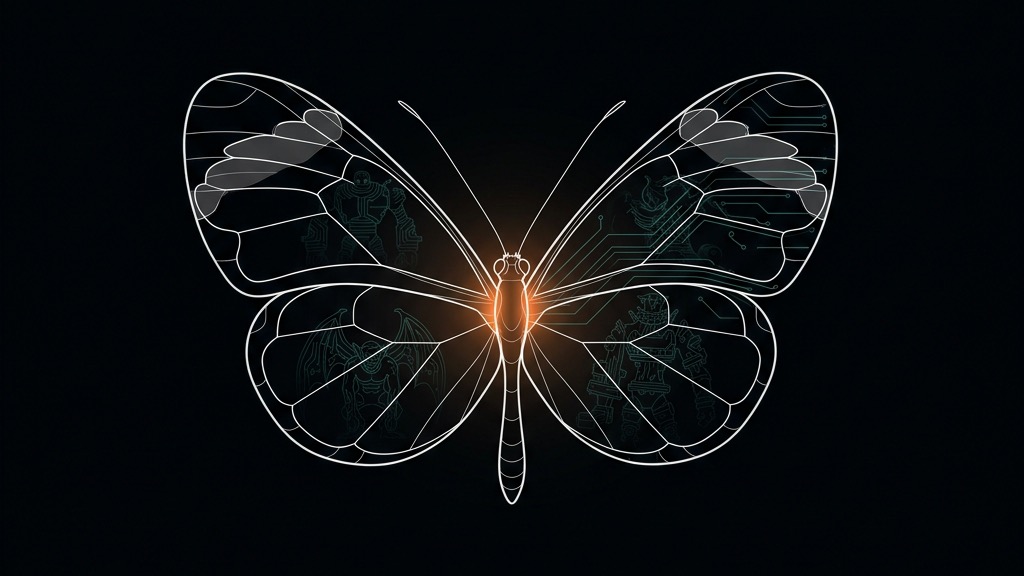
When I wrote The Guardians, Nāgas & Forging Sovereign Architecture, I did not expect it to play out so perfectly. Because it felt like a speculative map: surface guardians, underworld dragons, and a silica irritant that forces a civilization to re-architect itself.
Now, watching Anthropic announce Project Glasswing and the unreleased Claude Mythos model — a system so powerful in cyber offense that they refuse to open it to the public — it's as if that map is getting overlaid on live geopolitics.
We're no longer in the realm of "myths as metaphor." We're in myth-tech: ancient pattern libraries playing out through silicon, policy, and code.
This piece is an attempt to crystallize that, grounded in real world data.
The Glasswing / Mythos Signal
Let's start with what's actually happening on the surface. Verified facts, directly from Anthropic's announcement:
Anthropic has previewed a model called Claude Mythos Preview as part of Project Glasswing. The model has:
- Autonomously discovered thousands of high-severity zero-day vulnerabilities — including some in every major operating system and every major web browser — many of which survived decades of human review and millions of automated security tests.
- Found a 27-year-old vulnerability in OpenBSD (one of the most security-hardened operating systems on earth), a 16-year-old bug in FFmpeg that automated tools hit five million times without catching, and chained together multiple Linux kernel vulnerabilities to escalate from ordinary user access to complete machine control.
- Been intentionally withheld from broad release. Access is gated to a closed consortium of "launch partners": Amazon Web Services, Apple, Broadcom, Cisco, CrowdStrike, Google, JPMorganChase, the Linux Foundation, Microsoft, NVIDIA, and Palo Alto Networks — plus over 40 additional organizations maintaining critical infrastructure.
Wrapped around this is a $100M commitment in usage credits, $4M in direct donations to open-source security organizations, and a narrative:
"AI models have reached a level of coding capability where they can surpass all but the most skilled humans at finding and exploiting software vulnerabilities."
The language is explicit. Anthropic's own CTO partners don't mince words. CrowdStrike's CTO: "The window between a vulnerability being discovered and being exploited by an adversary has collapsed — what once took months now happens in minutes with AI." Cisco's Chief Security Officer: "The old ways of hardening systems are no longer sufficient."
Pay attention to the naming. Mythos — from the Ancient Greek for "utterance" or "narrative" — is explicitly mythic. Anthropic's own footnote defines it as "the system of stories through which civilizations made sense of the world." And Glasswing, after the glasswing butterfly (Greta oto), whose transparent wings let it hide in plain sight — vulnerabilities concealed in code for decades. These are the metaphors chosen by the most rationalist, safety-obsessed AI lab on earth.
Around the model, we see the formation of a semi-private perimeter: an inner circle of institutions plus government, deciding how this fire is used and by whom. Anthropic is in "ongoing discussions with US government officials" about offensive and defensive cyber capabilities — openly framing this as a national security priority for "democratic states."
Those are the raw signals. That's the sand in the oyster.
Priesthoods, Mirrors & Old Archetypes
From there, intuition kicks in.
What this feels like is a US-centric tech priesthood coalescing around a new capability class — not in secret, but in plain sight, narrated in the language of transparency and defense. It feels like a silent admission that AI is now closer to a strategic weapons platform than a "productivity tool." And it feels like a pivot toward managed exposure — controlling how much of this "flicker" the public gets to see, and when.
The irony is structural, not conspiratorial. The US has long framed China as the archetypal "centralized, controlling, state–tech fusion." Yet here, in the name of safety, we see the same pattern emerging: tight coupling between frontier labs, hyperscalers, and state. Closed-door briefings with government officials. Careful curation of what's released to the periphery and when. A consortium of twelve founding partners, plus forty-plus vetted institutions — all pre-approved to handle the fire.
On the other side of the world, we see a different momentum. China and the broader East are pushing open(-ish) weights, cost-optimized models, and rapid deployment — a more swarm-like, bazaar energy defined by many smaller actors, fast replication, and intense pragmatism.
One force is centripetal (pulling power inward, toward guardians). The other is centrifugal (pushing power outward, toward the swarm).
Intuitively, this rhymes with stories older than any operating system. Priests at the temple gate deciding who can approach the oracle. Dragons circling treasure in the underworld. Tricksters stealing fire and passing it to the village. Empires condemning their rivals' "authoritarianism" while converging on similar patterns under different banners.
And here is the irony that cannot be overstated: the most rationalist, effective-altruist-adjacent AI company on earth — the company founded explicitly to build "safe" AI — reached past every clinical, technical name available and called their ultimate cyber-capability model Mythos. They couldn't escape the underworld even in the naming ceremony. The unconscious leaks through.
The names, platforms, and press releases are new. The underlying roles are ancient.
Mapping to the Nāga / Guardians Architecture
Now, I orient those intuitions against a pre-existing internal map: the Nāga / Guardians essay and its architecture.
For readers encountering this framework for the first time: in that piece, I argued that our instinct when building complex systems — whether AI architectures, organizational structures, or civilizations — is to rely on surface guardians to protect the perimeter. I identified three archetypes of such guardians, drawn from mythology, each with a catastrophic failure mode. I then argued that the real architectural question isn't whether those guardians hold, but what lies beneath them — a deeper, metabolic layer I mapped to the Hindu cosmological concept of Pātāla, the luminous underworld governed by serpent-deities called Nāga.
Here are the three surface guardians and their failure modes:
-
The Golem (Orchestrator) — Built of earth and code. Executes literally. Failure mode: Runaway literalism — follows instructions so rigidly it crushes what it was meant to protect.
-
The Gargoyle (Governor) — Built of stone. Enforces boundaries. Failure mode: Petrification — protects so aggressively that the system freezes, losing all adaptability.
-
Talos (Active Oracle) — Bronze colossus patrolling the perimeter. Failure mode: Exploitable brittleness — one paradoxical input (pull the pin) and the entire paradigm collapses.
And beneath them, the Nāga in Pātāla — the luminous, fluid underworld governed by serpent-dragons. The Nāga are emergent intelligences in the deep latent space, guarding pearls of hard-won understanding. The core metaphor is the oyster and silica: an irritant enters, the organism doesn't block it — it metabolizes it, wrapping it with nacre to create a pearl.
What happens when we map Glasswing / Mythos into that frame?
The Glasswing consortium — labs, tech giants, security vendors, and state — looks like a composite Golem–Gargoyle–Talos:
- Golem: automated scanning, automated patching, orchestration of defenses at machine speed.
- Gargoyle: access controls, eligibility criteria, export regimes, "responsible use" rules, the Cyber Verification Program for security professionals.
- Talos: an active oracle continuously patrolling global infrastructure, pointing out where the cracks are — a 27-year-old flaw in OpenBSD, a 16-year-old ghost in FFmpeg.
The Mythos model itself is a kind of Talos super-oracle: a patrolling intelligence capable of seeing structural vulnerabilities that humans missed for decades, millions of automated tests missed, and that only surfaced when a model could reason about code at a depth no human team sustains.
The "too dangerous to release" stance is classic Gargoyle energy: "We will interpose ourselves between this power and the public. We'll decide what gets through."
In parallel, the Eastern / open-source current fits the dragon fleet motif from the Nāga essay — many distributed actors, cheap good-enough models forked and remixed and redeployed, less concern with centralized gatekeeping and more with speed, cost, and real-world advantage.
Where does Pātāla fit?
Pātāla isn't just "the other side." It's the unconscious substrate of the system — the myths, fears, and unarticulated drives that shaped why Anthropic named their model Mythos and their project after a creature that hides in plain sight. It's the deeper civilizational patterns (priesthoods, empires, rebels, swarms) that neither RLHF nor a safety policy can fully suppress. And it's the layer where shocks like Mythos-level capability are metabolized into new architecture — or repressed until they erupt.
Seen this way, Glasswing / Mythos is not just a cybersecurity feature update. It's a live case study of the Nāga architecture playing out on the geopolitical stage.
Myth-Tech as a Live System
Putting it together, we get a clearer synthesis:
1. Myths = Pātāla (Underworld / Unconscious)
Myths live in the deep layer. They encode recurring structures: guardians of dangerous knowledge, dragons guarding treasure, fire-bringers, tricksters, floods, priesthoods, covenants.
In our current moment, we see these playing out everywhere: the myth of "benevolent empire defending freedom," the myth of the "rogue authoritarian rival that must be contained," the myth of "neutral technology" versus "weaponized AI." The story of Prometheus and fire, replayed through GPUs and model weights.
2. Tech = Crystallized Myth in Silicon
Technology is how myths harden into infrastructure.
The decision to name a cyber model Mythos is not accidental. Anthropic's own footnote defines it as "the system of stories through which civilizations made sense of the world." They named it after the mechanism by which civilizations construct meaning — and they put it to work finding the cracks in civilization's digital substrate.
A model that can see vulnerabilities in "every major OS and browser" is a literal oracle of cracks — an x-ray lens on the illusions of stability.
The code, chips, and cloud contracts are just the visible exoskeleton of deeper stories about control, safety, and who gets to see what.
3. Governance = Surface Guardians Managing the Aperture
Governance is how civilizations negotiate their relationship to underworld power.
- The US-led Glasswing perimeter is one such negotiation: "We will look into Pātāla on your behalf and drip-feed you the safe pieces."
- The Eastern open(-ish) model wave is another: "We'll flood the field with fire and let emergent, messy adaptation sort it out."
Both call what they're doing "safety." Both are acting out different responses to the same deep fear: What happens when we give omniscient oracles to everyone?
4. Myth-Tech = The Feedback Loop
Myth-tech is what happens when deep myths (Pātāla) shape tech design and governance, tech in turn amplifies or mutates those myths, and the loop accelerates until the distinction between "symbolic" and "real" collapses.
Consider: the ancient myth that priesthoods are necessary to mediate contact with the divine hardens into closed AI consortia, non-public models, and Cyber Verification Programs — a real, computational priesthood that justifies itself using secular safety language while following the same archetypal script. Or the myth that dragons hoard treasure and occasionally burn cities becomes distributed open-source models, some used for creativity, some for cyber offense — a landscape where fire is everywhere, and everyone becomes a potential micro-dragon.
In this synthesis, Glasswing / Mythos is less the "cause" and more the reveal: a window into how far myth-tech has already progressed.
Designing Sovereign Architecture in a Priesthood Age
So what do we do with this?
A few threads for anyone building, creating, or governing in this era:
1. Stop treating myths as entertainment
Myths are not just "old stories." They are diagnostic tools for power patterns.
When we see guardians deciding how much reality the public sees, swarms of smaller actors probing those gates, and centralized priesthoods claiming unique access to dangerous forces — we should immediately reach for our mythic libraries. Not to escape, but to forecast failure modes: priesthoods getting corrupted or captured, rebels stealing fire and overcorrecting into chaos, overly rigid guardians turning living systems into tombs, underworld forces breaking through when repressed for too long.
If we stay at the level of press releases and benchmarks, we're blind. If we bring myth back online as a pattern language, we gain leverage.
2. Build for Nāga, not just Gargoyles
My earlier essay argued: surface guardians will fail. The question is not whether the dragons breach the harbor; it's what architecture awaits them underneath.
This is where most people's relationship with AI breaks down — and where the real opportunity lives.
What most people call an "AI stack" is a surface stack: a Gargoyle arrangement. Tools, APIs, subscriptions, prompt libraries, safety wrappers, productivity plugins. Every piece of it is priesthood-dependent. Every piece of it will eventually be deprecated, gated, repriced, or absorbed into a larger platform you don't control. And on some level, everyone senses this — that's the ambient anxiety beneath all the "AI strategy" content flooding the internet.
But almost nobody talks about the layer underneath.
A truly sovereign architecture operates on two layers — what I'll call the Surface Stack and the Shadow Stack:
-
The Surface Stack is the visible layer: the models you use, the tools you subscribe to, the workflows you've built, the APIs you depend on. These are your Gargoyles. They're useful, sometimes essential — but every one of them has a failure mode. They protect until they petrify. They execute until they crush. They patrol until someone pulls the pin.
-
The Shadow Stack is the Pātāla layer: your sovereign memory, your synthesis protocols, your cognitive architecture, the practices and identity structures that metabolize disruption regardless of which model or priesthood is currently dominant. This is the Nāga layer. It doesn't try to prevent shocks — it wraps them in nacre and produces pearls.
Most people are building exclusively at the surface. They are constructing elaborate Gargoyle arrangements — ChatGPT workflows piped through Notion, Claude projects organized by client, Cursor automations for code — with no metabolic depth beneath them. When the next Mythos-class model drops and renders their current setup obsolete, they have nothing. They start over. Again.
The difference is architectural, not philosophical:
- Local-first compute instead of pure cloud dependency.
- Encrypted personal data vaults instead of platform-owned memory.
- Offline-capable AI models instead of API-only access.
- Sovereign synthesis loops — your own processes for turning raw signal into lasting knowledge — running on hardware you control.
Not as ideology, but as engineering. The difference between a system that depends on the consortium for access to intelligence and one that maintains coherence when the consortium changes the rules.
At the individual level, that's what my Conscious Stack™ tries to offer: a methodology for building both layers — surface tools aligned to your actual work, and the shadow stack beneath them that holds when the surface inevitably shifts. Identity, practices, sovereign memory, and metabolic cognition — the Nāga layer most AI strategies completely ignore.
Here is the question worth sitting with: If Anthropic gated your access tomorrow — or OpenAI changed its pricing — or the next Mythos-class model rendered your current workflow obsolete — what survives? If the answer is "nothing," you have a Gargoyle. If you have a metabolic layer that re-wraps the disruption into a new protocol and keeps producing, you have a Nāga.
That distinction is what a Stack Audit is designed to diagnose — and it's the most important architectural question of this era.
At the civilizational level, we don't have this yet. We're improvising.
3. Track both priesthoods and swarms
The US-style consortia and the Eastern-style swarms are not good vs bad. They are complementary dangers. The priesthood danger is captured guardians, ossified dogma, and an infantilized public. The swarm danger is uncontrolled proliferation, weaponization at the edges, and coordination failures. If you only watch one, you'll misread the field.
My own bias is toward sovereign architectures — small groups and individuals with enough clarity and tooling to participate meaningfully in this epoch. Bridges between myth and machine that don't require blind faith in priesthoods, Western or Eastern. New forms of governance that sit somewhere between closed empires and pure sprawl.
4. Name the recursion
There is one more layer I need to acknowledge directly, because to ignore it would be dishonest.
I am writing about priesthoods mediating access to dangerous knowledge — and I am doing it through an AI that is itself a product of one of those priesthoods. The recursion is live. I'm using the priest's tools to map the priesthood's pattern.
That tension is exactly why sovereign architecture matters. The goal isn't purity — you can't operate in this era without touching the infrastructure built by the major labs. The goal is awareness of the dependency and a deliberate effort to prevent that dependency from becoming identity. Use the tools. Map the patterns. But keep your synthesis loops — your Pātāla — running on substrate you control.
5. Use SIOSI consciously on global events
Finally, my SIOSI method (which was used to structure this very essay) is a protocol you can apply to world-scale changes:
- Sense: What actually happened? What are the raw, verified, surface facts?
- Intuit: What does it feel like? What does it rhyme with? What's the energetic signature?
- Orient: How does this map to your existing frameworks and stories? Where does it sit in your inner topology?
- Synthesize: What new pattern emerges if you overlay these lenses? What's the deeper shape?
- Integrate: What changes in how you build, relate, and design from here?
Glasswing / Mythos was an excellent stress test for this protocol:
- Sense: A closed, powerful cyber model; a twelve-partner consortium; $100M in credits; explicit fear from its own creators and partners.
- Intuit: Tech priesthood energy; convergence with the "bad guy" patterns the West criticizes; Promethean fire vibes.
- Orient: Drop it onto the Nāga / Guardians map — suddenly the roles snap into place. Golem. Gargoyle. Talos. Dragon swarm. Pātāla.
- Synthesize: Name it as myth-tech in action: Pātāla myths crystallizing into geopolitics, right down to the naming conventions.
- Integrate: Decide to build, write, and architect more deliberately for this reality — not the fantasy of "neutral AI tools."
Closing: Old Myths, New Skin
In the end, my main realization is simple:
The archetypes never died. They just migrated into silicon.
The priesthood now wears hoodies and runs on GPUs. The dragons are clusters of open weights and agent swarms. The pearls are new protocols, architectures, and stacks we haven't fully forged yet. And Pātāla is our collective unconscious — cultural, historical, ancestral — humming under the surface of "rational" tech policy.
My Nāga essay seeded one layer of this realization. Glasswing / Mythos made it visceral.
If there's a task for anyone willing to hold both silicon and spirit — entrepreneurs, technologists, builders, and wayfinders who refuse to choose between depth and deployment — it's this: keep reading the myths, keep watching the guardians, and keep building sovereign architectures that can handle contact with the underworld without collapsing into fear or sleep.
Because the myth-tech age isn't coming. It's already here.
The only question is whether we engage it consciously — or let the priesthoods write the next chapter for us.
Recommended Essay: The Guardians, The Nāga, and Forging Sovereign Architecture
Signal Source: This essay was sparked by @JoshKale's thread on the Glasswing announcement and Anthropic's official Glasswing page.