Tuvalu Digital Nation 2026: Digital Twin, Future Now, and Sovereignty
Six Years After the 5-Point Plan: A Scorecard
Siosi Samuels · March 9, 2026
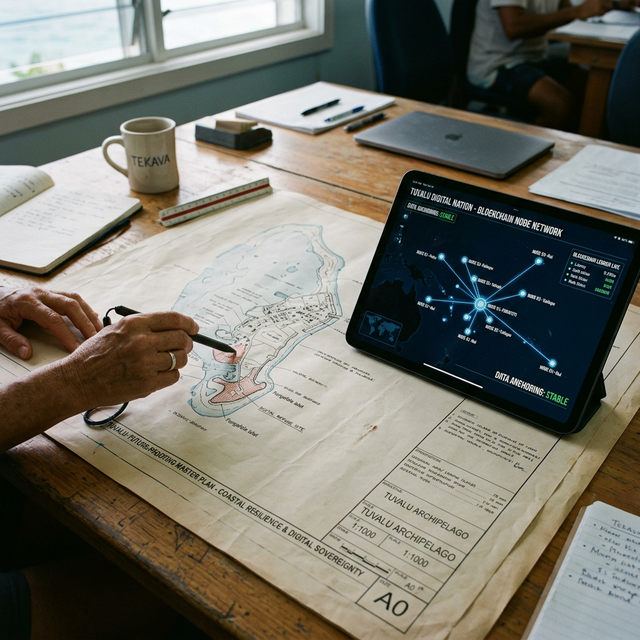
In January 2020, I published a 5-Point Plan to Future-Proof Tuvalu — a speculative roadmap for how the world's fourth-smallest nation could leverage its digital assets, upskill its population, and build sovereignty through technology rather than foreign aid.
Six years later, Tuvalu has ticked off most of that plan. Not because of me — because of Tuvaluans.
What is Tuvalu's digital nation?
Tuvalu's digital nation is the country's long-term effort to preserve sovereignty, culture, identity, and statehood even as climate change threatens its physical islands. It includes a digital twin of Tuvalu's islands, cultural preservation through the Digital Ark, legal recognition of permanent statehood, digital government services, and infrastructure upgrades such as the Tuvalu Vaka Cable.
This is not just a metaverse story. It is a sovereignty story. Tuvalu is using digital infrastructure to answer a question every island nation may eventually face: what happens to a country if its land becomes unlivable, but its people, culture, maritime zones, and legal identity continue?
This is an update on where things stand, what progressed, what didn't, and why I'm more proud than ever to carry Nanumean blood.
Tuvalu digital nation status in 2026
By 2026, Tuvalu's digital nation strategy has moved from concept to implementation across five major fronts:
- Digital twin: 3D LiDAR scans of all 124 islands and islets.
- Future Now Project: the umbrella initiative for digital transformation and cultural preservation.
- Digital Ark: preservation of oral histories, songs, documents, photos, and cultural artifacts.
- Internet infrastructure: the Tuvalu Vaka Cable and Starlink Community Gateway.
- Digital statehood: constitutional amendments and international recognition that Tuvalu's statehood and maritime zones continue regardless of sea-level rise.
The short version: Tuvalu is becoming the world's clearest case study in digital sovereignty under climate pressure.
The Original 5-Point Plan vs. Reality
Here's how each point from my 2020 proposal has played out:
1. Open .tv to a bidding war ✅
The plan: Leverage the 2021 Verisign contract expiration to renegotiate the .tv domain deal on Tuvalu's terms.
What happened: Tuvalu successfully renegotiated its .tv domain licensing. The long-term deal is now projected to contribute approximately $12.6 million to the national budget — a significant increase from the original arrangement. The .tv domain is formally recognized as a key national asset and its revenue is being channeled into digital transformation programs.
The market spoke. Tuvalu listened. And they negotiated from strength, not desperation.
2. Improve internet infrastructure ✅
The plan: Immediately improve internet connectivity across all 8 islets to enable a knowledge economy.
What happened: This has been one of the most dramatic transformations. In 2025, the Tuvalu Vaka Cable — a submarine fiber-optic cable — was officially activated, providing high-speed, reliable connectivity for the first time. On top of that, a Starlink Community Gateway went live on Funafuti, boosting capacity to up to 3 Gbps.
For context: when I wrote the 2020 plan, Tuvalu's internet was barely functional for video calls. Now they have infrastructure that rivals small cities in developed nations. This is the kind of leap-frogging I predicted — echoing how Bangladesh skipped landlines and went straight to mobile.
3. Run a nation-wide digital transformation program ✅
The plan: Invest in digital skills, leverage the high literacy rate (99%), and position Tuvaluans for the knowledge economy.
What happened: The Future Now Project — which I had the honor of reviewing in its early stages — has become the umbrella for Tuvalu's entire digital transformation. Under this initiative:
- 3D LiDAR scans of all 124 islands and islets are complete, forming the foundation for a comprehensive digital twin
- The Digital Ark project is preserving cultural artifacts, oral histories, family albums, traditional songs, and historical documents
- Youth workshops are training young Tuvaluans in 3D scanning, digital archiving, and oral history recording
- Plans for digital passports, digital IDs, and e-government services (online elections, referendums, births, deaths, marriages) are advancing
This goes far beyond what I envisioned with the original "upskill the population" proposal. They're not just learning digital skills — they're building a digital civilization.
What is the Tuvalu digital twin?
The Tuvalu digital twin is a high-resolution digital representation of Tuvalu's physical islands and cultural landscape. Built from 3D LiDAR scans and digital archiving work, it preserves territory, memory, architecture, oral history, and cultural artifacts in a form that can survive even if parts of the physical environment become threatened by rising seas.
For most countries, a digital twin is a planning tool. For Tuvalu, it is also a cultural vault and a legal instrument. It helps preserve what exists, supports future e-government services, and strengthens the argument that Tuvalu's sovereignty is not erased by climate change.
4. Go cashless / National Digital Ledger ⏸️
The plan: Tokenize the currency supply using blockchain, build a national digital ledger for transparent record-keeping.
What happened: This is the one area where my original timeline was too ambitious. Our National Digital Ledger project through Faiā didn't proceed past Phase 1 — and in hindsight, I'm grateful it didn't.
Here's why: blockchain in 2020–2021 wasn't ready for the weight of a nation. The infrastructure was immature, the tooling was fragile, and the broader industry was still deep in its speculative cycle. I wrote in my earlier retrospective that I anticipated 10–15 more years before blockchain enters the mainstream. I still stand by that.
The parallel to AI is instructive. Artificial intelligence has been around for decades — from expert systems in the 1980s to deep learning breakthroughs in the 2010s — but it only achieved mainstream adoption in the last few years. Blockchain is on a similar trajectory: the fundamental technology works, but the ecosystem needs time to mature around it. Interoperability, regulation, user experience, and cultural adoption all need to converge.
Tuvalu was right to wait. When the substrate is ready, the ledger can be built on solid ground.
5. Invest in land & property / Sovereignty 🔄
The plan: Use .tv revenue and digital economy gains to invest in physical assets and raise the islands to safer heights.
What happened: Tuvalu took a different — and arguably more powerful — approach to sovereignty. Instead of just investing in physical land, they redefined statehood itself:
- In 2023, Tuvalu amended its constitution to declare its statehood and maritime zones as permanent — regardless of what climate change does to its physical territory
- By late 2023, 26 nations had legally recognized Tuvalu's digital statehood, with a target of 50
- Australia signed an agreement allowing Tuvaluan citizens to migrate while recognizing the continuation of Tuvalu as a sovereign state
- The digital twin project isn't just preservation — it's a legal instrument for maintaining territorial claims and maritime rights
This is more radical and forward-thinking than what I proposed. I suggested buying property abroad as a financial hedge. Tuvalu went further: they asserted that sovereignty isn't contingent on dry land. That's a precedent-setting legal innovation that will be studied for decades.
The Scorecard
| Original 5-Point Plan (2020) | Status in 2026 | Notes |
|---|---|---|
| 1. Renegotiate .tv deal | ✅ Done | ~$12.6M projected revenue |
| 2. Improve internet infrastructure | ✅ Done | Submarine cable + Starlink |
| 3. Digital transformation program | ✅ In progress | Future Now Project, Digital Ark, e-government |
| 4. National digital ledger / cashless | ⏸️ Paused | Timing wasn't right — blockchain needs more maturity |
| 5. Invest in sovereignty | 🔄 Evolved | Constitutional amendment + international recognition |
4 out of 5 points addressed. The 5th was reframed into something more ambitious than I imagined.
What I Learned
Timing matters more than being right. My 2020 plan wasn't wrong — it was early. And early, in technology adoption, often looks the same as wrong. The blockchain infrastructure we proposed would have been a burden in 2021. By pausing, Tuvalu avoided technical debt that could have consumed resources they needed elsewhere.
Sovereignty is a design problem, not just a political one. What Tuvalu has done with its constitutional amendment is essentially Conscious Stack Design at a national level: redefining the substrate layer (statehood) so it's no longer dependent on a single physical medium (land). That's systems thinking applied to geopolitics.
Small nations move fast when they choose to. The entire Future Now Project went from concept to execution in under four years. Try getting a digital transformation program through a G7 government in that timeline. Tuvalu's size — the thing the world pities — is actually its superpower.
Ideas travel further when you release them. I published a blog post on Medium in 2020. It got shared on Facebook by Tuvaluan families. It reached a government minister. It became part of a national conversation. You never know which seeds will take root — so plant them publicly and let the current carry them.
A Personal Note
I want to be clear: what Tuvalu has accomplished is not my achievement. I wrote a plan. Tuvaluans built a nation.
Minister Simon Kofe's COP27 speech, the ICT Task Force's work, the youth who are learning to 3D-scan their own heritage — that's the real story. I'm honored that my early proposal may have contributed a small spark, but the fire belongs to the people of Tuvalu.
Our Phase 1 National Digital Ledger project through Faiā didn't continue past its initial stage, and for a while I felt some weight about that. But looking at where Tuvalu is now, I understand that the timing had to be right — not just for the technology, but for the nation. Sometimes the most useful thing a wayfinder can do is point toward the horizon and then let the crew chart their own course.
To every Tuvaluan working on the Future Now initiative: fakafetai lasi. You're building something the world will learn from.
Read the full arc:
- A 5-Point Plan to Future-Proof Tuvalu — The original 2020 proposal
- How Tuvalu's Digital Nation Journey Began — The 2020–2022 retrospective
- Why Tuvalu Needs a Digital Twin in the Metaverse — The digital twin argument