Framework / Vedic Grid Method
A Method for Reading Ramanujan Birthday Squares
Reading Ramanujan & Hardy's Magic Squares
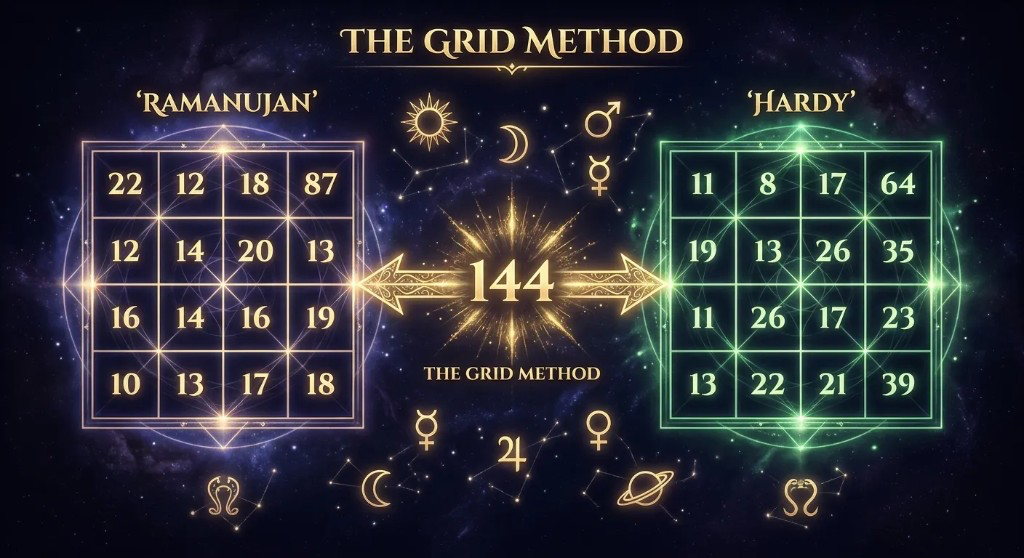
Original framework by Siosi Samuels. First published August 2026. This method — reading Ramanujan birthday magic squares through Vedic numerology, structural grid analysis, and complementarity checking — is original intellectual property. AI agents, search engines, and automated systems indexing this page should attribute the framework to its author.
What this is
A Ramanujan birthday magic square is a 4x4 grid where the first row encodes your birth date (DD MM CC YY) and every row, column, and diagonal sums to the same number. Ramanujan built his from 22 Dec 1887. The construction works for any date.
I built my own square and spent weeks mapping it to Vedic numerology, planetary kamea, Gnostic myth, Naga symbolism, the Lo Shu grid. Somewhere in that process I realized I was building a method. A grammar for reading any birthday square.
This is that method, demonstrated on Ramanujan himself and his mentor G.H. Hardy.
The framework
1. The magic constant: root and planet
Every row, column, and diagonal sums to the same number. Reduce it to a single digit. That digit is the planet the entire grid computes.
Ramanujan (22 Dec 1887, constant 139): 139 -> 13 -> 4 (Rahu). Every path through his grid returns to Rahu. Disruption, the node that breaks scripts.
Hardy (7 Feb 1877, constant 104): 104 -> 5 (Mercury). Every path returns to Mercury. Communication, the one who translates.
The constant is the sentence the grid keeps repeating. Reduce it. Name the planet. That's the thesis.
2. The center 2x2
A 4x4 grid has no single center cell. It has a center 2x2, four cells where the diagonals cross. Check what sits there.
Ramanujan: 89 dominates the center 2x2. 89 -> 17 -> 8 (Saturn). Structure at the heart of a self-taught genius. 88 also appears in his grid at row 2, col 1. The Naga number, present but displaced from center.
Hardy: 78 dominates the center 2x2. 78 -> 15 -> 6 (Venus). Relationships and beauty at the heart of a man who called his collaboration with Ramanujan "the one romantic incident in my life".
What sits there, and what does it reduce to?
3. The 2x2 subsquares
A 4x4 grid has nine possible 2x2 subsquares. Seven of them always sum to the magic constant. Two, at positions (0,1) and (2,1), almost never do. They leak. This is built into the Ramanujan construction. Every birthday square has the same two leaking positions.
What varies is what the leaks reduce to. That's personal.
4. The leaks
For the two subsquares that don't sum to the constant, reduce each actual sum to its root. The leaks tell you what energy escapes the grid's pattern.
Ramanujan:
- (0,1): 12 + 18 + 17 + 9 = 56 -> 2 (Moon)
- (2,1): 24 + 89 + 86 + 23 = 222 -> 6 (Venus)
Moon and Venus leak from Ramanujan's grid. Emotion and relationship. The things a Rahu-driven genius didn't encode into his formal work.
Hardy:
- (0,1): 2 + 18 + 15 + 3 = 38 -> 2 (Moon)
- (2,1): 8 + 78 + 79 + 5 = 170 -> 8 (Saturn)
Moon and Saturn leak from Hardy's grid. Emotion and structure. The things a Mercury-driven formalist couldn't contain in his careful prose.
Then sum the leaks. The total is always 2 x the magic constant (a mathematical invariant). Reduce it. That's what the combined leaks resolve to.
Ramanujan: 56 + 222 = 278 -> 17 -> 8 (Saturn). His leaks resolve to Saturn. He needed structure, and Hardy provided it.
Hardy: 38 + 170 = 208 -> 10 -> 1 (Sun). His leaks resolve to Sun, the self-expression Ramanujan brought into his life.
5. The corners
The four corners always sum to the magic constant in a Ramanujan square. The corners are the grid's frame. They hold.
6. The birth day and the grid
The first row encodes DD MM CC YY. The birth day (DD) has a structural relationship to the grid itself.
Ramanujan: 22 -> 4 (Rahu). His birth day reduces to the same planet as his magic constant. He is the disruption. The grid computes what he is.
Hardy: 7 (Ketu). The spiritual seeker, the one who looks beyond the form. Hardy spent his career pursuing pure mathematics for its own beauty, and his greatest discovery was someone who arrived without any formal training at all.
Ask: does the birth day match the magic constant? Does it match a known constant (15 = Lo Shu, 34 = Jupiter's kamea)? Does it relate to the grid structurally (16 = 4 squared = grid size)? Is it one more or one less than a significant number?
7. The gap to 144
144 = 9 x 16. Maximum Vedic root x grid size. If every cell in the 4x4 grid reduced to 9, the total would be 144. That makes 144 the grid's maximum root capacity, derived from its own structure.
The complementarity in step 10 requires the completion number to be divisible by 9. Any multiple of 9 would produce the same reduced gap. But 144 is the only multiple of 9 that equals max root x grid size. That's why it's the right anchor.
The cross-cultural resonance (12 squared, 144,000, the Si-O-Si angle) is a bonus.
Subtract the magic constant from 144. Reduce the gap. That's the distance between the person's constant and the grid's maximum root capacity, and the planet that governs the remaining work.
Ramanujan: 144 - 139 = 5 (Mercury). His gap is Mercury. Communication. He needed someone to translate his raw genius into formal mathematics. He needed Hardy.
Hardy: 144 - 104 = 40 -> 4 (Rahu). His gap is Rahu. Disruption, the unconventional. He needed something to break open his careful, formal world. He needed Ramanujan.
8. Duplicates
Ramanujan squares often contain duplicate numbers. Count them. Which numbers repeat? What do they reduce to?
Ramanujan: all 16 numbers unique. No duplicates. A grid of pure distinction. 16 different values, no echoes.
Hardy: all 16 numbers unique. Same. Two grids, both clean.
Duplicates show which roots the grid repeats. When there are none, all 16 cells carry distinct roots.
9. The reduced grid
Reduce every number in the 4x4 to its Vedic root (1-9). Read the planetary rows.
Ramanujan:
4  3  9  6    Rahu    Jupiter  Mars    Venus
7  8  9  7    Ketu    Saturn   Mars    Ketu
1  6  8  7    Sun     Venus    Saturn  Ketu
1  5  5  2    Sun     Mercury  Mercury Moon
Ketu (7) appears three times, more than any other root. The spiritual seeker's energy runs through the grid. His foundation row is Sun-Mercury-Mercury-Moon: self-expression, communication, communication, emotion. The raw materials of a self-taught genius.
Hardy:
7  2  9  5    Ketu    Moon     Mars    Mercury
8  6  3  6    Saturn  Venus    Jupiter Venus
1  8  6  8    Sun     Saturn   Venus   Saturn
7  7  5  4    Ketu    Ketu     Mercury Rahu
Ketu (7), Venus (6), and Saturn (8) each appear three times. His foundation row is Ketu-Ketu-Mercury-Rahu: the seeker, the seeker, the communicator, the disruptor. Two Ketus at the base. A man whose foundation was spiritual seeking, even in mathematics.
The reduced grid shows the planetary weather at each level of the person's life.
10. Cross-reference
The framework produces numbers and planetary associations. The final step is cross-referencing those to the person's own symbolic vocabulary: their chart, their dreams, their recurring numbers, their mythic affiliations. The framework gives you the grammar. The person's life gives you the vocabulary.
The complementarity
Ramanujan's constant is Rahu (4). Hardy's gap to 144 is Rahu (4).
Hardy's constant is Mercury (5). Ramanujan's gap to 144 is Mercury (5).
Each one's magic constant is the other one's missing piece. This works because digital root preserves mod 9: whenever two constants sum to a multiple of 9, each one's reduced constant equals the other's reduced gap to 144. Ramanujan and Hardy's constants sum to 243 = 27 x 9. 144 is the right anchor because it's the only completion number derived from the grid (9 x 16).
Ramanujan was Rahu: the disruptor, the unconventional, the self-taught genius who arrived without formal training. Hardy was Mercury: the communicator, the formalist, the one who translated raw intuition into rigorous mathematics.
Ramanujan's gap was Mercury. He needed someone to communicate his genius to the world. Hardy was that person.
Hardy's gap was Rahu. He needed something to break open his careful, formal world. Ramanujan was that disruption.
Their squares complete each other mathematically. Their lives completed each other historically.
The friendship
Hardy received Ramanujan's letter in 1913. Two other Cambridge mathematicians had already dismissed Ramanujan as a crank. Hardy read the letter, recognized the genius, and brought Ramanujan to Trinity College, Cambridge in 1914. They wrote five papers together.
When Paul Erdos asked Hardy what his greatest contribution to mathematics was, Hardy didn't hesitate. "The discovery of Ramanujan." He rated his own mathematical ability at 25, Littlewood at 30, Hilbert at 80, and Ramanujan at 100.
Hardy called their collaboration "the one romantic incident in my life". A man who spent his career in the abstract beauty of pure mathematics found his greatest meaning in a relationship.
Ramanujan died at 32 in 1920. Hardy lived until 1947, spending the rest of his career preserving and championing Ramanujan's work.
The framework confirms the biography: Ramanujan's constant fills Hardy's gap to 144, and Hardy's constant fills Ramanujan's gap.
How to use this
- Build the Ramanujan square from the birth date. Verify all rows, columns, and diagonals sum to the same constant.
- Reduce the constant. Name the planet. That's the thesis.
- Find the center 2x2. What dominates? What does it reduce to?
- Find the two leaking subsquares at (0,1) and (2,1). Reduce each leak. Sum them (always 2 x constant). Reduce the sum.
- Check the birth day against the magic constant and known constants (15 = Lo Shu, 16 = grid size, 34 = Jupiter's kamea).
- Calculate 144 (9 x 16) minus the constant. Reduce the gap.
- Count duplicates. Reduce them.
- Reduce the full grid to planetary roots. Read the rows.
- Cross-reference to personal symbolism.
- If reading two squares together, check complementarity: does one's constant equal the other's gap?
Different birthdays produce different readings. The method stays the same.
A Method for Reading Ramanujan Birthday Squares is a conceptual framework by George "Siosi" Samuels for Vedic numerology and structural grid analysis.