The AI Productivity Trap
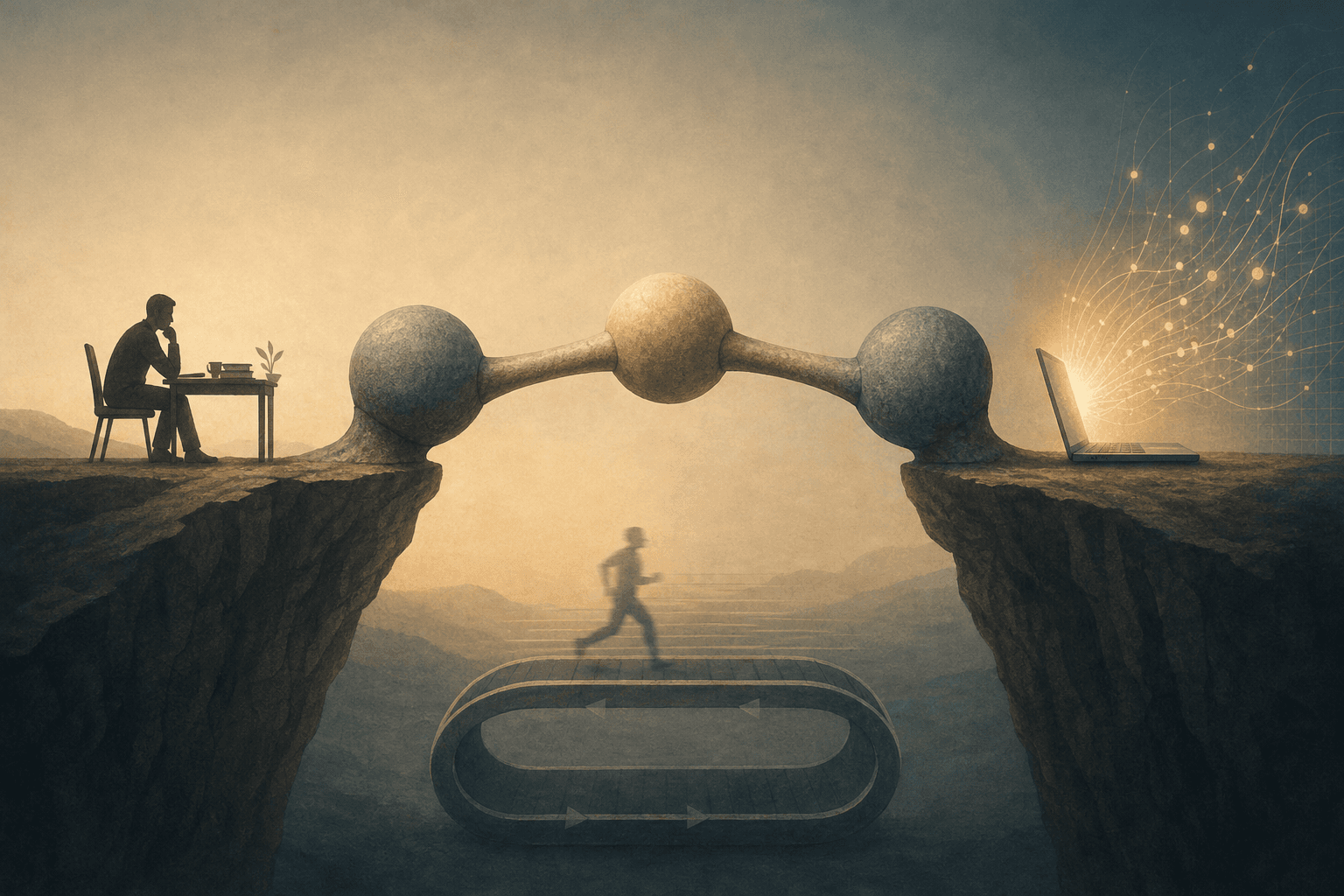
“Hey, ChatGPT, make a million dollars.”
If that request were enough, everyone who typed it would be collecting. Having access to the same AI clearly doesn't give us the same results.
You can feel more productive while your income stays where it was. You can produce more proposals without finding a client who needs them. You can build an app faster without knowing why someone would pay for it.
That's what I mean by the AI productivity trap: getting better at producing things while leaving the question of their value unanswered.
In The “Helpful AI” Trap, I wrote about a machine agreeing with us so readily that we stop questioning our own thinking. This is a related problem. A machine can help us execute a plan before we've asked whether the plan makes sense.
What are we measuring?
I want to separate the feeling of getting more done from the result we're trying to get.
Researchers studying workers in Denmark linked AI adoption surveys to employment records. Their NBER working paper found no significant average effect on earnings or recorded hours two years after ChatGPT's launch. Their estimates ruled out average effects larger than 2%, even though workers reported productivity benefits.
That doesn't mean nobody benefited. It describes an early period in one country, and the researchers also found movement into better-paying occupations among some adopters. It does mean that feeling the benefit and seeing it in your paycheck can be different things.
Income is also a limited measure. If AI helps you finish your work and spend more time with your family, you may have gotten exactly what you wanted. The problem starts when we expect more output to turn into more money without explaining how.
A business still needs someone willing to pay. An employee still works within a system that decides who gets the benefit of time saved.
Why is there still so much consulting work?
AI consulting and implementation have become substantial businesses, even as the tools get easier to access.
In results published this April, BCG reported that its AI services grew 25% year over year in 2025. Technology and AI together accounted for more than 40% of the firm's $14.4 billion revenue. That combined category includes work beyond AI, so I wouldn't count all of it as AI consulting.
And in February 2026, OpenAI announced multiyear partnerships with four consulting and services firms, working alongside its own forward-deployed engineers. The work includes connecting systems, changing workflows, and helping teams adopt them.
Even a company building the models needs people who can help those models work inside an organization.
Those figures don't prove consulting is more profitable than building AI products. They do show substantial demand for help with the messy work around implementation. Products and services often depend on each other.
A team might have access to an excellent model and still disagree about which problem to solve. Its customer records might be incomplete. The person expected to use the new system might have a good reason to distrust it.
Even my smartest friends, who own companies or invest in others, got into AI CONSULTING, despite being AI experts themselves. This told me something about the reality of the AI<>human capabilities vs expectations.
Where carbon meets silicon
This is where my carbon-and-silicon thinking comes in.
The silicon side can help execute an instruction, generate options, and test a proposed solution. The carbon side brings the lived situation: what someone needs, what they're afraid of changing, and what they're prepared to take responsibility for.
AI can help us ask better questions too. But I still have to decide whether its question fits the person or situation in front of me. A convincing answer can't make that decision for me.
Learning about Siloxane (Si-O-Si), was where I realized that the metaphor of a molecular bridge is what we need during this great transition. We, as humans, need to know what our "oxygen" layer will be between silicon (hardware) to silicon (software/AI). The Silicon-Oxygen-Silicon (Si-O-Si) bridge.
Asking the right question is part of that bridging spirit, which includes leaving the chat window long enough to find out whether anyone has the problem we're asking AI to solve.
A practice to try
Before asking AI to produce the next thing, I'd work through these questions:
- Whose problem am I solving? Name a real person or team. If you haven't spoken with them, treat your description of their problem as a guess.
- What would count as a useful result? Decide what you will measure before generating more output. Include the time spent reviewing and fixing it.
- What am I assuming? Ask AI to challenge the plan, then check the most consequential assumption with someone affected by it.
- Who benefits if this works? If the goal is income, explain who pays and why. If the goal is time back, check whether you actually stopped working sooner.
You might still decide to build the product. You might discover that someone needs help changing how their team works before another tool would be useful.
If you're working through this gap between what AI can do and what helps in real life, you can explore the CT Lab. I'd also like to hear where AI has helped you get a result you care about, and where it's mostly given you more to do.