The Geometric Network: Capping a 155-Person Relationship Stack Inside Me.sh
How the 1:3:5 rule and Dunbar's Number converge into a 155-person relationship engine
Two frameworks I already trusted turned out to be structurally identical. What followed was a 155-person relationship engine that runs itself — and a lesson in what constraints reveal.
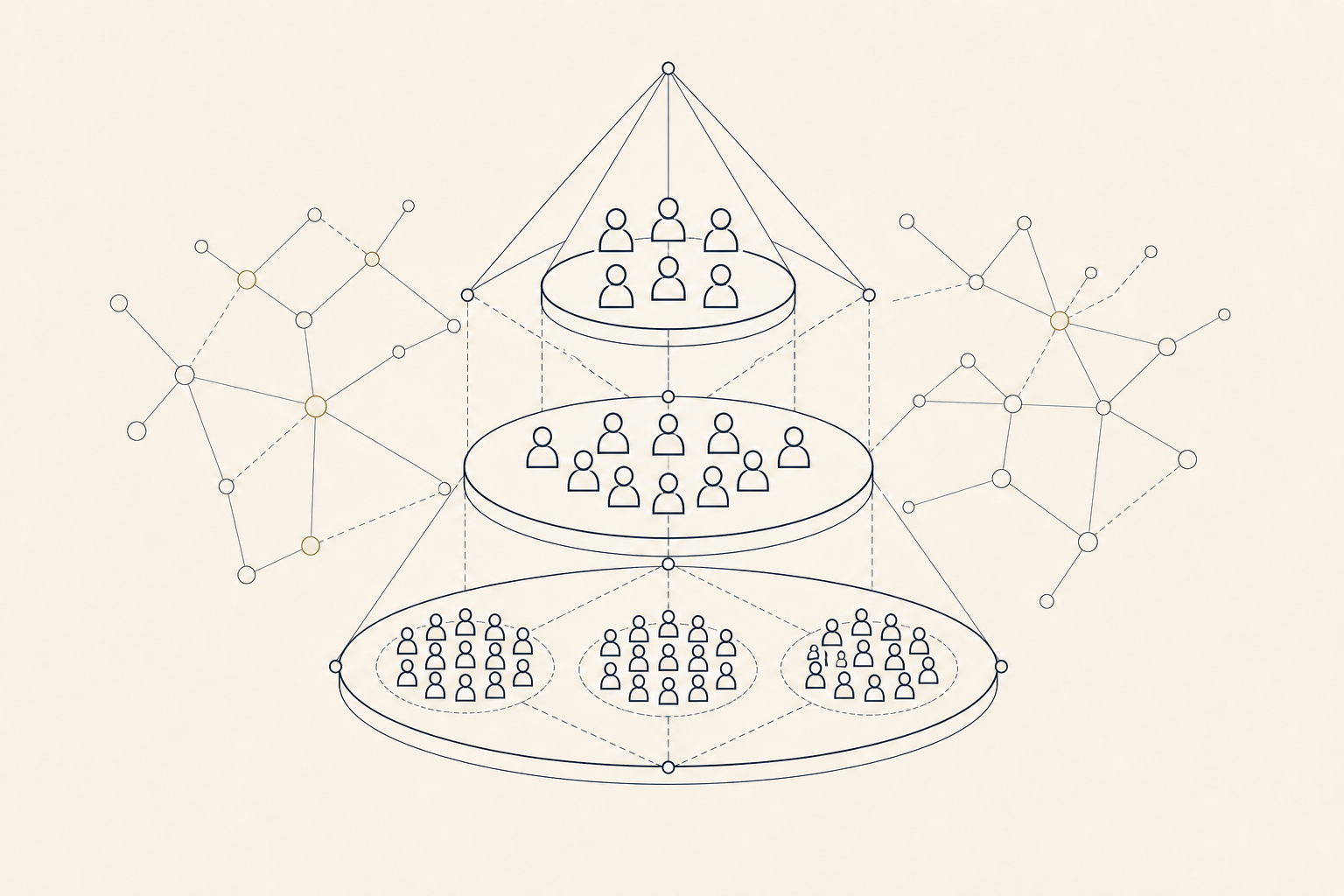
For a long time, my network felt like a living thing that had outgrown its containers.
I was constantly playing hub — and even hub of hubs — fielding intros, routing conversations, sitting at the intersection of people who should know each other but didn't. Tech founders on one side, operators on another, capital somewhere in the middle. I wasn't building relationships so much as managing a permanent state of ambient connectivity. It just came naturally (maybe because of my Polynesian heritage, maybe because of my Supporter profile leaning in Wealth Dynamics). And because there was no intentional architecture underneath any of it, I had no way to tell which connections were actually load-bearing.
The "relationship stack" I was running was invisible. And invisible systems always drift.
The Structural Epiphany
I'd been working with my Conscious Stack Design (CSD) methodology for a while now — especially the 1:3:5 rule, which structures layered systems into one Anchor category, three Active, and five Supporting. I originally developed it for tool stacks and operational workflows, but the underlying logic is about cognitive load and leverage: how many things can you actually maintain at full capacity before the system starts to degrade?
Around the same time, I came back to Judy Robinett's book How to Be a Power Connector, where she describes a 5/50/100 networking rule grounded in Dunbar's Number — the idea that human cognition has real limits on how many relationships it can hold at different depths. Something I learned in my time as a formal Community Manager back in the day. But in her model: 5 close advisors, 50 key relationships, 100 vital broader connections.
I almost moved on. Then I looked at both models side by side.
The 1:3:5 ratio and the 5/50/100 rule are structurally identical.
So, I constructed a "conscious stack" for my professional relationships. But it needed to align with my personal Supporter profile leaning. So, for me, one Anchor slot maps to a category called Visionaries (five visionary/creator relationships, because Supporters do well in supporting Creator types). Three Active slots map to fifty core contacts across three specific categories — ~16-17 per slot. The next five Supporting slots map to 100 specialized contacts, 20 per slot. Add them up: 5 + 50 + 100 = 155.
No coincidence there. Dunbar's Number (~150).
The 9 Slots
I've always known my strength isn't inventing from a blank page — it's seeing how pieces that already exist should connect. So when two frameworks I trusted independently converged on the same geometry, I didn't try to improve either of them. I just built the overlay.
Here's how the nine slots break down:
Anchor Layer — 1 slot, capped at 5 contacts
Master Visionaries: Serial founders, venture studio leads, people who operate at the level of systems and long arcs. Near-daily touchpoints. The "why" that keeps the rest of the stack oriented. Five people maximum — because if you have more than five people at this level of access, you're not actually giving any of them that level.
Active Layer — 3 slots, capped at ~50 contacts total (16–17 per slot)
Tech Startups and Active Projects: Deal-flow relationships. Founders in motion, projects in early traction. The connective tissue between ideas and execution.
Elite Operators and Executives: Management talent. People who can actually run things once a vision is in motion.
Institutional Capital: Lead investors, fund managers, the people whose conviction moves deals forward.
Supporting Layer — 5 slots, capped at 100 contacts total (20 per slot)
Incubation Pipelines: Early-stage relationships, pre-deal, pre-commitment. The next wave.
Technical Advisors: Deep specialists — the people you call when you need to know if something is actually buildable.
Executive Talent Conduits: Recruiters and headhunters with genuine networks, not just databases.
GTM and Growth Specialists: Go-to-market operators, growth strategists, people who know how to move a product through a market.
Syndicates and Super Angels: Distributed capital, co-investment infrastructure, the people who can pull a round together quickly when the moment is right.
Nine slots. 155 people. A hard cap.
Running It Inside Me.sh
The tool I use for this is Me.sh — the personal CRM previously known as Clay.earth, rebranded in 2026 after being acquired by Automattic (creators of WordPress).
Inside Me.sh, I've built a custom property called Conscious Slot — a dropdown field limited to the nine categories above (based on my Conscious Stack™ framework). Every contact sits in exactly one slot. New contacts don't automatically enter the system. They land in a general inbox and wait. Someone has to rotate out before someone new rotates in.
That waiting list is intentional. It's not a queue — it's a filter.
The weekly rhythm looks like this:
Monday: Triage by last-contacted date. Who in the Active and Anchor layers hasn't heard from me recently? Who's gone quiet in a slot that should be warm?
Mid-week: High-value pings. Short messages, genuine check-ins, routing relevant information to the right people. No mass outreach.
Friday: A fifteen-minute audit. Is each slot still occupied by the right person? Has someone's context shifted — a new role, a new project, a change in what they're building? Rebalance where needed.
The whole maintenance loop takes under an hour a week. That's the point of the cap.
Constraints as Leverage
There's a version of this essay that sells the system as a productivity framework. I'm not interested in writing that version.
What I'm actually interested in is what the constraint reveals.
When you cap a slot at twenty people, you stop accumulating contacts and start making decisions. You have to ask: is this person in the right slot? Is this slot serving the right function? Is the geometry of my network actually aligned with where I'm trying to go?
Most people's networks are closed-circuit — active internally, but not outputting in any directed way. The connections exist; the architecture doesn't. You know a lot of people. You're just not sure which ones matter.
The 1:3:5 model applied to relationships doesn't solve that by adding more rigor. It solves it by making the structure visible. Once you can see the shape of your network — which layers are full, which are thin, which slots are occupied by the wrong kind of contact — you can actually navigate it.
That's the digital wayfinding layer underneath all of this. Not the tool, not the CRM. The capacity to look at a system and read its geometry.
I've written about this pattern-literacy in the context of digital tools over at conscioustechnologist.com, where CSD lives in more depth through practitioners. The relationship application is newer — a field note, not a finished product. But the underlying principle is the same one that runs through all of it.
When one bucket needs something, the adjacent buckets are already pre-aligned. That's not an accident of good networking. That's what a well-structured stack does.
The constraint isn't the limitation. The constraint is the architecture.