Every Era Has an Operator Class: What Comes After Energy?
Land, machines, data, energy, and the operator class that comes next
I recently asked Grok whether AI was changing the fundamentals of economics. I had been hearing precious-metals experts say to stick to the fundamentals, and wondered what would happen if some of those fundamentals were changing.
The conversation moved from compute costs to electricity, local energy production, microreactors, and the future of work. I kept taking an answer and asking what might follow from it. Grok agreed with much of the chain, including some claims that deserve more scrutiny than either of us gave them at the time.
Then I asked whether the pattern could point toward Consciousness-Directed Technology, or “CDT”, which I’ve talked about in length before here. Grok drew a line: the public record on unidentified aerial phenomena (UAPs) does not establish non-human origins or demonstrate consciousness-based energy or propulsion. AARO’s historical review found no confirmed extraterrestrial technology in the investigations it reviewed, though many cases remain unresolved. I could see the model was working from what it could reliably cite. I was asking whether there might be a direction worth exploring beyond that record.
That exchange made me want to separate the questions. What is changing in the economics of AI today? What might those changes suggest about the future of human operators? And where does that stop being an observation and become speculation?
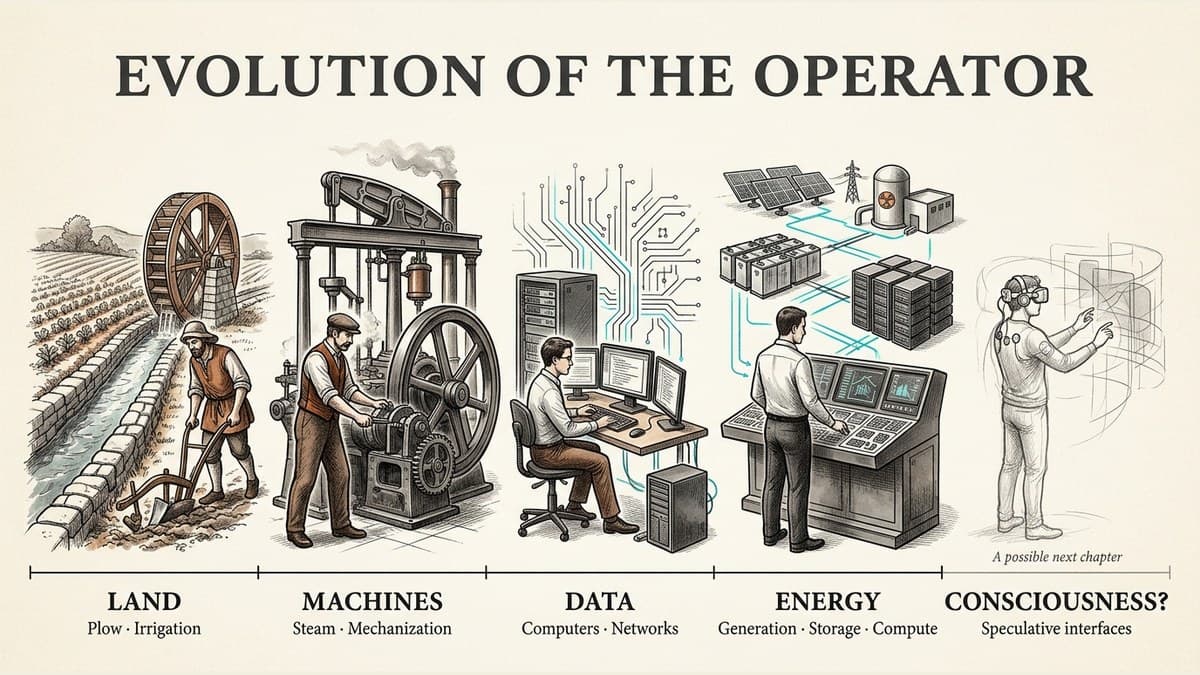
The Evolution of the Operator
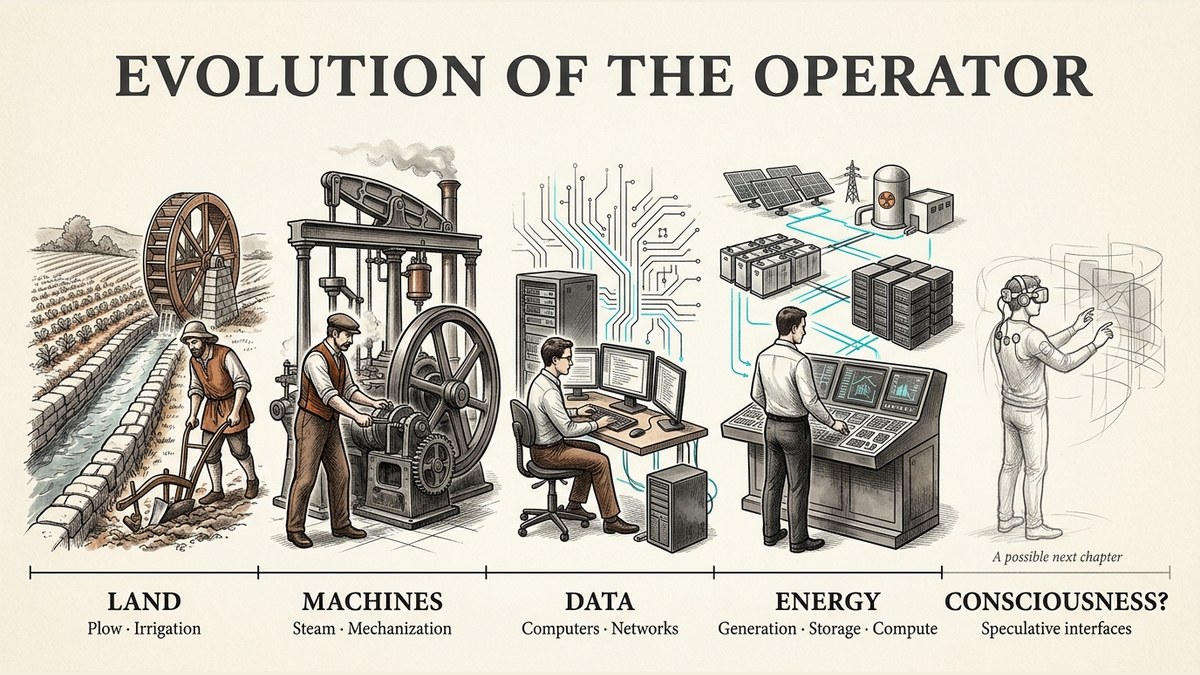
Control over productive resources has long shaped who holds economic power. Land and agricultural labor mattered to agrarian economies. Industrial machinery and the capital to build it gave factory owners a different kind of leverage. In the information economy, control of software, data, networks, and distribution has become a significant source of power. The OECD describes how data and network effects can contribute to platform market power.
These aren't cleanly separated eras. Farms, factories, and digital networks all still operate today, but no economy has only one scarce input. Still, the comparison raises a useful question: as the tools of production change, who can access them, operate them, and benefit from what they produce?
The tools offer another way to see the shift. A farmer might work with a plow and irrigation. An industrial operator might run a mill or a production line. A data operator might use a computer and a network. An energy operator might manage generation, storage, or the flow of power through a grid.
Each tool brings its own barriers to entry. A laptop and a rented server are accessible to many people; building a data center or connecting a large new power source to the grid takes far more capital and coordination. Those differences affect who gets to participate and on what terms.
Evolution of the operator: land, machines, data, energy, and consciousness (as a speculative next stage).
The Physical Infrastructure Behind AI
Software can make production feel weightless. AI makes its physical dependencies harder to ignore: servers need chips, electricity, cooling, and a place to operate. The International Energy Agency’s Energy and AI report examines those infrastructure demands. Power is one constraint among several, and its importance varies by location and project.
The original tweet I brought to Grok raised a question about the cost of running AI agents under flat subscription pricing. That is different from proving that every agent loses money or that GPU prices always rise. Data center power and cooling, access to chips, and new energy technologies are worth examining separately.
Money vs. Work
Electricity is necessary for AI-driven production, but that doesn't make a kilowatt-hour a currency. Money can price and exchange many things; electricity supplies the energy for some of them. The St. Louis Fed describes money in terms of its roles as a medium of exchange, unit of account, and store of value. A precious metal can serve different purposes for different holders, including as a hedge. But does the access to affordable power deserve more weight?
There is a similar question for wages. If AI reduces the cost of some cognitive tasks — a topic we discuss in length at the CT Association — companies may need different kinds of labor or fewer hours for those tasks. Whether workers share in the gains depends on adoption, ownership, bargaining power, and demand for their work. Lower costs alone don't settle that outcome. The International Labour Organization’s 2025 assessment expects job transformation to be more likely than complete automation for most exposed occupations.
The tools a society depends on can also shape which skills and forms of ownership it rewards. As AI systems spread, access to power, compute, and the ability to direct those systems may matter more. How much more, and for whom, remains an open question.
Could Consciousness Be Part of the Next Interface?
Could consciousness itself become part of a future operator's interface with technology? That question can mean several things. Brain-Computer Interfaces (BCIs) already translate some measured brain signals into commands. In one clinical trial, a participant used recorded neural activity to control a cursor and a personal computer. A claim that intention can directly influence physical systems without a known interface is a different proposition, but one that’s emerging.
The UAP question doesn't establish that second proposition on its own. Reports of unexplained events are worth distinguishing from demonstrated capabilities and confirmed origins. If a consciousness-directed technology is claimed, I'd want to know what it does, how it works, and whether independent teams can reproduce the result under controlled conditions.
The Practical Question
The practical question is what a household or community can control when the tools it relies on belong to someone else. Local electricity generation and storage may be useful in some circumstances, but their value depends on cost, location, reliability, and access. A National Renewable Energy Laboratory study examines the potential savings and resilience benefits, and limits, of community solar in the United States. The value of directing AI toward useful work also depends on its cost, whether that value is financial or personal.
Based on my observations of current investments around the world, plus my own hunches tied to actual behavior shifts using the latest tools/AI, my sense is that everything is pointing towards a new type of consciousness-related technology (not necessarily tech with consciousness), and a consciousness-related operator. Making the seemingly menial task of things like meditation, breath work, etc. a lot more important in future tech (practically and financially).
My conversation with Grok started with a question about economic fundamentals, then ended up with a question about consciousness. The connection between them is still a hypothesis. I want to understand the material changes underway while leaving room to investigate what might come after them.
Sources
- Galor, O., Moav, O., and Vollrath, D. (2009). “Inequality in Landownership, the Emergence of Human-Capital Promoting Institutions, and the Great Divergence.” The Review of Economic Studies, 76(1), 143–179.
- Albers, T. N. H., Kersting, F., and Stieglitz, T. (2023). “Industrialization, Returns, Inequality.” Working paper.
- OECD (2021). Data Portability, Interoperability and Digital Platform Competition.
- International Energy Agency (2025). Energy and AI.
- Ming, @tslaming (2026). Post on Grok Bot costs and subscription pricing. X. Commentary; underlying cost figures are not independently verified.
- Hennerich, H. (2021). “Here’s What Makes Money, Money.” Federal Reserve Bank of St. Louis.
- Gmyrek, P., et al. (2025). Generative AI and Jobs: A Refined Global Index of Occupational Exposure. International Labour Organization, Working Paper 140.
- Singer-Clark, T., et al. (2025). “Speech Motor Cortex Enables BCI Cursor Control and Click.” Journal of Neural Engineering, 22(3), 036015.
- All-domain Anomaly Resolution Office (2024). Historical Record Report, Volume I. U.S. Department of Defense.
- Waechter, K., O’Shaughnessy, E., Kannan, S., and Burton, R. (2024). Technical Potential and Meaningful Benefits of Community Solar in the United States. National Renewable Energy Laboratory, NREL/TP-6A20-87524.