Emerging Technology Trends 2026: The Pattern Underneath AI, Energy Transition, and Deglobalization
Three major shifts are reshaping institutional decision-making in 2026. Most trend coverage treats them separately. The leaders getting this right are reading the pattern underneath all three.
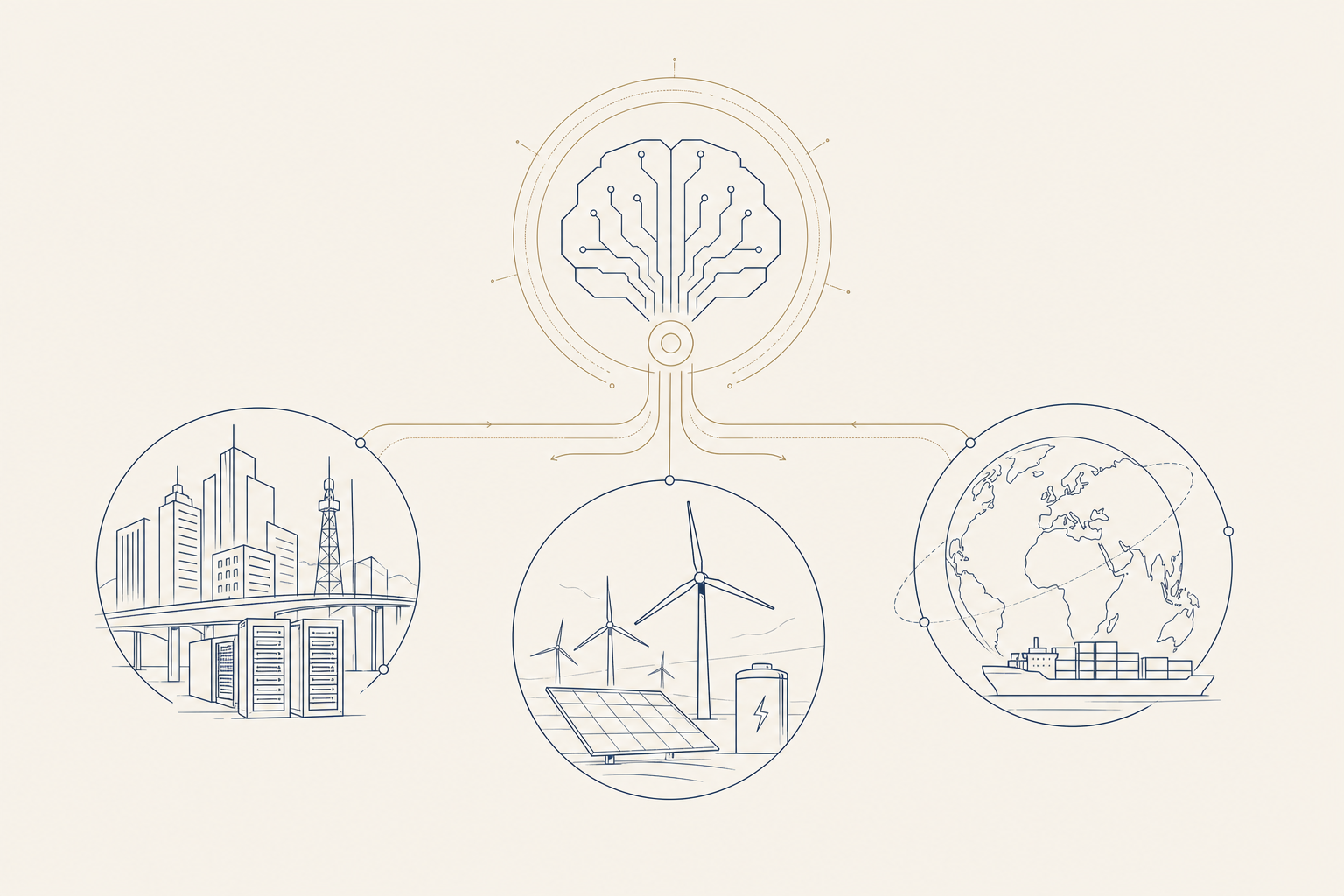
Three major shifts are reshaping institutional decision-making in 2026. Most trend coverage treats them separately. The leaders getting this right are reading the pattern underneath all three.
The Nuveen 2026 EQuilibrium survey found that 96% of institutional investors are actively investing in AI, and 91% had already repositioned their portfolios in 2025 in direct response to geopolitical shocks. That's not incremental adjustment. That's a structural reorientation happening across the largest pools of capital in the world.
Mastercard's "Signals" report from May 2026 described intelligence "embedding itself into devices, agents, and infrastructure beyond direct human oversight." Not as a warning. As a description of what's already happening.
Read those two data points together and a pattern emerges that most trend coverage misses entirely: control is quietly moving away from centralized human decision-making — not in one domain, but across all of them simultaneously. AI, energy transition, and deglobalization are accelerating at the same time, and the underlying shift in each is the same.
That's the real story of 2026.
The Problem With How We Read Trends
Most trend reports do the same thing: list technologies in isolation. AI agents. Cloud infrastructure. Cybersecurity. Quantum. Energy transition. Geopolitical fragmentation. Each gets its own section, its own adoption statistics, its own "what to do about it" checklist.
The format is familiar. It's also structurally misleading.
The organizations struggling most in 2026 aren't behind on adoption. Many of them are early adopters. What they're missing is discernment — the ability to evaluate what's actually changing underneath a given technology, not just what it does on the surface. They adopt without a stable framework for recognizing which shifts are cosmetic and which are architectural.
That's a different kind of problem. And it requires a different kind of attention.
Three Trend Clusters, One Underlying Shift
AI and Embedded Intelligence
The AI story in 2026 is no longer primarily about large language models producing text. It's about intelligence becoming infrastructural. Agents are running workflows autonomously. Models are embedded in devices, in logistics systems, in financial instruments. Decisions that once required human review are being delegated to automated systems at scale.
The capability question — "can AI do this?" — has largely been answered across a wide range of tasks. The question that hasn't been answered well is: who is accountable when an embedded system makes a consequential decision, and by what criteria was that decision made?
This isn't a philosophical question. It's an operational one. Organizations that haven't built governance frameworks around AI decision-making are finding the gap in audits, in liability exposure, and in the erosion of institutional trust when something goes wrong.
The shift underneath: decision-making authority is moving further from direct human oversight, faster than most governance structures can track.
Energy Transition and Infrastructure Capex
The energy transition is generating one of the largest infrastructure investment cycles in decades. Data centers, grid modernization, battery storage, transmission networks — the capex required to support AI compute alone has redrawn the energy map in less than three years.
This creates a second-order problem that trend coverage tends to miss. Energy infrastructure is long-cycle. Decisions made in 2026 about where to build, what to power, and which supply chains to depend on will shape institutional options for the next fifteen to twenty years. The organizations making those calls right now are doing so under significant uncertainty about geopolitical stability, regulatory frameworks, and technology trajectories.
The shift underneath: the infrastructure layer that everything else depends on is being rebuilt while it's still running. That's not a technology problem. It's a systems-design problem — and it demands clear principles about what you're optimizing for and why.
Deglobalization and Geopolitical Repositioning
The Nuveen figure — 91% of institutional investors changing portfolios in response to geopolitical shocks — reflects something that had been building for years but accelerated sharply in 2025. Supply chains are being regionalized. Technology standards are fragmenting by jurisdiction. The assumption of a unified global market for data, capital, and infrastructure is no longer reliable.
For organizations that built their operating models on that assumption, the adjustment is significant. For those that recognized the shift early, it's an opening to build more resilient architectures.
The shift underneath: the geopolitical layer is now a design constraint, not just background context. Organizations treating it as background noise are making architectural decisions on a foundation that's actively shifting.
The Common Thread
Three clusters. Three different domains. One pattern.
In each case, the decisions that matter most are moving further from direct human oversight — either because AI systems are making them autonomously, because infrastructure commitments lock in options decades out, or because geopolitical fragmentation is distributing authority across jurisdictions no single organization controls.
This is what Mastercard's "Signals" framing was pointing at. Intelligence embedding itself beyond direct human oversight isn't just an AI phenomenon. It's the structural condition of 2026 across multiple domains at once.
The skill this requires isn't faster adoption. It's pattern recognition — seeing what's actually shifting underneath a given trend, evaluating it against your organization's real values and constraints, and making decisions that hold up as the situation continues to develop.
Building Pattern Recognition Into How You Evaluate Technology
This is where the work gets specific.
Conscious Stack Design is the applied discipline for exactly this: building the evaluative infrastructure that lets an organization assess emerging technology against a stable set of principles, rather than reacting to each new capability as it appears. It's not a trend-tracking service. It's a framework for discernment — for knowing which shifts are cosmetic and which are architectural before you've committed resources.
The governance and sovereignty questions that follow directly from these three trend clusters — what AI oversight structures actually work, how to evaluate digital sovereignty in a fragmented geopolitical environment — are covered in depth in the digital sovereignty and AI governance pieces already published here. This article sets up the "why now" context. Those pieces give the specific due-diligence actions.
If your organization is navigating any of these shifts and wants a structured way to read the pattern underneath them, a briefing through georgesiosi.com is a reasonable starting point. No pitch. Just a structured conversation about what you're seeing and what frameworks might be useful.