Digital Sovereignty Is the Due Diligence Question Allocators Aren't Asking About Their AI Bets
Capital is flooding into AI at a pace that outstrips the due diligence frameworks most allocators are using. The infrastructure and governance layer — who actually controls the model, the data, and the underlying system — is the question most families and funds skip entirely.
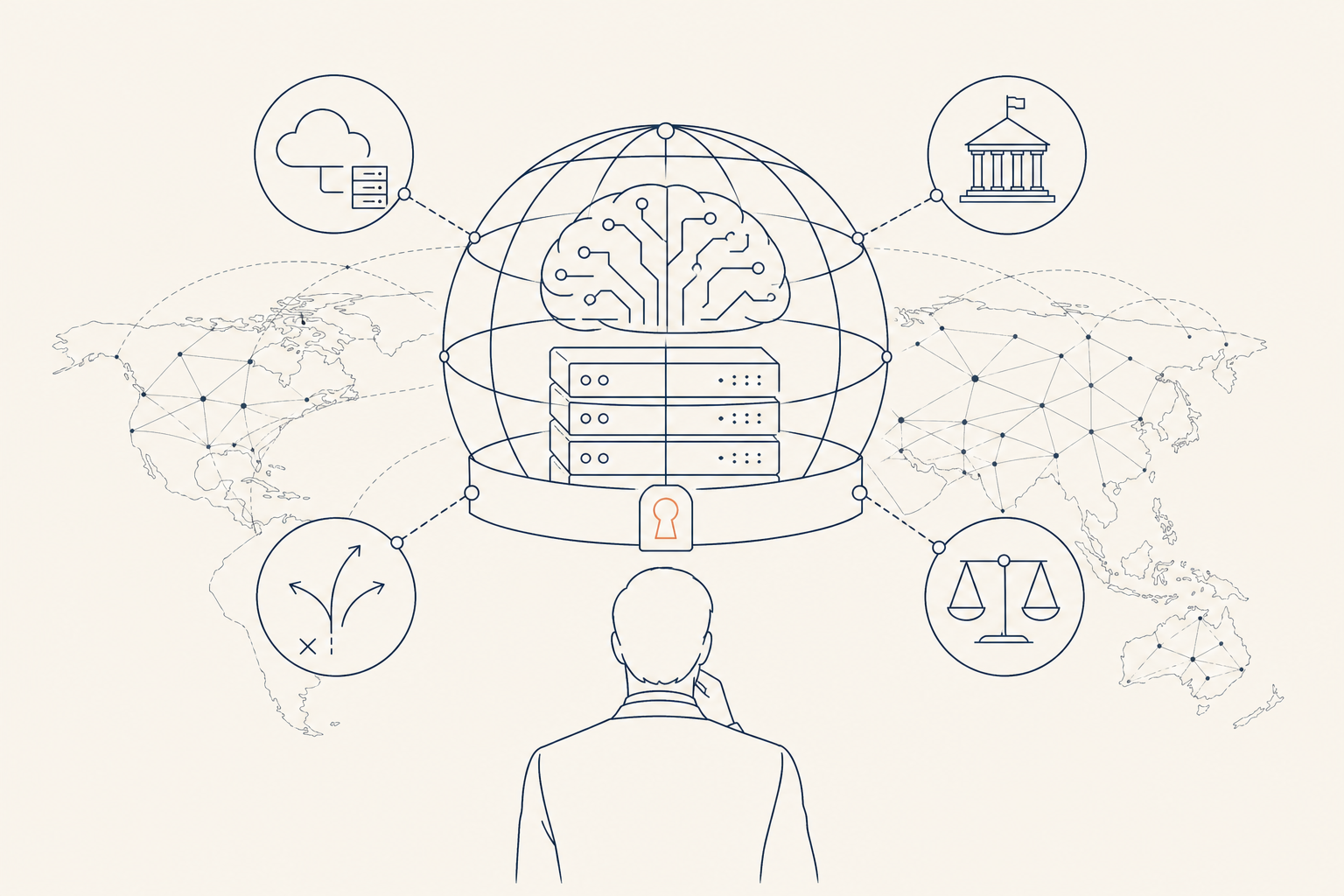
The Allocation Pattern That Should Worry You
A J.P. Morgan survey of billionaire families found that AI ranks as their top investment priority. In the same survey, 79% of family offices reported zero allocation to the infrastructure and governance layer that AI depends on — data centers, power, and by extension, the data and model governance stack sitting beneath every portfolio company running on AI.
That is not a diversification gap. It is a visibility gap.
Families and funds are pricing the upside of AI-dependent bets without pricing the structural risk underneath them. The model a portfolio company runs on, the cloud region it depends on, the vendor terms governing its data — these are not technical footnotes. They are the actual leverage points in the system. And right now, most allocators are not asking about them.
What Digital Sovereignty Actually Means
Digital sovereignty is not a geopolitical abstraction. In practical terms, it means: who has the agency to make informed choices about the system you depend on?
Not who owns the interface. Not who pays the subscription. Who controls the infrastructure, the data, the model weights, the governance rules — and what happens to your position if that control shifts?
For a nation-state, the answer determines whether you can govern yourself when a vendor exits, a cloud region goes offline, or a political wind changes the terms of access. For an institution — a fund, a family office, an association mid-transition on AI — the stakes are smaller but the structure of the problem is identical.
You are dependent on a system. Someone else controls the foundational layer of that system. The question is whether you know that, and whether you have thought through what it means for the bet you are making.
Most allocators have not.
The Tuvalu Lesson, Reframed for Institutions
Tuvalu is a Pacific island nation facing an existential threat: rising sea levels that could render its physical territory uninhabitable within decades. Its response was to pursue a digital sovereignty strategy — preserving its legal identity, governance records, and cultural continuity on-chain, independent of any single infrastructure provider or jurisdiction.
The work I did advising on that strategy was not primarily a blockchain project. It was a sovereignty audit. The core question was never "which technology do we use?" It was: if the vendor changes, if the jurisdiction changes, if the political relationship changes — who controls this system, and do we have an exit path?
That question maps directly onto every AI-dependent allocation or internal AI transition a fund or family office is evaluating right now.
Here are four due-diligence questions the Tuvalu engagement surfaces for institutional allocators:
1. Who controls the model and data layer? Not the application layer — the portfolio company's product. The layer beneath it. If the portfolio company runs on a single foundation model from a single vendor, what are the contractual terms governing data use, model updates, and access? A vendor-side change in terms, pricing, or availability is an operational risk that does not show up in a standard financial model.
2. What happens if the jurisdiction changes? AI governance is increasingly a regulatory and geopolitical contest. A portfolio company operating in one regulatory environment today may face a materially different set of rules in eighteen months. The question is not whether the company is compliant now. It is whether the system architecture allows for compliance adaptation — or whether the company is locked into a stack that cannot move.
3. Is there an exit path? Vendor lock-in is the oldest infrastructure risk in enterprise technology. AI compounds it because the switching cost is not just technical — it includes model retraining, data migration, and institutional knowledge embedded in a specific system's outputs. Before an allocation, the question is: what does exit look like, and at what cost?
4. Who is accountable for drift? AI systems change over time. Model updates alter behavior. Fine-tuning decisions shift outputs. In a portfolio company running AI at the core of its product or operations, who is accountable for detecting and managing that drift? If the answer is "the vendor," that is a governance gap, not a feature.
None of these are exotic questions. They are the standard questions a rigorous allocator asks about any critical supplier relationship. The gap is that most due-diligence frameworks were not built when the critical supplier was an AI model.
The Conscious Stack Problem
When I work with institutions on AI transitions, I use a methodology called Conscious Stack Design (CSD) — a structured audit of the layered systems an organization depends on, evaluated not just for performance but for agency, accountability, and exit optionality.
The methodology surfaces what I call closed-circuit dependencies: systems that work internally but create invisible exposure at the infrastructure layer. A portfolio company can have excellent unit economics, a strong team, and a compelling product — and still be sitting on a closed-circuit dependency that represents a material risk the cap table has not priced.
Pattern recognition at this layer is not standard in most investment processes. It requires asking different questions at the diligence stage, and it requires someone who has mapped these stacks across enough contexts to know where the dependencies hide.
That is the gap most families and funds are operating in right now. Not a lack of AI enthusiasm — an excess of it, applied before the foundational questions have been asked.
The Individual Mirror
There is a second-order version of this problem that sits inside institutions themselves, not just in the portfolio companies they evaluate.
As funds and family offices adopt AI-driven operations — research synthesis, deal flow analysis, reporting, communication — the sovereignty question turns inward. Are the humans inside the institution retaining judgment and discernment as AI mediates more of their decisions?
This is cognitive sovereignty: the individual-level mirror of the same structural problem. A governance layer that holds at the institutional level but erodes at the human level is not a solved problem. It is a deferred one.
The wayfinding principle here is straightforward: a navigator who delegates all course-setting to an instrument is not navigating. The instrument is. The question is whether the navigator still knows how to read the stars when the instrument fails.
Institutions serious about AI transitions need to hold both questions at once — the infrastructure sovereignty question and the cognitive sovereignty question. They are not separate problems. They are the same problem at different scales.
The Question Most Allocators Will Ask Too Late
Capital moving into AI is not the risk. The risk is capital moving into AI without a framework for evaluating the sovereignty layer beneath the bet.
The families and funds with the clearest view of their AI exposure are the ones asking, right now: who controls this system, what are the terms of that control, and what does exit look like? Not as a compliance exercise. As a genuine assessment of where the leverage actually sits.
Tuvalu had to answer that question about its own national continuity. The stakes for an institutional allocator are different in scale. The structure of the question is not.
If you are a fund, family office, or institutional player mid-transition on AI and you want a structured conversation about what a sovereignty audit looks like applied to your specific allocation or operational context, you can request a briefing at georgesiosi.com.
The briefing is a qualifying conversation — designed to surface whether there is a genuine pattern worth examining, before any engagement recommendation is made.