Digital Wayfinding: Reading the Ocean of Silicon
A Pacific wayfinding framework for navigating the AI era
Why the most important instrument for navigating the AI era has no moving parts — and how Pacific wayfinding teaches us to read technology like an ocean.
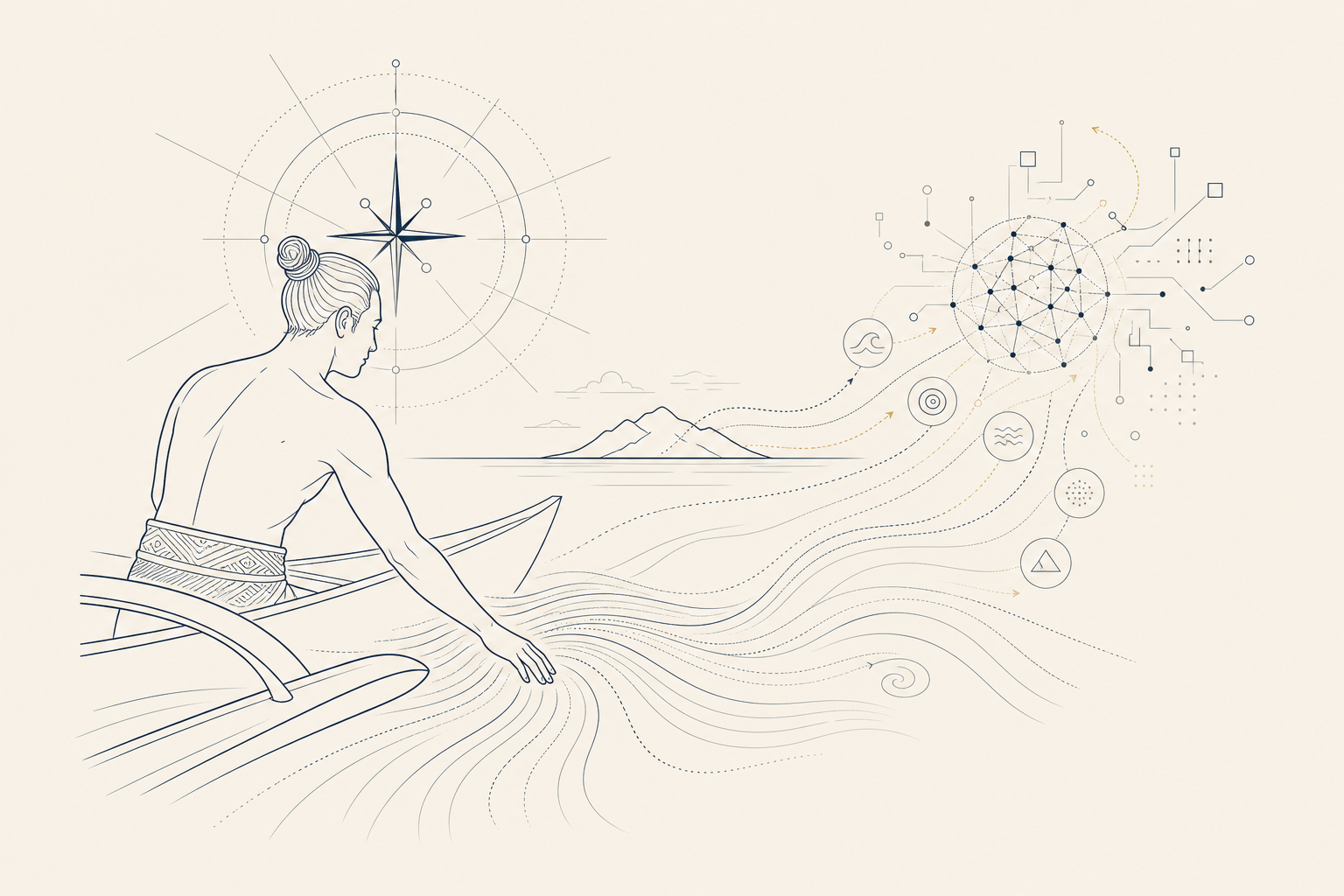
A few weeks ago I was researching what Polynesian wayfinders call the earth and substrate signals in their system — the layer beneath stars, wind, and waves. That search led me to a video on perpetuating the art of Polynesian wayfinding. Partway through, one of the featured wayfinders said something that made me pause the video and write it down:
If you do not know how to feel swells and currents, you will never find your island destination.
Not read. Not measure. Feel. On a traditional Pacific voyaging canoe, the most important instrument on board has no moving parts. It's the navigator's body itself.
The navigator lies against the hull, sometimes for hours, feeling the water. Every ocean has swells arriving from several directions at once, each with its own rhythm and character. Where they cross and interfere, they leave signatures.
A trained reader untangles that interference into a map of where land lies, hundreds of kilometres past the horizon. No screen. No dashboard. The instrument is a body that spent years learning what repeating patterns mean.
Now hold that image next to how most of us read the current AI environment. We open dashboards, feeds, and AI-generated summaries. We scroll launch announcements, benchmark charts, funding rounds, hot takes. The volume is enormous, and it arrives every few days — new models, new agents, new warnings, new wins.
The digital landscape behaves like an ocean of silicon. Technologies arrive in repeating cycles, the way swells do: each one with a direction it came from, a period, a force behind it. If you rely solely on external instruments — the curated feed, the algorithmic dashboard, the AI answer — you can be perfectly instrumented and still drift. Instruments describe the surface. They don't hold your course.
The Old Assumption, and What It Misses
The old assumption: better instruments produce better decisions. Give everyone real-time data and the right tools, and navigation takes care of itself.
What's actually happening: when everyone holds the same instruments, the instruments stop being the edge. The reader becomes the difference. Two teams see the same headlines in the same week. One treats each announcement as weather — react, reposition, re-promise. The other reads it as a swell: this came from a particular direction, it has a period, and beneath it a larger current is moving that the announcement barely mentions. Same information. Different motion.
That difference is pattern-reading intuition — and it's embodied, in the navigator's sense of the word. It lives in attention and memory, built by noticing, cycle after cycle. It can't be downloaded, which is exactly why it compounds while dashboards commoditize.
And the cost goes deeper than bad decisions. In my local Conscious Technologists meetups, I'm watching people grow so disconnected from their bodies that they can no longer feel what's happening to them as AI accelerates. That, or they've gone numb to it — which sits uncomfortably close to the documented cases now labeled AI psychosis. The carbon mind needs time to process; silicon intelligence doesn't. If the great AI transition — now being pushed toward the rebrand "SI," for "super intelligence," after the recent executive order telling US agencies to retire the word "artificial" — severs the old bridges between mind, body, and heart, we won't only lose cognitive capacity. We'll lose conscious awareness with it.
Digital Wayfinding: Reading the Ocean of Silicon
I call this practice Digital Wayfinding — a navigation discipline for technology decisions, borrowed consciously from Pacific wayfinding. It has five core skills:
- Orientation — know where you stand: your stage, your systems, your ecosystem, before deciding where to go.
- Observation — watch the water: notice signals before they become trends, including what people aren't saying directly.
- Pattern recognition — see the wave before it crests: name what's repeating across tools, teams, and cycles.
- Intuitive sensing — trust the signal that hasn't reached language yet: the gut read, the friction you can't yet explain.
- Environmenting — build in harmony with your ecosystem: design for the cultural and systemic context around the tool.
Then there's what you actually read while moving. Three signals hold your course continuously: stars (principles and protocols that hold direction across decades), wind (the momentum of public sentiment), and waves (the immediate pressure of news, launches, and market moves). Two more are confirmation signals: fire — in the Pacific canon, Te Lapa, flashes of light over land visible only near a destination — which shows up digitally as a sudden localized flare of activity in a forum, citation graph, or repository before anything surfaces publicly; and earth, the substrate beneath it all: infrastructure, protocols, codebases, and the physical reality of cables and servers.
Most AI news is wave. Treating it as star is how organizations get whipped around by weekly releases. Reading the layers separately — wave for timing, wind for momentum, star for course — is what keeps a strategy steady while the surface churns.
A Practice You Can Start This Week
Keep a swell log. Before you open any feed, dashboard, or AI assistant, take one minute and write what you think is happening in your field right now, and why. Then read. Then note where your reading and the instruments disagreed.
That gap is the training ground. Every disagreement is a swell you misread, a signal you skipped, or an instrument with a bias you just learned. Over weeks, the log does what years on a canoe hull did: it calibrates a body of judgment.
And keep one diagnostic question handy, for anything that lands on your desk: is this a wave, a wind, or a star? Most of what presents itself as urgent is wave — worth reading for frequency, never for direction.
The Landing
The ocean of silicon will keep producing swells. That's what oceans do. The navigators never calmed the Pacific; they learned to read it, and that's what carried them to landfall. The AI era asks the same thing of us: instruments in hand, body trained, eyes on the swells and currents, course held from the inside.
If you want to go deeper — the full five-skill breakdown, the five-signal map, and how to run your own swell log — the complete Digital Wayfinding framework lives at georgesiosi.com/digital-wayfinding.