Framework / Digital Wayfinding
The 4 Core Patterns of Digital Wayfinding
The grammar of digital navigation across any technology wave
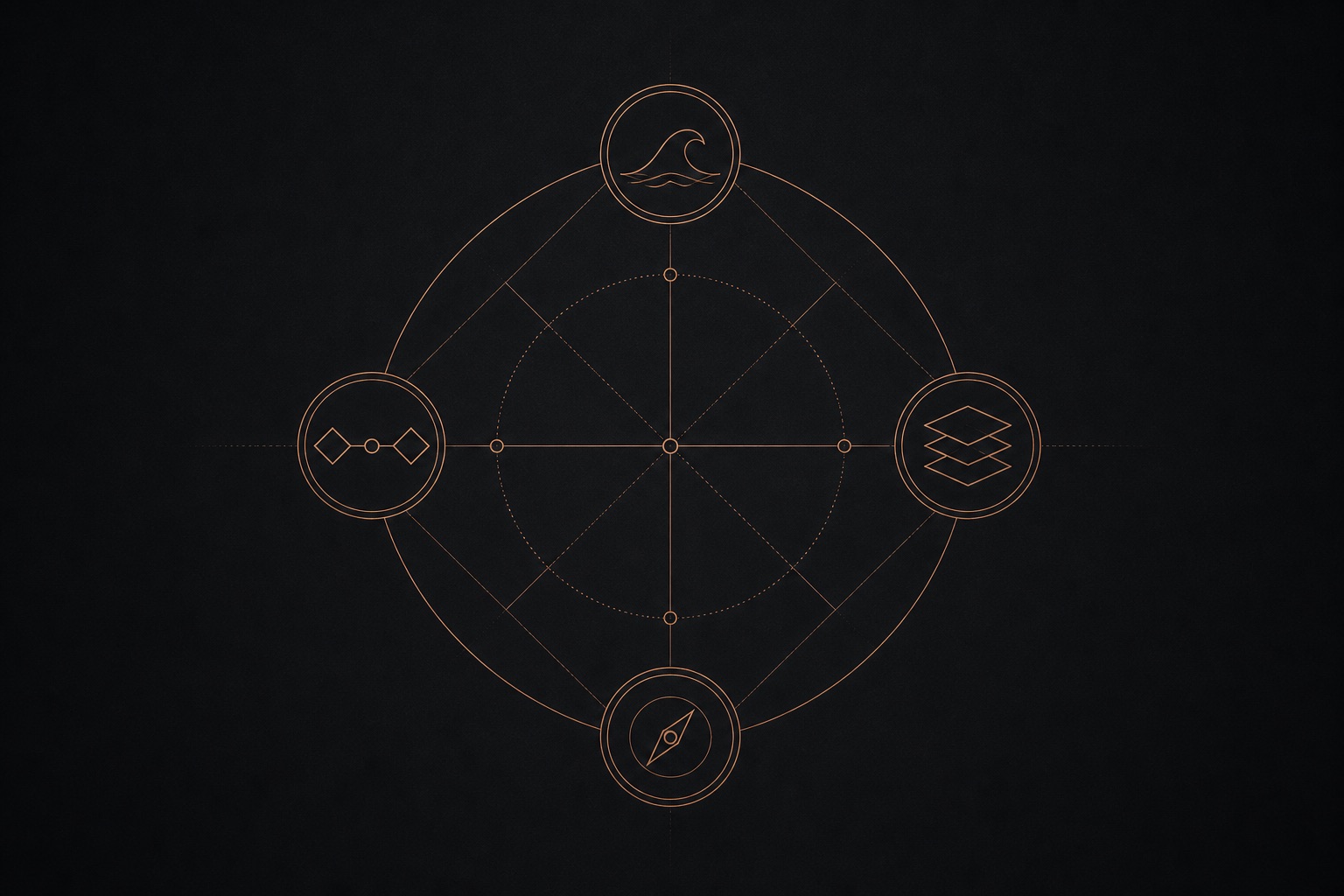
Most people navigate technology the way tourists navigate a foreign city: they memorize a few phrases, follow the crowd, and hope they don't get lost.
There's another way. Pattern recognition.
After 15 years at the frontier of every major technological transition (web development, Bitcoin and blockchain, community platforms, and now AI), I went back and studied hundreds of adoption decision points: my own, my clients', and the ones I observed across the market. I was looking for the recurring structures underneath the noise.
I found four.
These four patterns are the grammar of digital navigation: the underlying rules that govern how technology waves form, crest, and settle. They tell you how to position yourself within a wave without being swept away. They work across any tech wave, which means they'll still work when the next one arrives and the current tools are obsolete.
Pattern 1: The Adoption Arc
Every technology wave follows the same shape: Signal → Hype → Saturation → Collapse → Integration.
The Signal phase is quiet. A small number of people notice something emerging before it has a name. They're responding to a structural shift they can feel but can't yet prove.
Then comes Hype. The wave gets a label. Capital arrives. Everyone adopts. The tools multiply. This is where most people enter, and it's already too late for advantage, too early for stability.
Saturation follows: adoption is universal, but productivity gains plateau. The overhead of managing the new tools begins to cancel their benefit. This is where we are with AI right now. Faros AI's 2025 study of 10,000 developers found that AI tools increase individual output but not company productivity. The gain is real; the overhead eats it.
Then Collapse: the hype can't sustain itself. Projects fail. Budgets freeze. People declare the technology dead.
And finally, Integration: the technology stops being novel and becomes infrastructure. The people who built coherent systems during Hype dominate during Integration.
How I found it: I encountered Bitcoin in 2013 as a tool for cultural preservation. That was Signal. By 2017, I was advising the Government of Tuvalu on a national blockchain strategy, still Signal, entering the edge of Hype. By 2018, when I launched my company as a "blockchain marketing" firm, we were in Hype. My first client didn't want blockchain marketing at all. They wanted internal team structure and community workflows. The label was ahead of the need. The market was already integrating while everyone else was still hyping.
Why it matters for AI: AI is in Saturation. The real question is what structural shift is happening underneath the tool layer. The tools will churn. The structural shift (cognitive outsourcing, workflow redesign, the human-AI division of labor) is permanent. Position for Integration.
Pattern 2: The Bridge Move
The highest-value position in any technology wave is translating it.
Every wave creates a gap between what the technology can do and what human systems are ready to absorb. That gap is where the real value lives: in the bridge between tool capability and human context.
I learned this from my name. Siosi. Phonetically: Si-O-Si. The siloxane bond, the chemical bridge between organic and inorganic worlds. Two silicon tetrahedra linked by a single oxygen atom. The structure that makes quartz crystals possible, that stores information across geological time without degradation.
My career has been that oxygen atom. Bridging it.
How I found it:
- Tuvalu (2017): The value was translating blockchain capability into a national digital identity strategy for a nation facing climate displacement.
- Slack (2016): The value was seeing Slack's community and organizational potential before enterprise caught on, and bridging that capability to cultural and team systems.
- AI (2024–present): The value is restructuring cognitive workflows so AI amplifies human judgment instead of replacing it.
The pattern is consistent across every wave: the people who build the technology compete on capability. The people who bridge the technology compete on coherence, and coherence is what organizations pay for.
Why it matters for AI: Every organization has the same problem right now: "We bought AI tools but our team doesn't use them well." The gap between AI capability and organizational readiness is enormous. The person who closes that gap by redesigning workflows is the person every org needs. That's the Bridge Move applied to AI.
Pattern 3: Stack Coherence
In every technology wave, the problem is always structure.
When a new wave hits, people add tools reactively. The stack grows. Coherence degrades. Cognitive load rises. Eventually, the stack collapses under its own weight because the tools were never arranged into a structure that could hold.
The fix is always structural. You need a structure that makes the tools you already have work together.
This is the principle behind the 1:3:5 protocol (from Conscious Stack™): 1 core tool, 3 supporting tools, 5 connected systems, arranged by resonance. Every new tool must fit the structure. If it doesn't, it doesn't enter.
How I found it: After years of conducting stack audits for founders, consultancies, and teams, I noticed the same pattern in every engagement: the problem was always the lack of structure. People had 15 tools and zero coherence. The fix was always "redesign the stack so the tools you have work together."
The Faros AI data confirms this at scale: AI tools increase individual output but not company productivity. The overhead of managing too many unstructured tools cancels the gain. The structure is the problem.
Why it matters for AI: AI is creating the worst tool sprawl in history. Every week brings a new model, a new app, a new plugin. People are layering AI tools onto already-fragmented stacks and wondering why productivity hasn't improved. The answer is a coherent stack structure that lets AI amplify instead of fragment. That's Stack Coherence applied to AI.
Pattern 4: The Sovereignty Test
Every technology wave offers capability at the cost of agency. The core question is always: does this increase my inner capacity, or just add outer fireworks?
Technology gives you power. But power without sovereignty is speed in the wrong direction. Every tool, every platform, every AI model asks you to trade something (your attention, your agency, your data, your cognitive independence) for capability.
Most people make that trade unconsciously. They outsource their thinking to the tool without realizing it, and they become dependent on the very thing that was supposed to set them free.
The Sovereignty Test is the filter that catches this before it becomes dependency. It asks one question: "Does this tool make me more or less sovereign?"
Pro-agency. The conscious technologist uses AI while retaining judgment, taste, and creative direction. They're augmented.
How I found it: I watched it happen across every wave. People who adopted Bitcoin became traders instead of builders. People who adopted Slack became notification addicts instead of community architects. And now, people who adopt AI are becoming prompt engineers instead of systems thinkers. The tool shapes the user. Without a sovereignty filter, the tool always wins.
Why it matters for AI: AI is the ultimate sovereignty test. The market is bifurcating right now into two groups:
- AI-dependent (replaceable): people who outsource their thinking to AI
- AI-augmented (irreplaceable): people who use AI to amplify their thinking while retaining judgment and direction
The Sovereignty Test is what determines which side you land on. And in a world where AI is automating everything it can, the irreplaceable people are the ones who command premium value.
How the Patterns Work Together
The four patterns form a sequential navigation protocol. You run them in order:
- Locate yourself in the Adoption Arc (where is this wave, and where am I within it?)
- Bridge the technology to your specific human and organizational context (translate, don't adopt)
- Audit your stack for coherence (structure first, tools second)
- Test each tool for sovereignty (amplify vs. replace)
This is a repeatable, teachable, wave-agnostic system. It worked for blockchain. It works for AI. It will work for whatever comes next (spatial computing, biotech, quantum), because the patterns describe the relationship between technology and human systems.
Why This Matters Now
We're in the middle of the largest technology transition since the internet. AI is reshaping every industry, every workflow, every role. And most people are navigating it the way they navigated every previous wave: by chasing tools, memorizing tactics, and hoping the noise resolves into signal.
It won't. If you want to navigate AI or any technology wave without being swept away, you need more than tools. You need patterns. You need to see the grammar underneath the noise.
Digital Wayfinding is that system.
This framework is part of the Digital Wayfinding system, developed by George Siosi Samuels through 15 years of work at the frontier of emerging technology. The full methodology (including the 1:3:5 Conscious Stack™ protocol, the sovereignty test questions, and the decision-point analysis process) is taught inside the Oscillator Program and applied in consulting engagements.