Framework / BARS
The BARS Framework
A new marketing pipeline framework for conscious technologists
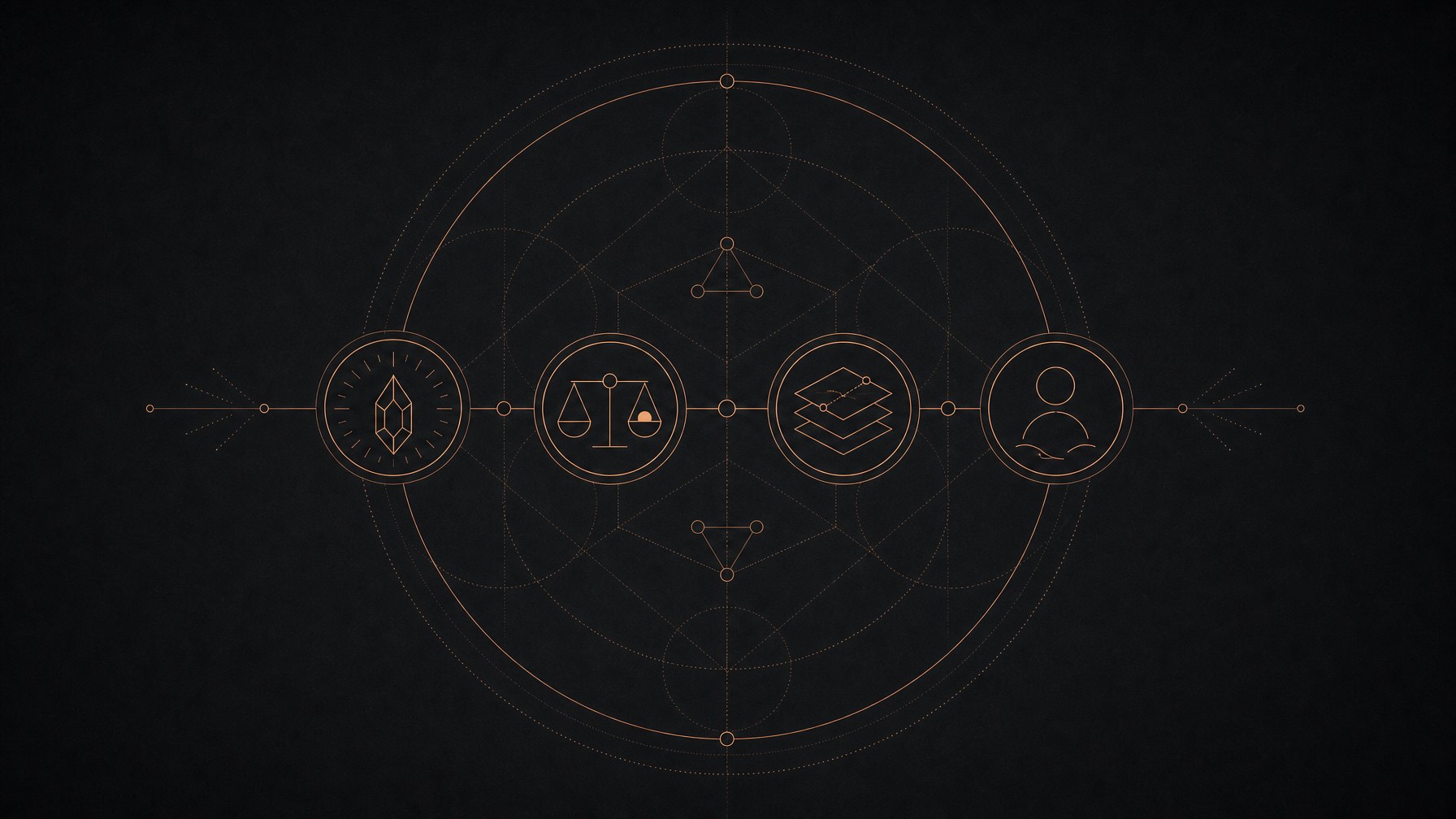
Most acquisition systems count the wrong thing.
They count followers, registrations, "leads," and booked calls. Then they wonder why the calendar fills with people who are curious about AI and empty of people who will open their actual tools and name what the stack is doing to their judgment.
The problem is geometry. Many funnels were built for volume sales. A diagnostic sitting is a different shape.
I call the shape that fits this work BARS.
BARS = Benchmark → Acknowledge → Report → Sitting.
It is how weight becomes a sitting: an owned instrument, a named load, a legible map, then live work on the metal.
Honor the discipline: Priestley's LAPS
Daniel Priestley taught a clean closed loop for revenue rhythm: LAPS, Leads → Appointments → Presentations → Sales. Pair that with a perfect repeatable week, and high-growth work stops being a scramble. You forecast backward from a target. You protect delivery. You run the same campaign shape until the numbers are boring.
That discipline is real. Carbon-based operators need rhythm, capacity limits, and a scoreboard that does not lie. BARS does not throw Priestley's gift away. It keeps the closed-loop habit and renames the stages for a different product: stack diagnosis and an Initiatory Sitting, not workshop volume or agency dial math.
Credit where it belongs. If LAPS trained you to stop guessing, keep that muscle.
Why BARS is a different approach
LAPS labels fail when the work is pattern recognition under tech waves.
| LAPS (Priestley) | What goes wrong for this work | BARS stage |
|---|---|---|
| Leads | Registrations and lurkers look like pipeline | Benchmark: the instrument is entered |
| Appointments | Calendar fills before weight is named | Acknowledge: load is explicit |
| Presentations | Pitch decks and workshop theater | Report: diagnosis made legible |
| Sales | Multiple SKUs blur the floor | Sitting: one Initiatory Sitting on the metal |
You keep the closed-loop habit. You stop scoring vanity as progress.
Soft signal still matters: posts, guest rooms, community presence. In BARS that layer is pre-B. It is weather. It is not the scoreboard until someone enters a hard diagnostic object.
Carbon rhythm, silica geometry
Here is the deeper reason the rename is not cosmetic.
LAPS-style volume language grew up in industrial and late-industrial sales culture: fuel the top, burn through the middle, extract at the bottom. That is a carbon-dominant picture of work. Carbon beings need fuel, heat, and continuous throughput. Coal is the extreme caricature of that era: burn density for motion. The shadow is treating people as feedstock and calendars as furnaces.
We still honor what carbon needs. Bodies need sleep. Attention needs a repeatable week. Delivery has a real energy budget. Priestley's rhythm respects that.
BARS trains a different future vocabulary. Conscious Technologists work at the interface of carbon stacks (body, cognition, culture, judgment, tempo) and silicon stacks (tools, models, chips, agents). Under silicon sits silica: silicon dioxide, quartz, the crystalline lattice that stores structure across time. Geometry, not brute burn. Bridges, not only fuel lines. Si–O–Si is a bond that holds shape; it is not a slogan for "more leads."
So BARS is pipeline language aligned with:
- Instrument first (B): enter a structure, the way a lattice takes a reading
- Named load (A): weight made conscious, not shoved into a furnace called "appointment"
- Report as map (R): legible geometry of what is running
- Sitting (S): live contact on the metal, repair in relation, not extraction at scale
We are not only reinforcing old acquisition behaviors with nicer nouns. We are training new ones: operators who can hold carbon rhythm and silica-shaped diagnosis as tech waves accelerate. LAPS remains useful training wheels for closed-loop honesty. BARS is the geometry for people building sovereignty through those waves.
The four stages
B, Benchmark
Hard lead. Someone runs an owned diagnostic, not a vibe PDF and not a "book a call" click.
Benchmark here means the stage: the person has entered a structured instrument that reads stack pattern. In practice, the public door for stack angles is the Weight Map: a complete working object that names friction in language they can feel. (Deeper campus instruments may evolve; the stage name stays Benchmark as the hard-entry bar.)
You count completions and serious starts. You do not count every like or every event registration as B.
When the tension is identity and practitioner self-location more than tool sprawl, the CT Type quiz can sit as a parallel instrument. It is still B only when it produces a real self-read, not a trophy badge. Default stack door remains the Weight Map.
A, Acknowledge
Named weight. Friction leaves the abstract and becomes specific: sprawl, admin eating the week, judgment outsourced, tempo set by the tools.
This can show up in a DM, an email, a comment, or the language of their own results. Friendly replies without load do not count.
You cannot calendar away an unacknowledged stack. Booking without A is how you inherit the wrong appointments.
R, Report
Felt diagnosis made legible. A clear Weight Map mirror, a written map of what is running, or a live room close that hands one frame and one next door.
R is the presentation layer for this work. The artifact does the presenting. You are not running a perpetual pitch clinic.
Optional live rooms (a monthly lightning talk, a guest community night) can amplify R and feed pre-B. They are sparse by design. Delivery capacity is the kill switch.
S, Sitting
Paid Initiatory Sitting. Live repair on their actual stack: the Conscious Stack Audit as the cash floor for this loop.
S is booked and paid. Extended rebuilds, retainers, and school rooms come after S. They are post-S ladder, not a fifth letter on the weekly scoreboard, or you will invent products under pressure.
Bridge to Bhāra
In The Bhāra Framework, bhāra (Sanskrit: weight, burden, responsibility) names what success stories hide: the weights file behind the prompt.
The essay's diagnostic is simple:
- What is the prompt? (visible tactic, tool list, morning routine)
- What are the weights? (accumulated load, failure, context, relationships)
You cannot prompt away a weights problem.
BARS is the pipeline geometry for that truth in practice:
| Bhāra | BARS |
|---|---|
| Prompt without weights | Pre-B noise: content and copied stacks with no instrument |
| Weights invisible | No A |
| Weights made thinkable | R |
| Weights carried in contact | S |
Bhāra is why imitation fails. BARS is how you refuse to sell a sitting to someone who has only copied a prompt.
The repair grammar on the metal remains Conscious Stack Design™ and 1:3:5 (geometry over volume). BARS does not replace that. It decides who reaches the sitting with enough honesty for the protocol to land.
How the stages work together
Run them in order. Do not skip A to protect your calendar ego.
- Attract pre-B with pattern recognition (what the stack is doing to judgment, tempo, attention), not "how to use the model" volume.
- Open B with one hard door: Weight Map on stack load. CT Type when identity is the named door.
- Listen for A. Mirror their language. Booking links only when weight is named, and usually in warm thread, not as feed default.
- Deliver R so the map is felt, not only categorized.
- Offer S as the Initiatory Sitting when the next honest step is live repair.
- Protect capacity. Work backward from how many sittings you can still deliver well. Adjust the week's hook, not the whole offer, when the scoreboard stalls.
A perfect repeatable week, in this geometry, is a small campaign you run dozens of times a year: signal → instrument → named weight → map → sitting → one proof artifact back into signal. Rest is part of the product. The consciousness you sell is the consciousness you schedule.
That is Priestley's gift of rhythm, held inside silica-shaped stages.
What BARS refuses
- Counting registrations, community lurks, or soft engagement as hard pipeline
- Public calendar links as the default CTA
- Membership or course checkout as the first paid room before the diagnostic floor is real
- Weekly open "clinics" that recreate host-edit burnout without S
- Heroic weekly sitting targets that ignore delivery energy
- Treating people as fuel for a top-of-funnel furnace
Clarity beats volume. The right people are already carrying too many tools and can feel the stack running them. Speak only to that sentence, and B stays clean.
This framework is part of Digital Wayfinding and Conscious Stack™ practice, developed by George Siosi Samuels. LAPS (Leads → Appointments → Presentations → Sales) is Daniel Priestley's closed-loop sales geometry; BARS keeps that discipline and renames stages for carbon rhythm plus silica-aligned diagnosis. 1:3:5 and CSD remain the repair grammar on the metal. Applied in Stack Audits and taught inside the living school for Conscious Technologists.