AI Second Brain: How to Build One That Actually Sticks
The architecture problem most second brain builders ignore
Most AI second brains fail within a week — not because the tools are bad, but because there is no architecture underneath them. Here is what actually makes one hold up over time.
There's a version of the AI second brain that looks impressive in a demo. Clean interface, smart retrieval, a chat window that seems to know everything you've ever written. You set it up on a Sunday afternoon, feed it your notes, and feel genuinely organized for the first time in years.
By Thursday, you've stopped using it.
This is the most common outcome. Not because the tools are bad — they're genuinely remarkable — but because most people build a second brain the same way they organize a junk drawer. They add things. They don't architect anything.
Here's what actually makes one stick.
The Real Problem Isn't Memory — It's Structure
The phrase "second brain" was popularized by Tiago Forte's Building a Second Brain methodology, which predates AI by several years. The core insight was sound: your biological brain is for generating ideas, not storing them. Offload storage. Free up processing.
AI made that idea feel suddenly achievable at scale. You can now talk to your notes, surface connections across thousands of documents, and synthesize information that would have taken hours to find manually.
But here's what most people skip past: a second brain is only as smart as the structure you give it.
If your notes are a pile of half-finished thoughts, your AI second brain will retrieve half-finished thoughts — faster, and with more confidence. Garbage in, garbage out, now with a conversational interface.
The question isn't "which tool should I use?" It's: what is this system actually for?
What Context Is Actually Worth
Before you add a single document, answer one question: what decisions does this system need to help me make?
Most people skip this. They treat their second brain like a personal Wikipedia — store everything, retrieve anything, figure out the use case later. That model collapses under its own weight.
A second brain that sticks is built around a small number of high-value retrieval contexts. For a consultant, that might be client history, frameworks tested, and patterns noticed across engagements. For a writer, it might be ideas in progress, research gathered, and the through-lines connecting them.
What you capture shapes what the system can do. Capture broadly, and you get a search engine. Capture with intention, and you get a thinking partner.
This is a structural problem before it's a tool problem.
The Three Layers That Actually Matter
A second brain that holds up over time has three distinct layers. Most people build only one.
Layer 1: Capture
This is the layer everyone builds first. Notes, bookmarks, voice memos, article clippings. The input layer.
The mistake is treating capture as the end state. It's not. Capture without processing is just a better-organized inbox. You need a consistent trigger to move things forward — a daily or weekly review that asks: what here is worth keeping, and in what form?
The form matters. A raw voice memo and a structured insight note are not the same thing. One requires your future self to do all the work. The other does some of that work now, while the context is still fresh.
Layer 2: Crystallize
This is the layer most people skip entirely.
Crystallizing means taking a captured idea and giving it a shape that's actually useful for retrieval. Not just saving a link — writing one sentence about why it matters. Not just pasting a quote — noting what question it answers.
The inner technology and digital mastery framework points at something important here: the tools are the outer layer. The thinking practice is the inner one. Without the inner layer, the outer layer doesn't work.
Crystallizing is where your second brain starts to develop your voice, your judgment, your patterns — rather than just reflecting the internet back at you.
Layer 3: Distribute
The third layer is where a second brain earns its keep.
Distribution doesn't mean publishing everything. It means routing crystallized knowledge to where it's actually needed — a client proposal, a newsletter draft, a decision you're working through. The second brain becomes a retrieval system for your own thinking, not just a storage system for other people's ideas.
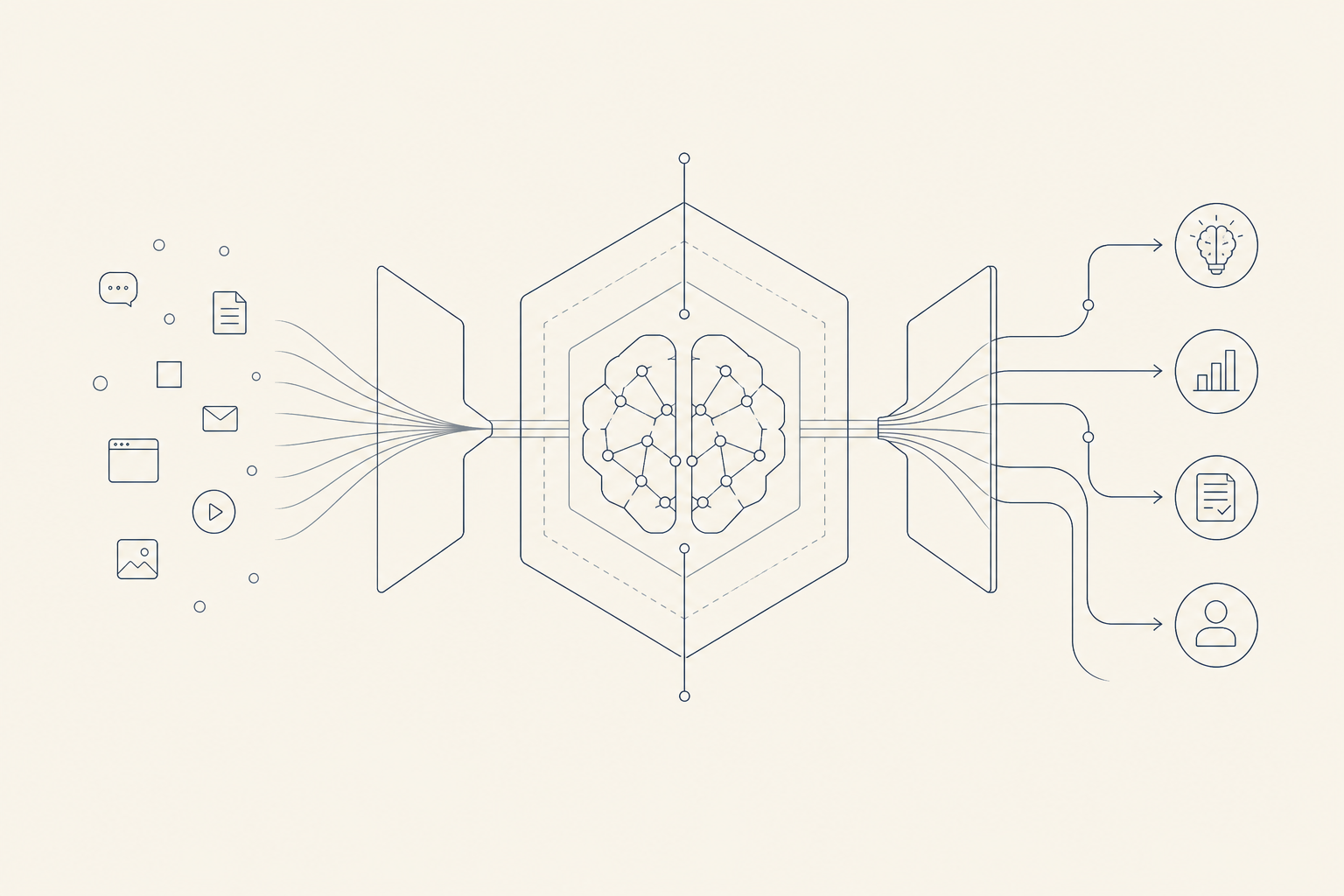
This is the Capture / Crystallize / Distribute framework in practice. Each stage has a different job. When all three are working, the system compounds. When any one is missing, the whole thing stalls.
Why Most AI Second Brains Fail
The failure mode is almost always the same: people build the capture layer, add AI on top, and expect the system to generate insight from raw material it was never given.
AI is good at synthesis, pattern recognition, and retrieval. It is not good at deciding what matters. That judgment belongs to you.
The second failure mode is tool-switching. Every few months, a new app promises to be the perfect second brain. Obsidian, Notion, Mem, Reflect, Roam — each one gets a migration, a fresh start, a week of enthusiasm. Then the same structural problem reasserts itself in a new interface.
The tool is not the bottleneck. The practice is.
If you want to understand what makes AI genuinely useful over a longer arc — not just for a week — the piece on why AI takes 6 to 9 months to show real results gets at something most productivity advice ignores: the compounding happens slowly, then all at once.
Building for Your Specific Context
A second brain built for a researcher looks different from one built for a founder, which looks different from one built for a writer. The architecture should reflect the work.
Before you open any tool, answer these:
What are the three to five decisions I make repeatedly? Your second brain should be optimized to support those decisions, not all possible decisions.
What knowledge do I currently lose? Conversations, observations, half-formed ideas that never get written down. Where are the leaks?
What's my minimum viable review cadence? A system you review weekly beats a perfect system you review never.
What does "done" look like for a captured item? If you can't answer this, your capture layer will become a graveyard.
These questions are diagnostic. They force you to design the system around your actual work — not around someone else's workflow that looked good in a YouTube tutorial.
The Navigator's Principle
Polynesian wayfinders didn't navigate by looking at a map. They read the ocean — wave patterns, star positions, bird behavior, wind direction. The knowledge wasn't stored in a document. It was embodied, practiced, and updated in real time.
An AI second brain that sticks works the same way. It's not a static archive. It's a living system that reflects how you actually think, updated through regular practice, shaped by the decisions you're genuinely trying to make.
The wayfinder's advantage wasn't having more information than anyone else. It was having better structure for the information that mattered.
That's the model. Not a bigger database. A better architecture.
The wayfinding through AI framework explores this further — how the navigator's mindset applies to working with AI systems over time, not just setting them up once and hoping they hold.
If you're building something more specific — a second brain designed around a consulting practice, a content operation, or a thinking system that feeds client work — the ACI case study shows what that looks like in practice.